


 Publication and Archiving Requirements for Public Entity Legal Notices Published after March 1, 2026:
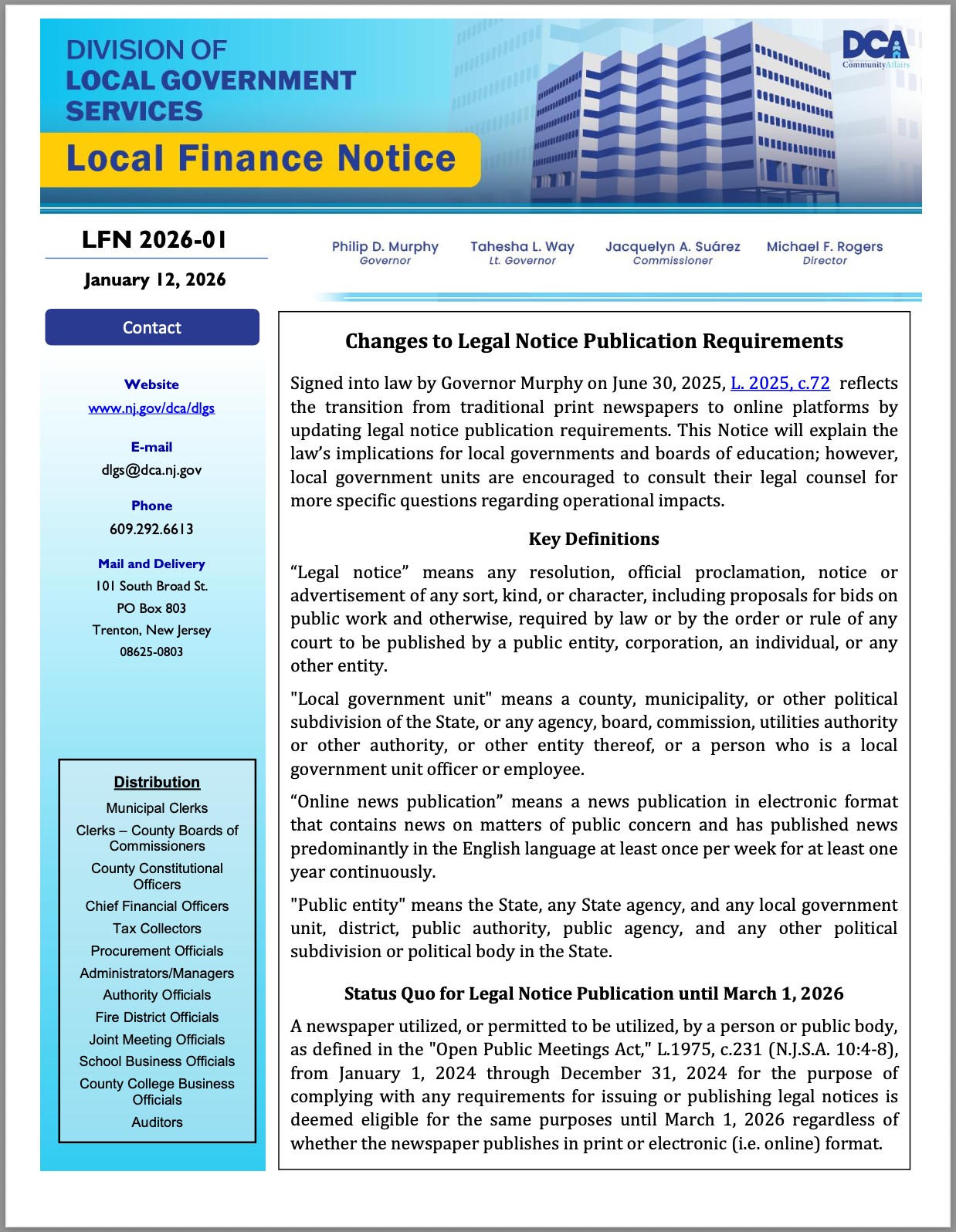
Town of Hammonton Legal Notices will no longer be published in the newspaper. Signed into law by Governor Murphy on June 30, 2025, L. 2025, c.72 reflects the transition from traditional print newspapers to online platforms by updating legal notice publication requirements. The New Jersey Department of Community Affairs notice, which explains the law’s implications for local governments, can be downloaded by clicking the link below.
All legal notices will be available on this page, which will also function as an online archive.
URL: www.townofhammonton.org/legalnotices

Town of Hammonton • Legal Notice • Advertisement for Bids • Posted 10-6-26
Jake’s Law – Inclusive Playground at Hammonton Lake Park
Download: www.townofhammonton.org/Jakes-Law-NTB.pdf
NOTICE TO BIDDERS
1. BIDS: Sealed Bids for the Jake’s Law – Inclusive Playground at Hammonton Lake Park, in the Town of Hammonton, will be received at 10:00 A.M. on 10/22/2026 at which time Bids will be publicly opened and read aloud at the 3rd Floor Conference Room, located at 100 Central Avenue, Hammonton, NJ 08037. Bids will not be accepted after the specified time.
The project will consist of the replacement of park playground equipment with ADA compliant equipment and related site ADA improvements in and around Hammonton Lake Park within the Town of Hammonton.
Accordingly, the Town of Hammonton will award the project to the qualified Bidder who submits the lowest responsible bid price for the total project construction.
Bids must be on the official Bid Form which can be obtained from the Engineer, at the offices of ARH Inc., 215 Bellevue Avenue, Hammonton, NJ 08037 and accompanied by a Consent of Surety, a Non-Collusion Affidavit, other documents required pursuant to the specifications, and a certified check, cashier’s check or bid bond in the amount of 10% of the amount bid but not in excess of $20,000.00, and be delivered at the place on or before the hour named above. Each Bid must state the name and address of person, firm and corporation interested in the same as a principal. Bids must be submitted in an opaque sealed envelope, addressed to the Town Clerk, Town of Hammonton, 100 Central Avenue, Hammonton, NJ 08037 and identified as “Bid – Jake’s Law – Inclusive Playground at Hammonton Lake Park”
Specifications provide for receipt of Bids by mail. Those Bids which are mailed to the contracting unit shall be sealed, properly marked, and shall only be opened for examination at such time and place as all Bids received are unsealed and announced.
The Mayor, Town Council, and its Solicitor (hereinafter referred to as Owner) will be the sole discretionary body for consideration or rejection of the Bids.
2. BID DOCUMENTS: The Specifications, Drawings and Bid Form for the project can be obtained at a cost of $50.00 from the office of the Engineer, ARH Associates, Inc., 215 Bellevue Avenue, Hammonton, NJ 08037, phone (609) 561-0482, and may be inspected by prospective Bidders during business hours. The Engineer will furnish the Bidder with a copy of the specifications upon receipt of payment (for the cost of the specification preparation).
3. WITHDRAWAL OF BIDS: Any Bid may be withdrawn prior to the above scheduled time for the opening of Bids or any authorized postponement thereof. Bids received after time and date designated shall not be considered. No Bidder may withdrawal a Bid for a period of sixty (60) calendar days after the actual date of the opening thereof.
4. AFFIRMATIVE ACTION REGULATIONS: Bidders are required to comply with the requirements of P.L. 1975, c.127 (NJAC 17:27).
5. CONTRACT COMPLETION: Construction shall commence at the project site within fourteen (14) calendar days after the date to be specified in the written ‘Notice to Proceed’ by the Engineer and shall be completed within 60 calendar days from the date the written ‘Notice to Proceed’ is given, unless otherwise agreed to.
6. PREVAILING WAGE REQUIREMENTS: The provisions of the Department of Labor’s current wage rate determinations and the New Jersey Prevailing Wage Act are requirements of this project. The contractor shall pay not less than the prevailing wage rate to workers employed in the performance of any contract for the project, in accordance with the rate determined by the Commissioner of New Jersey Department of Labor pursuant to N.J.S.A. 34:11-56.25 et seq. OR the United States Secretary of Labor pursuant to 29 CFR Part 5, whichever is greater.
7. PUBLIC WORKS CONTRACTOR REGISTRATION ACT: The provisions of the New Jersey Public Works Contractor Registration Act are requirements of this project.
8. BUSINESS REGISTRATION CERTIFICATE: The provisions of the New Jersey Business Registration Requirements shall be adhered to on this project.
9. PROJECT FUNDING: Please be advised that State funds through the Green Acres Program are being utilized in this project. Under N.J.A.C. 7:1D-2, vendors currently suspended, debarred, or disqualified are excluded from participation on this project. Please note there is also local funding through the Town of Hammonton for some of the activities on this project.
Frank Zuber, Town Clerk
Town of Hammonton
Town of Hammonton • Public Notice • Posted 10-6-26
Bond Ordinance #014-2026 Statement And Summary
Download: Legal-Ad-CM-9-28.pdf
The bond ordinance, the summary terms of which are included herein, has been finally adopted by the Town of Hammonton, in the County of Atlantic, State of New Jersey on September 28, 2026, and the twenty (20) day period of limitation within which a suit, action or proceeding questioning the validity of such ordinance can be commenced, as provided in the Local Bond Law, has begun to run from the date of the first publication of this statement. Copies of the full ordinance are available at no cost and during regular business hours at the Clerk’s office for members of the general public who request the same. The summary of the terms of such bond ordinance follows:
Title: BOND ORDINANCE PROVIDING FOR VARIOUS RECREATION IMPROVEMENTS AT HAMMONTON LAKE PARK, BY AND IN THE TOWN OF HAMMONTON, IN THE COUNTY OF ATLANTIC, STATE OF NEW JERSEY; APPROPRIATING $1,200,000 THEREFOR (INCLUDING $67,000 REAPPROPRIATED FROM BOND ORDINANCE #6-2025, $285,036.51 REAPPROPRIATED FROM BOND ORDINANCE #13-2025, $57,963.49 RECEIVED FROM PINELANDS PRESERVATION ALLIANCE, A $40,000 FITNESS GRANT EXPECTED TO BE RECEIVED FROM THE NATIONAL FITNESS CAMPAIGN GRANT COMMITTEE AND A $600,000 GRANT EXPECTED TO BE RECEIVED FROM THE DEPARTMENT OF ENVIRONMENTAL PROTECTION GREEN ACRES PROGRAM) AND AUTHORIZING THE ISSUANCE OF $150,000 BONDS OR NOTES TO FINANCE PART OF THE COST THE
Purpose(s): The Bond Ordinance provides for various recreation improvements at Hammonton Lake
Appropriation: $1,200,000
Grants: $600,000 Department of Environmental Protection Green Acres Program Grant; and a $450,000 Local Matching Grant
Bonds/Notes Authorized: $150,000
Section 20 Costs: $240,000
Useful Life: 15 years
Frank Zuber, Town Clerk
Town of Hammonton
Town of Hammonton • Legal Notices • Posted 9-11-26
Joseph Pino
934 13th St Hammonton NJ 08037 Block 303 Lot 4.13
Appl #01-26PB ARH #1112192.01
Applicant was approved for a lot line adjustment for existing lots 4 and 13. Lot 13 contains an existing single family home and cultivated blueberry rows at the rear yard while Lot 4 is currently vacant wooded land, upon approval applicant proposes single family dwelling on lot 4 along with 5 acre cultivated blueberry farm.
Ronald and Elizabeth Penza
460B&466 S. Chew Rd Hammonton NJ 08037 Block 1301 Lot 19&20
Appl #14-26PB ARH #1112197.01
Applicant was approved for a minor subdivision to adjust the lot line between existing lots 19 and 20. No other improvements proposed.
Freeboba
311 Chestnut St. Hammonton NJ 08037 Block 3003 Lot 12.01
Appl #05-25ZB ARH #1113094.01
Applicant seeks approval for a change of use to lot 12.01 which is currently a vacant garage but was formerly used as a construction business office. The requested use is a training facility for young athletes.
James and Annalyse Jackson
801 7th St Hammonton NJ 08037 Block 1601 Lot 52
Appl #4-30-PB ARH #1112198.01
Applicant was approved for a curb/sidewalk waiver located in the AP zone.
Frank and Shari Crocco
537 Old Forks Rd Hammonton NJ 08037 Block1802 Lot 13
Appl #08-26PB ARH #1112199.01
Applicant was approved for a curb and sidewalk waiver.
Tractor Supply
70 Trenton Rd Hammonton NJ 08037 Block 4602 Lot 9
Appl #13-25PB ARH #1112189.01
Applicant was approved to install a freestanding an addition to the primary building to be used as pet/animal feed storage. Other improvements include new automatic and rolling cantilevered gates, customer way finding signage, pavement striping, parking lighting and signage with conditions of cleaning behind the building and removing the sale items in parking spaces and sidewalk.
Town of Hammonton • Legal Notice • Posted 8-31-26
Notice of Pending Bond Ordinance #014-2026 and Summary
Download: Notice of Pending Bond Ordinance #014-2026 and Summary
The bond ordinance, the summary terms of which are included herein, was introduced and passed upon first reading at a meeting of the governing body of the Town of Hammonton, in the County of Atlantic, State of New Jersey, on August 24, 2026. It will be further considered for final passage, after public hearing thereon, at the Municipal Building in the Town on September 28, 2026 at 7:00 p.m. During the week prior to and up to and including the date of such meeting, copies of the full ordinance will be available at no cost and during regular business hours at the Clerk’s office for the members of the general public who shall request the same. The summary of the terms of such bond ordinance follows:
Title: BOND ORDINANCE PROVIDING FOR VARIOUS RECREATION IMPROVEMENTS AT HAMMONTON LAKE PARK, BY AND IN THE TOWN OF HAMMONTON, IN THE COUNTY OF ATLANTIC, STATE OF NEW JERSEY; APPROPRIATING $1,200,000 THEREFOR (INCLUDING $67,000 REAPPROPRIATED FROM BOND ORDINANCE #6-2025, $285,036.51 REAPPROPRIATED FROM BOND ORDINANCE #13-2025, $57,963.49 RECEIVED FROM PINELANDS PRESERVATION ALLIANCE, A $40,000 FITNESS GRANT EXPECTED TO BE RECEIVED FROM THE NATIONAL FITNESS CAMPAIGN GRANT COMMITTEE AND A $600,000 GRANT EXPECTED TO BE RECEIVED FROM THE DEPARTMENT OF ENVIRONMENTAL PROTECTION GREEN ACRES PROGRAM) AND AUTHORIZING THE ISSUANCE OF $150,000 BONDS OR NOTES TO FINANCE PART OF THE COST THEREOF
Purpose(s): The Bond Ordinance provides for various recreation improvements at Hammonton Lake Park.
Appropriation: $1,200,000
Grants: $600,000 Department of Environmental Protection Green Acres Program Grant; and a $450,000 Local Matching Grant
Bonds/Notes Authorized: $150,000
Section 20 Costs: $240,000
Useful Life: 15 years
Frank Zuber
Town of Hammonton Municipal Clerk
Town of Hammonton • Public Notice • Posted 7-9-26
Request for Proposal • Operator for the Town of Hammonton’s Municipal Airport
Download: Airport Request for Operator 7-9-26.pdf
Summary
The Town of Hammonton is seeking proposals for the provision of comprehensive aviation services at the Hammonton Municipal Airport. The selected organization/individual will have the opportunity to lease a hangar (100 X 90) and will possess a combination of the following qualifications. Applicants are not required to meet every qualification to be considered.
Detailed Specifications
General Requirements:
- The Operator must comply with all applicable local, state, and federal laws governing aviation operations.
- All staff must hold relevant certifications and licensure, including but not limited to FAA Airframe and Powerplant (A&P) licenses for maintenance personnel.
Service Specifications
The Operator shall provide, at a minimum, the following services:
A. Aircraft Maintenance and Repair Services:
- Provide routine and emergency maintenance as per FAA regulations, including inspections, repairs, and modifications.
- Maintain repair logs and provide documentation as required for compliance with 14 CFR Part 43.
- Employ qualified maintenance staff that holds current licenses.
B. Customer Support Services:
- Provide customer service to meet the needs of all airport users.
- Offer flight planning services, including weather information and routing assistance.
C. Flight Training and Aviation Development
- The Operator shall demonstrate a plan to recruit and establish a certified flight school at the Hammonton Airport.F. Service Requirements
The successful Operator shall adhere to the following service requirements:
- Maintain a responsive and professional atmosphere for all airport users and stakeholders.
- Ensure that personnel are appropriately trained and regularly certified in their respective fields of operation.
- Implement and maintain safety programs that meet or exceed OSHA regulations and FAA safety guidelines.
- Regularly review and update operational procedures to ensure compliance with changing regulations and standards.
- Provide annual reports to the Town of Hammonton regarding operational performance, aircraft identification numbers, safety metrics, and customer satisfaction. Engage in ongoing marketing efforts to promote the services of Hammonton Municipal Airport and attract additional traffic.
Delivery Requirements
The Operator must follow strict delivery requirements to ensure services are available promptly and efficiently:
- All maintenance services shall be readily available during regular operational hours with emergency services available after hours as needed.
- Orders for aircraft parts and supplies must be fulfilled within specified timeframes, with priority given to emergency repairs.
- Timely submission of reports, including safety audits, operations reports, and customer feedback, to the Town of Hammonton as required.
- The operator has the ability to sell AV gas and the Town will control the Jet A fuel sales.
The qualifications submitted should include:
- Proposal for the monthly lease payment
- A detailed description of the services offered
- Evidence of regulatory compliance, including any necessary licenses and certifications
- A summary of past experience in operations, including references and case studies if applicable
- Personnel qualifications, including resumes or profiles of key staff members designated for airport operationsConclusion
The selected organization or individual must demonstrate an ability to deliver outstanding service, maintain high safety standards, and comply with all relevant aviation regulations.
Proposals should be submitted to Frank Zuber Town of Hammonton 100 Central Ave Hammonton, NJ 08037 or email to fzuber@townofhammonton.org. Submission deadline is Friday July 31, 2026 by 4 pm.
The Town reserves the right to reject any or all proposals submitted.
Frank Zuber
Town of Hammonton Municipal Clerk
Town of Hammonton • Special Meeting of Mayor and Council • Posted 6-24-26
To be held on Monday June 29, 2026 in Town Hall Council Chambers, 100 Central Avenue.
Public Session @ 4:00 p.m.
To Discuss: Route 54 Water Main Replacement Project
Additional items may be discussed as deemed necessary and official action may or may not be taken during the open portion of the meeting.
Frank Zuber
Town of Hammonton Municipal Clerk
Town of Hammonton • Public Notice • Posted 6-24-26
Bond Ordinance #013-2026 Statement and Summary
Download: BOND-ORDINANCE-013-2026-STATEMENT-AND-SUMMARY.pdf
The bond ordinance, the summary terms of which are included herein, has been finally adopted by the Town Council of the Town of Hammonton, in the County of Atlantic, State of New Jersey on June 22, 2026 and the twenty (20) day period of limitation within which a suit, action or proceeding questioning the validity of such ordinance can be commenced, as provided in the Local Bond Law, has begun to run from the date of the first publication of this statement. Copies of the full ordinance are available at no cost and during regular business hours, at the Clerk’s office for members of the general public who request the same. The summary of the terms of such bond ordinance follows:
Title: BOND ORDINANCE PROVIDING FOR PFAS IMPROVEMENTS TO THE WATER LINES LOCATED AT LAKEVIEW GARDENS, BY AND IN THE TOWN OF HAMMONTON, IN THE COUNTY OF ATLANTIC, STATE OF NEW JERSEY; APPROPRIATING $2,500,000 THEREFOR AND AUTHORIZING THE ISSUANCE OF $2,500,000 BONDS OR NOTES TO FINANCE THE COST THEREOF
Purpose(s): The Bond Ordinance provides for PFAS improvements to the water lines located at Lakeview Gardens in and for the Water/Sewer Utility of the Town.
Appropriation: $2,500,000
Bonds/Notes Authorized: $2,500,000
Section 20: $500,000
Useful Life: 30 years
Frank Zuber
Town of Hammonton Municipal Clerk
Town of Hammonton • Public Notice • Posted 6-24-26
Notice of Final Adoption of Bond Ordinance #012-2026 and Summary
Download: BOND-ORDINANCE-012-2026
The bond ordinance, the summary terms of which are included herein, has been finally adopted by the Town Council of the Town of Hammonton, in the County of Atlantic, State of New Jersey on June 22, 2026 and the twenty (20) day period of limitation within which a suit, action or proceeding questioning the validity of such ordinance can be commenced, as provided in the Local Bond Law, has begun to run from the date of the first publication of this statement. Copies of the full ordinance are available at no cost and during regular business hours, at the Clerk’s office for members of the general public who request the same. The summary of the terms of such bond ordinance follows:
Title: BOND ORDINANCE AMENDING AND SUPPLEMENTING BOND ORDINANCE NUMBER 007-2026 HERETOFORE FINALLY ADOPTED ON MAY 26, 2026, BY THE TOWN OF HAMMONTON, IN THE COUNTY OF ATLANTIC, STATE OF NEW JERSEY; TO INCREASE THE APPROPRIATION THEREIN TO $7,500,000 AND TO INCREASE THE AUTHORIZATION OF BONDS OR NOTES THEREIN TO $7,500,000 AND TO INCREASE COSTS PROVIDED IN N.J.S.A. 40A:2-20 THEREIN
Purpose(s): To (i) increase the total appropriation from $2,600,000 to $7,500,000, and (ii) increase the total bonds/notes debt authorization from $2,600,000 to $7,500,000.
Appropriation: Increase from $2,600,000 to $7,500,000
Bonds/Notes Authorized: Increase from $2,600,000 to $7,500,000
Section 20 Costs: Increase from $520,000 to $1,400,000
Useful Life: No Change
Frank Zuber
Town of Hammonton Municipal Clerk
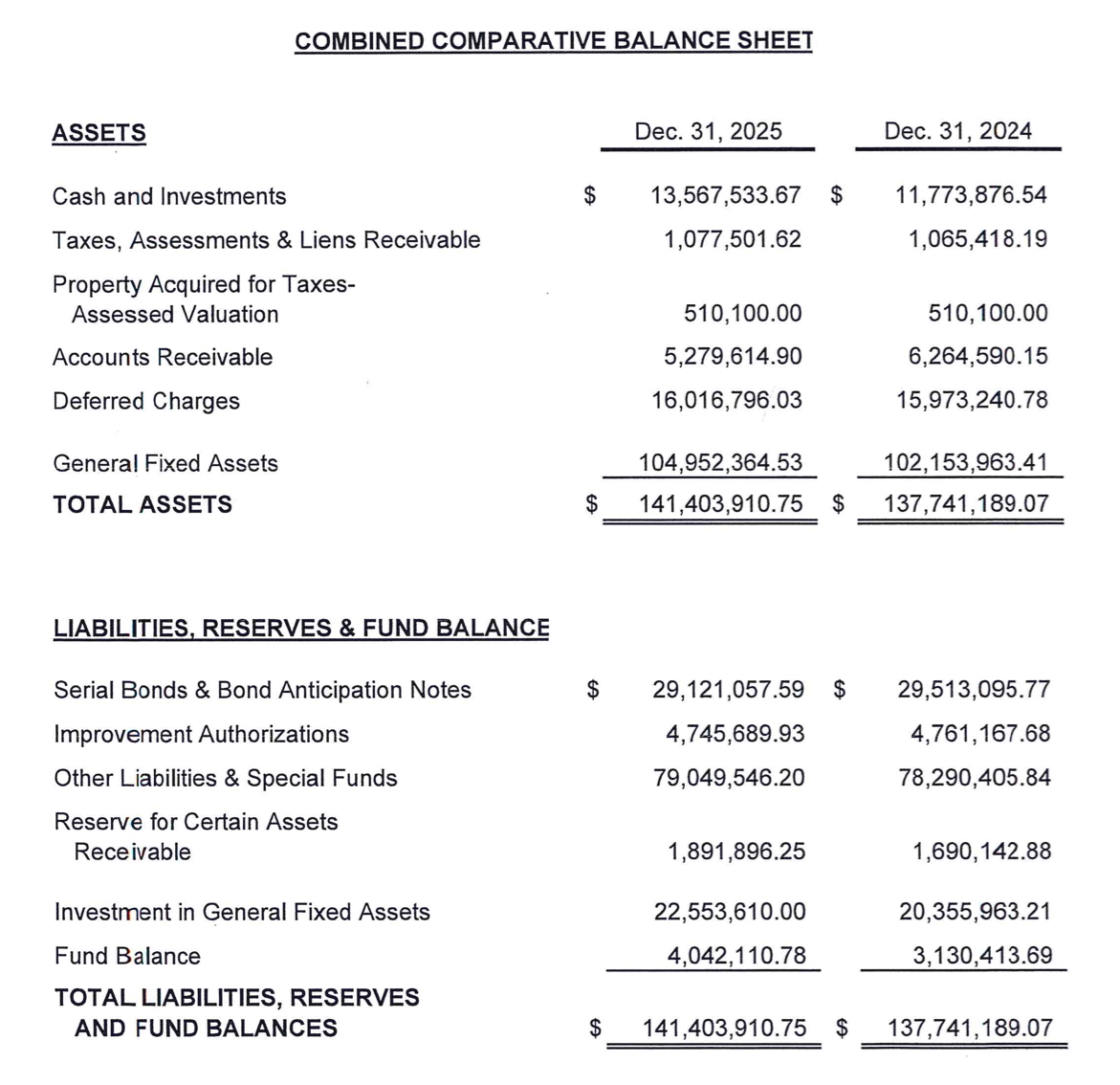
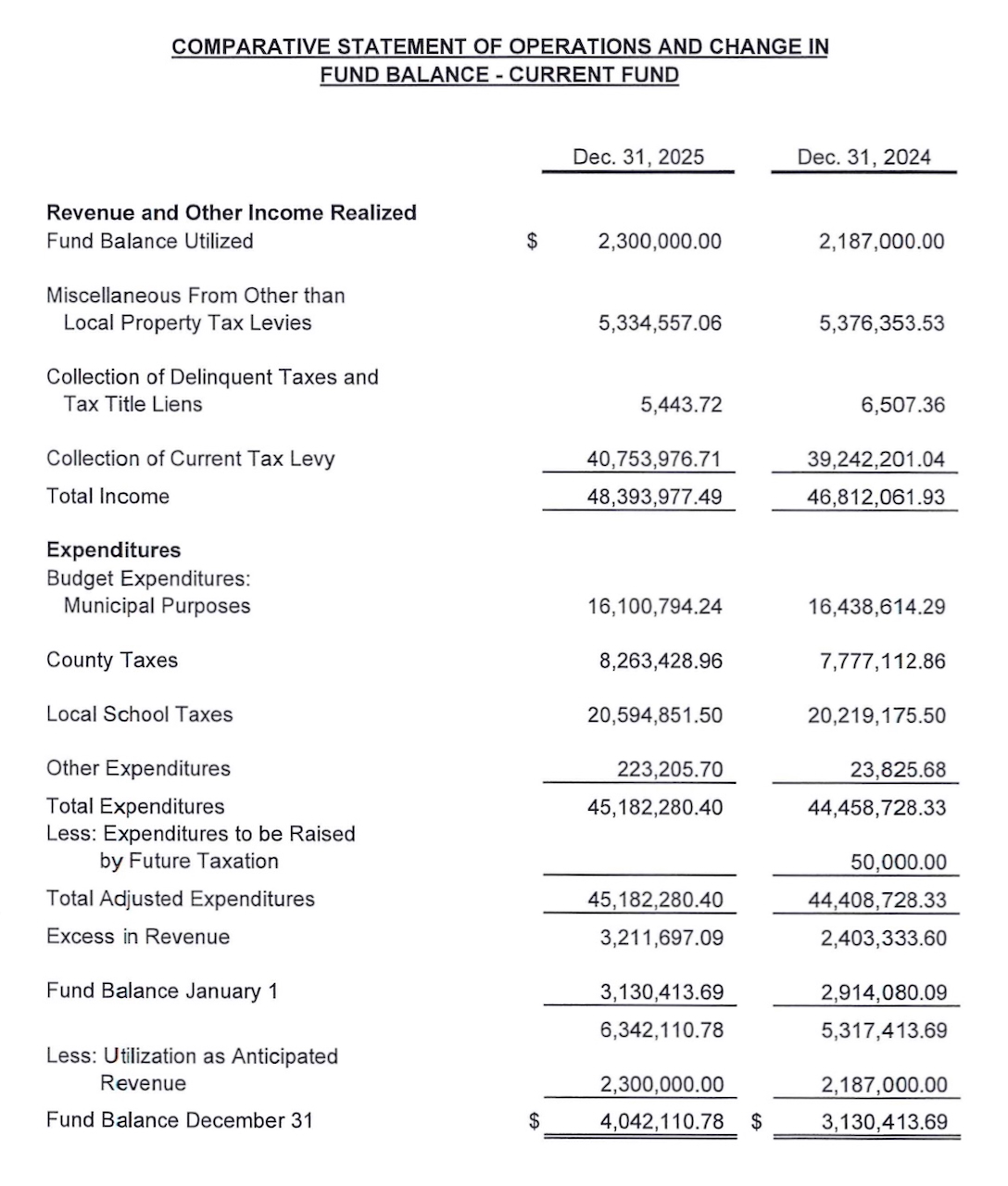
Town of Hammonton • Legal Ad • Synopsis of Audit Report • Posted 6-23-26
Download: Synopsis of Audit Report
Attention is directed to the fact that a summary or synopsis of the audit report, together with the recommendations, is the minimum required to be published pursuant to N.J.S. 40A:5-7.
RECOMMENDATIONS:
That the Town obtain the actuarial report required by GASB 75
The above synopsis was prepared from the report of the audit of the Town of Hammonton, County of Atlantic, for the calendar year 2025. This report of audit, submitted by Leon Costello, Registered Municipal Accountant, of Ford, Scott, and Associates, L.L.C., CPAs, is on file at the Township Clerk’s office and may be inspected by any interested person.
Frank Zuber
Town of Hammonton Municipal Clerk
Town of Hammonton • Notice to Bidders • Posted 6-11-26
REBID June 2026 Rt. 54 Project
Download: Notice to Bidders Rebid June 2026 Rt. 54 Project
Town of Hammonton – 12th Street (NJSH Rt.54) Water Main Replacement
Town of Hammonton, Atlantic County, NJ
NOTICE TO BIDDERS
1. BIDS: Sealed Bids for the 12th Street (Rt. 54) Water Main Replacement, Bellevue Avenue Capital Project, in the Town of Hammonton, will be received at 10:00 A.M. on 06/24/2026 at which time Bids will be publicly opened and read aloud at the Town Hall, located at 100 Central Avenue, Hammonton, NJ 08037. Bids will not be accepted after the specified time.
a. The project will consist of the replacement of approximately 5,350 LF of potable water main, select curb and driveway replacement, replacement fire hydrants, service laterals, and related site work along a portion of 12th Street (NJSH Route 54) within the Town of Hammonton. As well as the installation of 1,280 LF of potable water main, along a portion of Chew Road specified as an alternate bid. Award of this project is contingent upon a construction period adjustment to the existing NJDOT project along Route 54, which the Town is pursuing.
b. Accordingly, the Town of Hammonton will award the project to the qualified Bidder who submits the lowest responsible bid price for the total project construction.
c. Bids must be on the official Bid Form which can be obtained from the Engineer, at the offices of ARH Associates Inc., 215 Bellevue Avenue, Hammonton, NJ 08037 and accompanied by a Consent of Surety, a Non-Collusion Affidavit, other documents required pursuant to the specifications, and a certified check, cashier’s check or bid bond in the amount of 10% of the amount bid but not in excess of $20,000.00, and be delivered at the place on or before the hour named above. Each Bid must state the name and address of the person, firm and corporation interested in the same as a principal. Bids must be submitted in an opaque sealed envelope, addressed to the Town Clerk, Town of Hammonton, 100 Central Avenue, Hammonton, NJ 08037 and identified as “Bid 12th Street (Rt. 54) Water Main Replacement, Bellevue Avenue Capital Project”
d. Specifications provide for receipt of Bids by mail. Those Bids which are mailed to the contracting unit shall be sealed, properly marked, and shall only be opened for examination at such time and place as all Bids received are unsealed and announced.
e. The Mayor, Town Council, and its Solicitor (hereinafter referred to as Owner) will be the sole discretionary body for consideration or rejection of the Bids.
2. BID DOCUMENTS: The Specifications, Drawings and Bid Form for the project can be obtained at a cost of $50.00 from the office of the Engineer, ARH Associates, Inc., 215 Bellevue Avenue, Hammonton, NJ 08037, phone (609) 561-0482, and may be inspected by prospective Bidders during business hours. The Engineer will furnish the Bidder with a copy of the specifications upon receipt of payment (for the cost of the specification preparation).
3. WITHDRAWAL OF BIDS: Any Bid may be withdrawn prior to the above scheduled time for the opening of Bids or any authorized postponement thereof. Bids received after time and date designated shall not be considered. The provisions of N.J.S.A. 40A:11-23.3 shall be adhered to on this project.
4. AFFIRMATIVE ACTION REGULATIONS: Bidders are required to comply with the requirements of P.L. 1975, c.127 (NJAC 17:27).
5. CONTRACT COMPLETION: Construction shall commence at the project site within fourteen (14) calendar days after the date to be specified in the written ‘Notice to Proceed’ by the Engineer and shall be completed within one hundred twenty (120) calendar days from the date the written ‘Notice to Proceed’ is given, unless otherwise agreed to.
6. PREVAILING WAGE REQUIREMENTS: The provisions of the Department of Labor’s current wage rate determinations and the New Jersey Prevailing Wage Act are requirements of this project.
7. PUBLIC WORKS CONTRACTOR REGISTRATION ACT: The provisions of the New Jersey Public Works Contractor Registration Act are requirements of this project.
8. BUSINESS REGISTRATION CERTIFICATE: The provisions of the New Jersey Business Registration Requirements shall be adhered to on this project.
9. FUNDING STATEMENT N.J.A.C 7:22-3.17(d): This contract or subcontract is expected to be funded in part with funds from the New Jersey Department of Environmental Protection and the New Jersey Environmental Infrastructure Trust. Neither the State of New Jersey, the New Jersey Environmental Infrastructure Trust nor any of their departments, agencies or employees is, or will be, a party to this contract or subcontract or any lower tier contract or subcontract. This contract or subcontract is subject to the provisions of N.J.A.C. 7:22-3, 4, 5, 9 and 10.
10. SED RELATED ITEMS
1. Scope and Purpose
N.J.A.C. 7:22-9.1 (a)
(a) This subchapter establishes procedures for providing opportunities for social and economically disadvantaged (“SED”) contractors and vendors to supply materials and services under State financed construction contracts for environmental infrastructure facilities. To implement the policies established in N.J.S.A. 58:11B-26, 40:11A-41 et seq., and 52:32-17 et seq., this subchapter applies to environmental infrastructure projects receiving financial assistance from the Department and the Trust pursuant to N.J.A.C. 7:22-3, 4 and 6 and 7:22A-6 and 7. Under the provisions of N.J.A.C. 7:22-3, 4 and 6 and 7:22A-6 and 7, the Department and the Trust require recipients of Trust and Fund loans and other assistance to establish such programs for socially and economically disadvantaged small business concerns, to designate a project compliance officer, and to submit to the Department and Trust procurement plans for implementing the SED program.
2. Required SED Language
“The project or contract is funded in part by New Jersey wastewater treatment financing programs and the successful bidder must comply with all the provisions of N.J.A.C. 7:22-9.1 et seq. for the participation of small business enterprises owned and controlled by socially and economically disadvantaged individuals.”
3. Required SED Utilization Goal Language
“N.J.A.C. 7:22-3.17(a)24, 4.17(a)24, 6.17(a)24 and 7:22A-2.4(a) provide that a goal of not less than 10 percent be established for the award of contracts to small business concerns owned and controlled by one or more socially and economically disadvantaged individuals. The goal of 10 percent applies to the total amount of all contracts for building, materials and equipment, or services (including planning, design and building related activities) for a construction project.” “The project sponsor has identified that the SED utilization goal for this project is:___10%___” The goal should be stated here.
INSTRUCTION: Where a local government unit has a SED participation goal which exceeds 10 percent of the total amount of all contracts, the local government unit must comply with both the Department’s rules and the local minority and women-owned business ordinances. The project sponsor must state the identified SED utilization goal for the project.
4. SED Utilization Attainment Instruction
1. N.J.A.C. 7:22-9.3 (b) – Bids shall be solicited on an unrestricted basis. The bid documents, however, shall include a statement to the effect that the successful bidder must fulfill the SED utilization requirements by subcontracting portions or the work to SEDs; or
2. Contractors also have the option of establishing unrestricted bidding procedures to fulfill the 10 percent SED utilization requirement for the project.
5. SED Utilization Public Notice NJDEP OEOPCA Operational Direction:
N.J.A.C. 7:22-9.6 (a) Modified for operational purposes.
All project sponsors, at least 10 days prior to public advertisement for bids, shall notify the NJDEP Office of Equal Opportunity and Public Contract Assistance via H2Loans, of the availability of opportunities for SEDs to provide services, to bid on unrestricted contracts or subcontracts, or to provide any other necessary purchase or procurement.
6. Required SED Funding Award Language
N.J.A.C. 7:22-9.7 (b) The advertisement for bids shall indicate that:
“Awards will be made only to socially and economically disadvantaged business concerns that are certified by the New Jersey Commerce, Economic Growth and Tourism Commission, the New Jersey Department of Transportation, the Port Authority of New York and New Jersey, New Jersey Transit or other agencies deemed appropriate by the Office as eligible minority businesses or female businesses.”
“The invitation to bid is on an unrestricted basis whereby the successful bidder must fulfill the SED utilization requirements.”
Instruction: The agencies specified in N.J.A.C. 7:22-9.13(a)8 will have a list of eligible SED firms and shall, upon request, provide them to the project sponsor. The project sponsor shall, during the advertisement phase, provide copies of the list to all contractors on unrestricted contracts.
7. SED Advertisement Instruction
N.J.A.C. 7:22-9.7 requires project sponsors to adhere to specific advertisement criteria and duration. Specifically, relating to advertisement duration: In no case shall the advertisement for bids be published less than 30 days prior to the date fixed for receiving bids on the purchase or contract.
8. SED Utilization Bid Consideration Instruction N.J.A.C. 7:22-9.10 Lowest bid resulting in payment of unreasonable price
(a) If the contracting agency determines that the acceptance of the lowest responsible bid will result either in the payment of an unreasonable price or in a contract otherwise unacceptable pursuant to the statutes and rules governing public contracts, the contracting agency shall reject all bids.
(b) Bidders and the office shall be notified of the rejection of all bids, the reasons for the rejection, and the contracting agency’s intent to solicit bids for a second time.
(c) If the contracting agency determines a second time that the acceptance of the lowest responsible bid will result either in the payment of an unreasonable price or in a contract otherwise unacceptable pursuant to the statutes and rules governing public contracts, the contracting agency shall reject all bids and notify the NJDEP Office of Equal Opportunity and Public Contract Assistance and, after receipt of the NJDEP Office of Equal Opportunity and Public Contract Assistance’s approval, shall amend the project plan accordingly.
(d) Bidders shall be notified of the cancellation, the reasons for the cancellation and the contracting agency’s intent to resolicit bids on an unrestricted basis. SEDs may participate in the bidding on an unrestricted basis.
By Order of the Town Council
Frank Zuber, Business Administrator
Town of Hammonton
Town of Hammonton • Public Notice • Posted 6-10-26
BOND ORDINANCE #011-2026 STATEMENT AND SUMMARY
Download: Bond Ordinance #011-2026 Statement and Summary
The bond ordinance, the summary terms of which are included herein, has been finally adopted by the Town Council of the Town of Hammonton, in the County of Atlantic, State of New Jersey on May 8, 2026 and the twenty (20) day period of limitation within which a suit, action or proceeding questioning the validity of such ordinance can be commenced, as provided in the Local Bond Law, has begun to run from the date of the first publication of this statement. Copies of the full ordinance are available at no cost and during regular business hours, at the Clerk’s office for members of the general public who request the same. The summary of the terms of such bond ordinance follows:
Title: BOND ORDINANCE PROVIDING FOR VARIOUS 2026 CAPITAL IMPROVEMENTS AND ACQUISITIONS, BY AND IN THE TOWN OF HAMMONTON, IN THE COUNTY OF ATLANTIC, STATE OF NEW JERSEY, APPROPRIATING $1,660,000 THEREFOR AND AUTHORIZING THE ISSUANCE OF $1,577,000 BONDS OR NOTES OF THE TOWN TO FINANCE PART OF THE COST THEREOF
Purpose(s): The Bond Ordinance provides for (i) purchase of fuel tanks for the Hammonton Municipal Airport; (ii) purchase of non-passenger sport utility police vehicles for the Police Department; (iii) various roadway resurfacing project; and (iv) purchase of office equipment and computer upgrades for various Municipal Departments in the Town. For a complete description of the acquisitions and improvements to be undertaken, please refer to the full text of the Bond Ordinance.
Appropriation: $1,660,000
Bonds/Notes
Authorized: $1,577,000
Down Payment: $83,000
Section 20 Costs: $332,000
Average Useful Life: 13.70 years
Frank Zuber
Town of Hammonton Municipal Clerk
Town of Hammonton • Public Notice • Posted 5-28-26
BOND ORDINANCE #006-2026 STATEMENT AND SUMMARY
Download: BOND ORDINANCE #006-2026 STATEMENT AND SUMMARY
The bond ordinance, the summary terms of which are included herein, has been finally adopted by the Town Council of the Town of Hammonton, in the County of Atlantic, State of New Jersey on May 26, 2026 and the twenty (20) day period of limitation within which a suit, action or proceeding questioning the validity of such ordinance can be commenced, as provided in the Local Bond Law, has begun to run from the date of the first publication of this statement. Copies of the full ordinance are available at no cost and during regular business hours, at the Clerk’s office for members of the general public who request the same. The summary of the terms of such bond ordinance follows:
- Title: BOND ORDINANCE PROVIDING FOR AIRPORT DEVELOPMENT AND/OR NOISE PROGRAM IMPLEMENTATION AT THE HAMMONTON MUNICIPAL AIRPORT, BY AND IN THE TOWN OF HAMMONTON, IN THE COUNTY OF ATLANTIC, STATE OF NEW JERSEY; APPROPRIATING $293,000 THEREFOR AND AUTHORIZING THE ISSUANCE OF $14,000 BONDS OR NOTES OF THE TOWN TO FINANCE PART OF THE COST THEREOF
- Purpose(s): The Bond Ordinance provides for airport development and/or noise program implementation at the Hammonton Municipal Airport.
- Appropriation: $293,000
- Bonds/Notes Authorized: $14,000
- Down Payment: $947.00
- Grant: $278,053 United States Department of Transportation Federal Aviation Administration
- Section 20 Costs: $58,000
- Useful Life: 5 years
Frank Zuber, Municipal Clerk
Town of Hammonton • Public Notice • Posted 5-28-26
BOND ORDINANCE #007-2026 STATEMENT AND SUMMARY
Download: BOND ORDINANCE #007-2026 STATEMENT AND SUMMARY
The bond ordinance, the summary terms of which are included herein, has been finally adopted by the Town Council of the Town of Hammonton, in the County of Atlantic, State of New Jersey on May 26, 2026 and the twenty (20) day period of limitation within which a suit, action or proceeding questioning the validity of such ordinance can be commenced, as provided in the Local Bond Law, has begun to run from the date of the first publication of this statement. Copies of the full ordinance are available at no cost and during regular business hours, at the Clerk’s office for members of the general public who request the same. The summary of the terms of such bond ordinance follows:
- Title: BOND ORDINANCE PROVIDING FOR WATER MAIN AND DRAINAGE IMPROVEMENTS, BY AND IN THE TOWN OF HAMMONTON, IN THE COUNTY OF ATLANTIC, STATE OF NEW JERSEY; APPROPRIATING $2,600,000 THEREFOR AND AUTHORIZING THE ISSUANCE OF $2,600,000 BONDS OR NOTES TO FINANCE THE COST THEREOF
- Purpose(s): The Bond Ordinance provides for water main and drainage improvements along the entire lengths or portions thereof Route 54 and 12th Street in and for the Water/Sewer Utility of the Town.
- Appropriation: $2,600,000
- Bonds/Notes Authorized: $2,600,000
- Section 20: $520,000
- Useful Life: 30 years
Frank Zuber, Municipal Clerk
Town of Hammonton • Legal Notice • Posted 5-28-26
Ordinance #008- 2026
Download: Ordinance #008- 2026
Take notice that an Ordinance entitled “Exceed the municipal budget appropriation limits and to establish a CAP Bank,” passed second reading at the public hearing at the regular meeting of Mayor and Council held on May 26, 2026.
Frank Zuber, Municipal Clerk
Town of Hammonton • Legal Notice • Posted 5-28-26
Ordinance #009- 2026
Download: Ordinance #009- 2026
Take notice that an Ordinance entitled “Amending Chapter 271 Section 6 of the code of the Town of Hammonton Entitled “Parking Prohibited at All Times”,” passed second reading at the public hearing at the regular meeting of Mayor and Council held on May 26, 2026.
Frank Zuber, Municipal Clerk
Town of Hammonton • Public Notice • Posted 5-28-26
NOTICE OF PENDING BOND ORDINANCE #011-2026 AND SUMMARY
Download: PENDING BOND ORDINANCE #011-2026 AND SUMMARY
The bond ordinance, the summary terms of which are included herein, was introduced and passed upon first reading at a meeting of the governing body of the Town of Hammonton, in the County of Atlantic, State of New Jersey, on May 26, 2026. It will be further considered for final passage, after public hearing thereon, at a meeting of the governing body to be held on June 8, 2026 at 6:00 p.m. During the week prior to and up to and including the date of such meeting copies of the full bond ordinance will be available at no cost and during regular business hours at the Clerk’s office for the members of the general public who shall request the same. The summary of the terms of such bond ordinance follows:
- Title: BOND ORDINANCE PROVIDING FOR VARIOUS 2026 CAPITAL IMPROVEMENTS AND ACQUISITIONS, BY AND IN THE TOWN OF HAMMONTON, IN THE COUNTY OF ATLANTIC, STATE OF NEW JERSEY, APPROPRIATING $1,660,000 THEREFOR AND AUTHORIZING THE ISSUANCE OF $1,577,000 BONDS OR NOTES OF THE TOWN TO FINANCE PART OF THE COST THEREOF
- Purpose(s): The Bond Ordinance provides for (i) purchase of fuel tanks for the Hammonton Municipal Airport; (ii) purchase of non-passenger sport utility police vehicles for the Police Department; (iii) various roadway resurfacing project; and (iv) purchase of office equipment and computer upgrades for various Municipal Departments in the Town. For a complete description of the acquisitions and improvements to be undertaken, please refer to the full text of the Bond Ordinance.
- Appropriation: $1,660,000
- Bonds/Notes Authorized: $1,577,000
- Down Payment: $83,000
- Section 20 Costs: $332,000
- Average Useful Life: 13.70 years
Frank Zuber, Municipal Clerk
Town of Hammonton • Public Notice • Posted 5-28-26
NOTICE OF PENDING ORDINANCE #012-2026
Download: NOTICE OF PENDING ORDINANCE #012-2026
The bond ordinance published herewith was introduced and adopted upon first reading at a meeting of the Town Council of the Town of Hammonton, in the County of Atlantic, State of New Jersey, held on May 26, 2026. It will be further considered for final passage, after public hearing thereon, at a meeting of the governing body to be held on June 22, 2026 at 7:00 p.m. During the week prior to and up to and including the date of such meeting, copies of the full ordinance will be available at no cost and during regular business hours at the Clerk’s office or on the Town’s website for the members of the general public who shall request the same. The summary of the terms of such bond ordinance follows:
- Title: BOND ORDINANCE AMENDING AND SUPPLEMENTING BOND ORDINANCE NUMBER 007-2026 HERETOFORE FINALLY ADOPTED ON MAY 26, 2026, BY THE TOWN OF HAMMONTON, IN THE COUNTY OF ATLANTIC, STATE OF NEW JERSEY; TO INCREASE THE APPROPRIATION THEREIN TO $7,500,000 AND TO INCREASE THE AUTHORIZATION OF BONDS OR NOTES THEREIN TO $7,500,000 AND TO INCREASE COSTS PROVIDED IN N.J.S.A. 40A:2-20 THEREIN
- Purpose(s): To (i) increase the total appropriation from $2,600,000 to $7,500,000, and (ii) increase the total bonds/notes debt authorization from $2,600,000 to $7,500,000.
- Appropriation: Increase from $2,600,000 to $7,500,000
- Bonds/Notes Authorized: Increase from $2,600,000 to $7,500,000
- Section 20 Costs: Increase from $520,000 to $1,500,000
- Useful Life: No Change
Frank Zuber, Municipal Clerk
Town of Hammonton • Public Notice • Posted 5-28-26
NOTICE OF PENDING BOND ORDINANCE #013-2026 AND SUMMARY
Download: PENDING BOND ORDINANCE #013-2026 AND SUMMARY
The bond ordinance, the summary terms of which are included herein, was introduced and passed upon first reading at a meeting of the governing body of the Town of Hammonton, in the County of Atlantic, State of New Jersey, on May 26, 2026. It will be further considered for final passage, after public hearing thereon, at a meeting of the governing body to be held on June 22, 2026 at 7:00 p.m. During the week prior to and up to and including the date of such meeting copies of the full bond ordinance will be available at no cost and during regular business hours at the Clerk’s office for the members of the general public who shall request the same. The summary of the terms of such bond ordinance follows:
- Title: BOND ORDINANCE PROVIDING FOR PFAS IMPROVEMENTS TO THE WATER LINES LOCATED AT LAKEVIEW GARDENS, BY AND IN THE TOWN OF HAMMONTON, IN THE COUNTY OF ATLANTIC, STATE OF NEW JERSEY; APPROPRIATING $2,500,000 THEREFOR AND AUTHORIZING THE ISSUANCE OF $2,500,000 BONDS OR NOTES TO FINANCE THE COST THEREOF
- Purpose(s): The Bond Ordinance provides for PFAS improvements to the water lines located at Lakeview Gardens in and for the Water/Sewer Utility of the Town.
- Appropriation: $2,500,000
- Bonds/Notes Authorized: $2,500,000
- Section 20: $500,000
- Useful Life: 30 years
Frank Zuber, Municipal Clerk
Public Notice • Posted 5-14-26
Atlantic County Office of Mosquito Control
Download: Atlantic County Office of Mosquito Control Notice
In compliance with section 9.10 of the New Jersey Pesticide Control Code (N.J.A.C. Title 7, Chapter 30) The Atlantic County Dept. of Public Works, Office of Mosquito Control will be applying pesticides for the control of adult populations on an area-wide basis, as needed, throughout Atlantic County during the period of May 1, 2026 through November 30, 2026.
The pesticides used will be those recommended by the New Jersey Agricultural Experiment Station (NJAES) for the control of adult mosquitoes, which may include, but are not limited to:
Malathion (FyfanonÆ), Etofenprox (Zenivex E20, Zenivex E4), Prallethrin Sumithrin (Duet Dual Action, Duet HD), Pyrethrins (Merus 3.0TM).
Products will be applied by ground (using truck mounted equipment) and / or (using aircraft mounted equipment) with Low volume (LV) and / or Ultra Low Volume (ULV) capabilities. All applications will be according to product labeling.
In the case of any pesticide emergency please contact the New Jersey Poison Information and Education System @ 1- 800-222-1222 or National Pesticide Information Center @ 1-800-858-7378 for routine pesticide related health inquiries. Call the New Jersey Pesticide Control Program @ 1-609-984-6568 for pesticide regulation information, pesticide complaints and health referrals.
“Upon request the Atlantic County Office of Mosquito Control shall provide a resident with notification at least 12 hours prior to the application, except for Quarantine and Disease Vector Control only, when conditions necessitate pesticide applications sooner than that time”.
The phone number/web site for updated information and location of adult mosquito control applications is 1-877-643-2287 or www.aclink.org/mosquito-control/
Those seeking further information regarding Atlantic County mosquito control activities are requested to contact John Abdill Jr., NJCPA# 25869B @ phone number 609-645-5948.
Ordinance #010-2026 • Posted 5-5-26
Town of Hammonton Legal Notice of Pending Ordinance
Download: Ordinance-010-2026.pdf
The ordinance published herewith passed first reading at its introduction at the regular meeting of the Mayor and Council of the Town of Hammonton held on April 27, 2026. It will be further considered for final passage after public hearing thereon, at a meeting of said Mayor and Council to be held at the Town Hall Council chambers, 100 Central Ave., Hammonton, on May 26, 2026. A copy of this ordinance appears on the town hall bulletin board and may be obtained from the office of the Municipal Clerk in the Town Hall, 100 Central Avenue, Hammonton, NJ 08037 between the hours of 9:00 A.M. and 4:30 P.M., Monday thru Friday.
AN ORDINANCE TO AMEND CHAPTER 175 OF THE GENERAL ORDINANCE OF THE TOWN OF HAMMONTON
BE IT ORDAINED by the Mayor and Council of the Town of Hammonton, County of Atlantic and State of New Jersey as follows:
Section 1. Section 175-53 of the Town of Hammonton Land Development Ordinance is amended to read as follows:
A. The Chairman of the Planning Board shall appoint a Development Review Committee. The Committee shall consist of the following:
- At least one (1), but no more than four (4), regular or alternate Planning Board Members;
- The Board Engineer;
- The Board Planner;
- The Board Solicitor; and
- The Traffic Consultant on an as needed basis.
B. The Planning Board Chairman shall designate a Committee Chair from among the members of the Committee.
C. An Applicant may request an informal review of a concept design plan for which an Applicant intends to prepare and submit an application for development.
D. A concept design plan and the supporting documents for a proposed development shall show a general informal design of the development, including proposed building types if located in a Downtown District or Gateway District, and its public improvements.
E. The Development Review Committee shall review the conceptual plan presented by the Applicant to provide insight as to the deficiencies of said plan, and to comment on the acceptability of the proposed plan.
F. The Development Review Committee meeting is a working session between the Committee and the Applicant. The meeting is used to provide the Applicant with a review of his/her/its application. Positive review of the concept design plan by the Committee does not constitute an approval of the concept or plan, nor shall it be considered a valid basis for the construction of improvements or for other commitments which depend upon its design characteristics. Comments made by the Committee are non-binding. As such, neither the Applicant nor the Board shall be bound by the actions, suggestions or recommendations of the Committee.
G. An Applicant upon making a request for an informal review before the Committee must submit to the Planning Board Secretary at least ten (10) days before a scheduled committee meeting six (6) copies of the concept design plan.
H. The Committee shall meet on a monthly basis at a date, time and location within Town Hall selected by the Chairman of the Planning Board at the reorganization meeting of the Planning Board for the whole year.
I. An Applicant desiring to appear before the Development Review Committee must pay an application fee of $50.00 and an escrow fee of $1,000.00.
BE IT FURTHER ORDAINED, that if any section, paragraph, subsection, clause or provision of this Ordinance shall be adjudged by the Courts to be invalid, such adjudication shall apply only to the section, paragraph, subsection, clause or provision so adjudicated, and the remainder of the Ordinance shall be deemed valid and effective; and
BE IT FURTHER ORDAINED, that any Ordinances or parts thereof in conflict with the provisions of this Ordinance are repealed to the extent of such conflict; and
BE IT FURTHER ORDAINED, that this Ordinance shall take effect following adoption and approval in the time and manner prescribed by law.
Frank Zuber, Municipal Clerk
Ordinance #009 -2026 • Posted 5-5-26
Town of Hammonton Legal Notice of Pending Ordinance
Download: Ordinance-009-2026.pdf
The ordinance published herewith passed first reading at its introduction at the regular meeting of the Mayor and Council of the Town of Hammonton held on April 27, 2026.
It will be further considered for final passage after public hearing thereon, at a meeting of said Mayor and Council to be held at the Town Hall Council chambers, 100 Central Ave., Hammonton, on May 26, 2026. A copy of this ordinance appears on the town hall bulletin board and may be obtained from the office of the Municipal Clerk in the Town Hall, 100 Central Avenue, Hammonton, NJ 08037 between the hours of 9:00 A.M. and 4:30 P.M., Monday thru Friday.
AN ORDINANCE AMENDING CHAPTER 271 SECTION 6 OF THE CODE OF THE TOWN OF HAMMONTON, COUNTY OF ATLANTIC ENTITLED “PARKING PROHIBITED AT ALL TIMES”
WHEREAS, the Police Chief have recommended an amendment to Chapter 271 Vehicles and Traffic Section-6: Parking Prohibited At All Times, and the Mayor and Town Council have considered it in the best interest of the Town to amend this specific section; and
NOW, THEREFORE, BE IT RESOLVED by the Mayor and Town Council of the Town of Hammonton, County of Atlantic, State of New Jersey: That Chapter 271-6 “Vehicles and Traffic” Parking prohibited at all times on certain streets, is hereby amended as follows:
That Chapter 271-6 “Vehicles and Traffic” Parking prohibited at all times on certain streets, is hereby amended as follows:
NAME OF STREET: Orchard Street
SIDE: West
LOCATION: No Parking from Monroe Street to 1st Road
BE IT FURTHER RESOLVED, that all ordinances or parts of ordinances inconsistent herewith are hereby repealed to the extent of such inconsistency.
This ordinance shall take effect upon final passage and publication as required by law and the approval of the New Jersey Commissioner of Transportation and the County of Atlantic as set forth in N.J.S.A. 39:4-8.
Frank Zuber, Municipal Clerk
PUBLIC NOTICE • Posted 5-5-26
NOTICE OF PENDING BOND ORDINANCE #007-2026 AND SUMMARY
Download: PENDING-BOND-ORDINANCE-007-2026.pdf
The bond ordinance, the summary terms of which are included herein, was introduced and passed upon first reading at a meeting of the governing body of the Town of Hammonton, in the County of Atlantic, State of New Jersey, on April 27, 2026. It will be further considered for final passage, after public hearing thereon, at a meeting of the governing body to be held on May 26, 2026 at 7:00 p.m. During the week prior to and up to and including the date of such meeting copies of the full bond ordinance will be available at no cost and during regular business hours at the Clerk’s office for the members of the general public who shall request the same. The summary of the terms of such bond ordinance follows:
Title: BOND ORDINANCE PROVIDING FOR WATER MAIN AND DRAINAGE IMPROVEMENTS, BY AND IN THE TOWN OF HAMMONTON, IN THE COUNTY OF ATLANTIC, STATE OF NEW JERSEY; APPROPRIATING $2,600,000 THEREFOR AND AUTHORIZING THE ISSUANCE OF $2,600,000 BONDS OR NOTES TO FINANCE THE COST THEREOF
Purpose(s): The Bond Ordinance provides for water main and drainage improvements along the entire lengths or portions thereof Route 54 and 12th Street in and for the Water/Sewer Utility of the Town.
Appropriation: $2,600,000
Bonds/Notes Authorized: $2,600,000
Section 20: $520,000
Useful Life: 30 years
Frank Zuber, Municipal Clerk
PUBLIC NOTICE • Posted 5-5-26
NOTICE OF PENDING BOND ORDINANCE #006-2026 AND SUMMARY
Download: ORDINANCE-006-2026.pdf
The bond ordinance, the summary terms of which are included herein, was introduced and passed upon first reading at a meeting of the governing body of the Town of Hammonton, in the County of Atlantic, State of New Jersey, on April 27, 2026. It will be further considered for final passage, after public hearing thereon, at a meeting of the governing body to be held on May 26, 2026 at 7:00 p.m. During the week prior to and up to and including the date of such meeting copies of the full bond ordinance will be available at no cost and during regular business hours at the Clerk’s office for the members of the general public who shall request the same. The summary of the terms of such bond ordinance follows:
Title: BOND ORDINANCE PROVIDING FOR AIRPORT DEVELOPMENT AND/OR NOISE PROGRAM IMPLEMENTATION AT THE HAMMONTON MUNICIPAL AIRPORT, BY AND IN THE TOWN OF HAMMONTON, IN THE COUNTY OF ATLANTIC, STATE OF NEW JERSEY; APPROPRIATING $293,000 THEREFOR AND AUTHORIZING THE ISSUANCE OF $14,000 BONDS OR NOTES OF THE TOWN TO FINANCE PART OF THE COST THEREOF
Purpose(s): The Bond Ordinance provides for airport development and/or noise program implementation at the Hammonton Municipal Airport.
Appropriation: $293,000
Bonds/Notes Authorized: $14,000
Down Payment: $947.00
Grant: $278,053 United States Department of Transportation Federal Aviation Administration
Section 20 Costs: $58,000
Useful Life: 5 years
Frank Zuber, Municipal Clerk
Ordinance #005- 2026 • Posted 5-5-26
TOWN OF HAMMONTON LEGAL NOTICE
Download: Ordinance-005-2026.pdf
Take notice that an Ordinance entitled “The installation and Maintenance of two poles within a right-of-way for the placement of banners over Bellevue Avenue (AKA Route 54),” passed second reading at the public hearing at the regular meeting of
Mayor and Council held on April 27, 2026.
Frank Zuber, Municipal Clerk
TOWN OF HAMMONTON • PUBLIC NOTICE • Posted 5-5-26
BOND ORDINANCE #004-2026 STATEMENT AND SUMMARY
Download: BOND-ORDINANCE-004-2026.pdf
The bond ordinance, the summary terms of which are included herein, has been finally adopted by the Town Council of the Town of Hammonton, in the County of Atlantic, State of New Jersey on April 27, 2026 and the twenty (20) day period of limitation within which a suit, action or proceeding questioning the validity of such ordinance can be commenced, as provided in the Local Bond Law, has begun to run from the date of the first publication of this statement. Copies of the full ordinance are available at no cost and during regular business hours, at the Clerk’s office for members of the general public who request the same. The summary of the terms of such bond ordinance follows:
Title: BOND ORDINANCE PROVIDING FOR VARIOUS ROADWAY AND DRAINAGE IMPROVEMENTS, BY AND IN THE TOWN OF HAMMONTON, IN THE COUNTY OF ATLANTIC, STATE OF NEW JERSEY, APPROPRIATING $597,918 THEREFOR (INCLUDING STATE OF NEW JERSEY DEPARTMENT OF TRANSPORTATION GRANTS TOTALING $506,418) AND AUTHORIZING THE ISSUANCE OF $86,925 IN BONDS OR NOTES OF THE TOWN TO FINANCE PART OF THE COST THEREOF
Purpose(s): Various roadway and drainage improvements along the entire lengths or portions thereof of Thirteenth Street and West End Avenue, respectively. For a complete description of the improvements, please refer to the full text of the Bond Ordinance.
Appropriation: $597,918
Bonds/Notes Authorized: $86,925
Grant: $229,190 and 277,228, respectively, grants expected to be received from the State of New Jersey Department of Transportation
Down Payment: $4,575
Section 20 Costs: $120,000
Average Useful Life: 10 years
Frank Zuber, Municipal Clerk
Ordinance #001-2026 • Posted 5-5-26
TOWN OF HAMMONTON LEGAL NOTICE
Download: Ordinance-001-2026.pdf
Take notice that an Ordinance entitled “Amending the redevelopment plan for premises identified on the municipal tax map as block 801, lots 7,8,9, and 11,” passed second reading at the public hearing at the regular meeting of Mayor and Council held on April 27, 2026.
Frank Zuber, Municipal Clerk
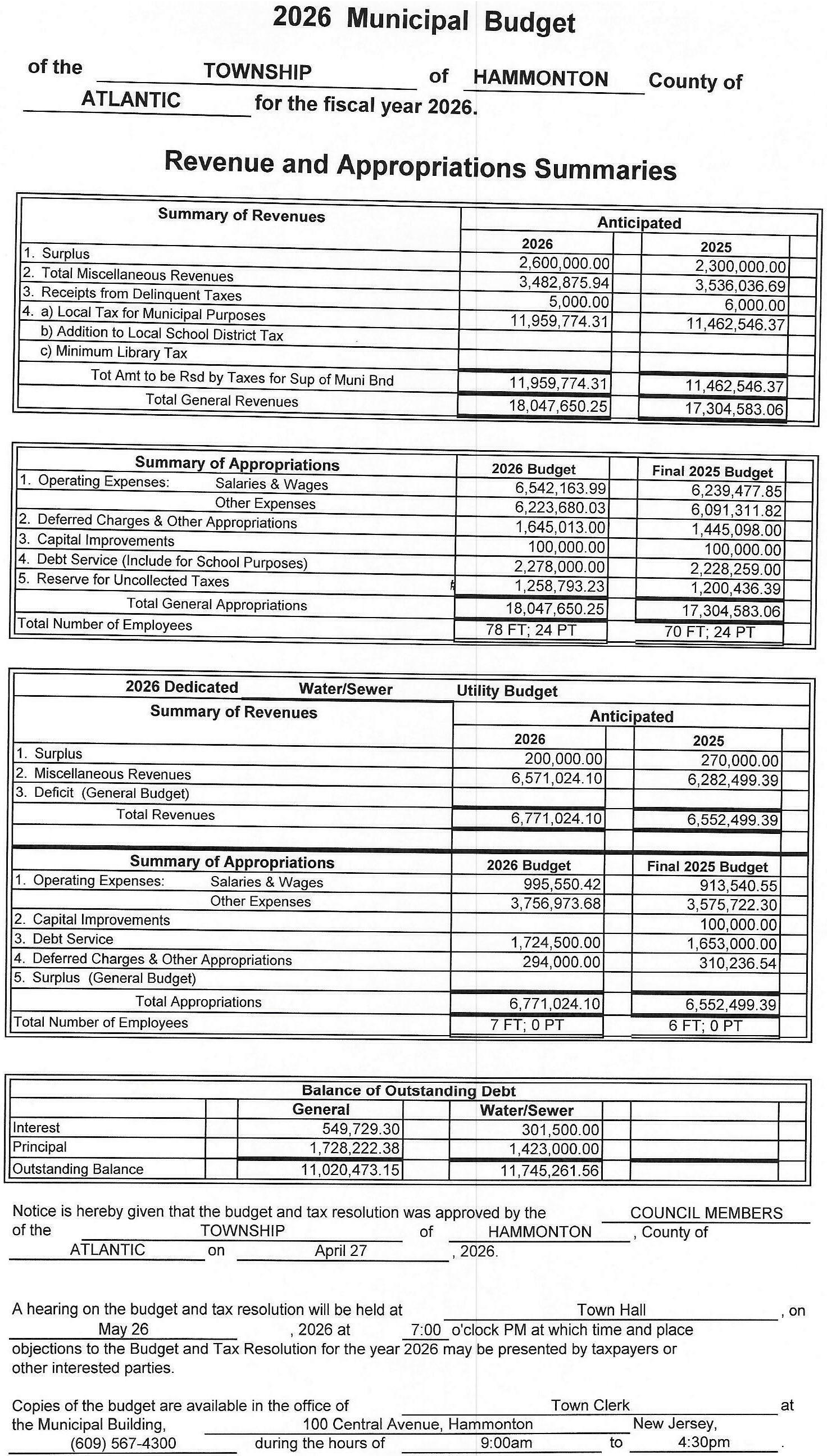
Municipal Budget of the Township of Hammonton
County of Atlantic for the Fiscal Year 2026 • Posted 4-28-26
Download: Hammonton 2026 Budget Advertisement
Notice is hereby given that the budget and tax resolution was approved by the council members of the Town of Hammonton, County of Atlantic, on April 27th, 2026. A hearing on the budget and tax resolution will be held at Town Hall on May 26th, 2026 7:00 PM at which time and place objections to the Budget and Tax Resolution for the year 2026 may be presented by taxpayers or other interested parties. Copies of the budget are available in the office of the Town Clerk, 3rd floor, at Town Hall, 100 Central Avenue, Hammonton, NJ. Phone: 609-567-4300. Hours: 9 AM to 4:30 pm.
Town of Hammonton • County of Atlantic • Calendar Year 2026 • Posted 4-28-26
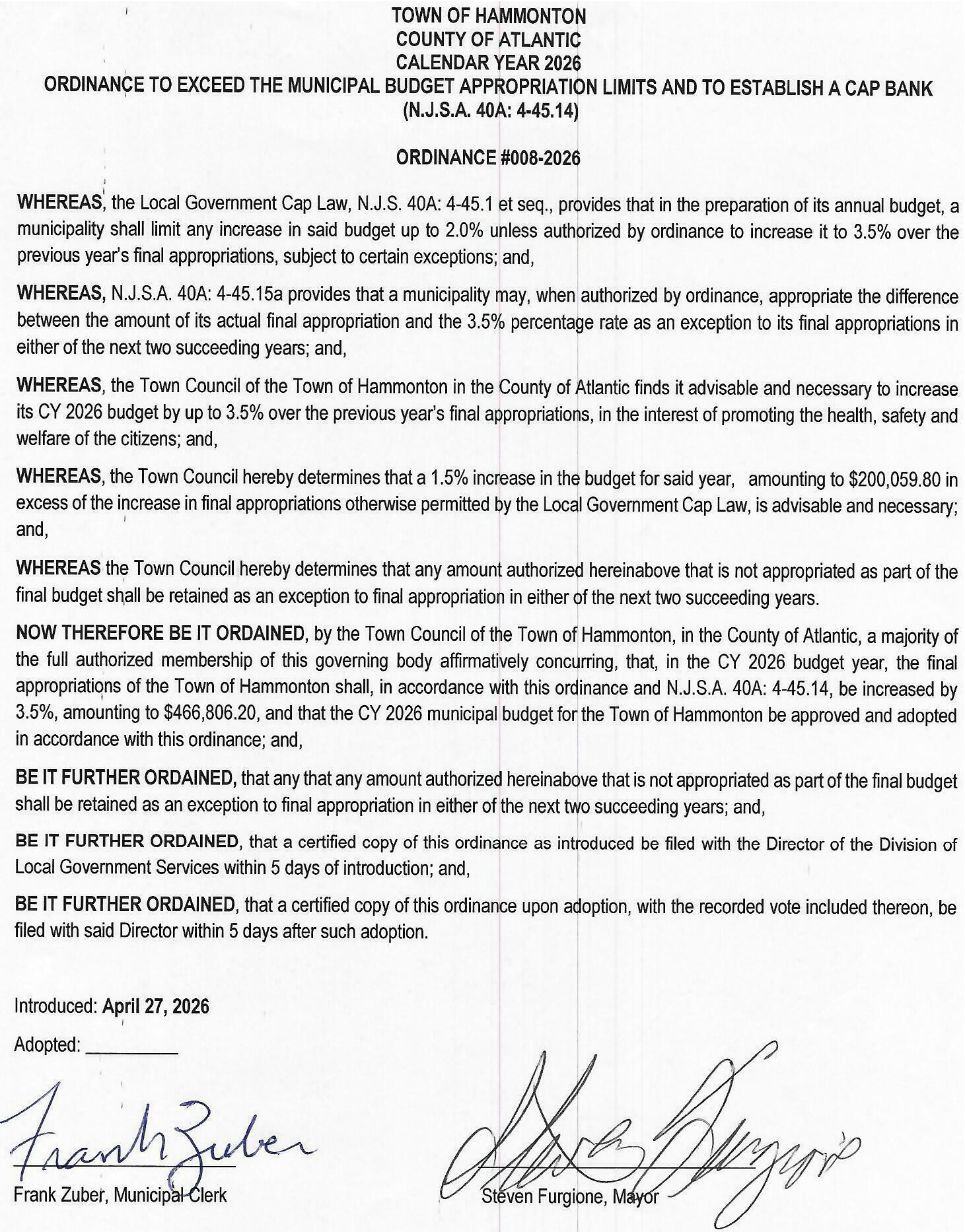
Ordinance to Exceed the Municipal Budget Appropriation Limits and to Establish a Cap Bank (N.J.S.A. 40A: 4-45.14)
Ordinance #008-2026
Download: Hammonton COLA Ordinance
WHEREAS, the Local Government Cap Law, N.J.S. 40A: 4-45.1 et seq., provides that in the preparation of its annual budget, a municipality shall limit any increase in said budget up to 2.0% unless authorized by ordinance to increase it to 3.5% over the previous year’s final appropriations, subject to certain exceptions; and,
WHEREAS, N.J.S.A. 40A: 4-45.15a provides that a municipality may, when authorized by ordinance, appropriate the difference between the amount of its actual final appropriation and the 3.5% percentage rate as an exception to its final appropriations in either of the next two succeeding years; and,
WHEREAS, the Town Council of the Town of Hammonton in the County of Atlantic finds it advisable and necessary to increase its CY 2026 budget by up to 3.5% over the previous year’s final appropriations, in the interest of promoting the health, safety and welfare of the citizens; and,
WHEREAS, the Town Council hereby determines that a 1.5% increase in the budget for said year, amounting to $200,059.80 in excess of the increase in final appropriations otherwise permitted by the Local Government Cap Law, is advisable and necessary; and,
WHEREAS the Town Council hereby determines that any amount authorized hereinabove that is not appropriated as part of the final budget shall be retained as an exception to final appropriation in either of the next two succeeding years.
NOW THEREFORE BE IT ORDAINED, by the Town Council of the Town of Hammonton, in the County of Atlantic, a majority of the full authorized membership of this governing body affirmatively concurring, that, in the CY 2026 budget year, the final appropriations of the Town of Hammonton shall, in accordance with this ordinance and N.J.S.A. 40A: 4-45.14, be increased by 3.5%, amounting to $466,806.20, and that the CY 2026 municipal budget for the Town of Hammonton be approved and adopted in accordance with this ordinance; and,
BE IT FURTHER ORDAINED, that any that any amount authorized hereinabove that is not appropriated as part of the final budget shall be retained as an exception to final appropriation in either of the next two succeeding years; and,
BE IT FURTHER ORDAINED, that a certified copy of this ordinance as introduced be filed with the Director of the Division of Local Government Services within 5 days of introduction; and,
BE IT FURTHER ORDAINED, that a certified copy of this ordinance upon adoption, with the recorded vote included thereon, be filed with said Director within 5 days after such adoption.
Introduced: April 27, 2026
Frank Zuber, Municipal Clerk
Steven Furgione, Mayor
Notice to Bidders: Rt 54 Water Main Replacement • Posted 4-17-26
Download: Notice to Bidders: Rt 54 Water Main Replacement
ARH# 11-30167
Town of Hammonton – 12th Street (NJSH Rt.54) Water Main Replacement
Town of Hammonton, Atlantic County, NJ
1. BIDS: Sealed Bids for the 12th Street (Rt. 54) Water Main Replacement, Bellevue Avenue Capital Project, in the Town of Hammonton, will be received at 10:00 A.M. on 05/19/2026 at which time Bids will be publicly opened and read aloud at the Town Hall, located at 100 Central Avenue, Hammonton, NJ 08037. Bids will not be accepted after the specified time.
a. The project will consist of the replacement of approximately 5,350 LF of potable water main, select curb and driveway replacement, replacement fire hydrants, service laterals, and related site work along a portion of 12th Street (NJSH Route 54) within the Town of Hammonton. As well as the installation of 1,280 LF of potable water main, along a portion of Chew Road specified as an alternate bid. Award of this project is contingent upon a construction period adjustment to the existing NJDOT project along Route 54, which the Town is pursuing.
b. Accordingly, the Town of Hammonton will award the project to the qualified Bidder who submits the lowest responsible bid price for the total project construction.
c. Bids must be on the official Bid Form which can be obtained from the Engineer, at the offices of ARH Associates Inc., 215 Bellevue Avenue, Hammonton, NJ 08037 and accompanied by a Consent of Surety, a Non-Collusion Affidavit, other documents required pursuant to the specifications, and a certified check, cashier’s check or bid bond in the amount of 10% of the amount bid but not in excess of $20,000.00, and be delivered at the place on or before the hour named above. Each Bid must state the name and address of the person, firm and corporation interested in the same as a principal. Bids must be submitted in an opaque sealed envelope, addressed to the Town Clerk, Town of Hammonton, 100 Central Avenue, Hammonton, NJ 08037 and identified as “Bid 12th Street (Rt. 54) Water Main Replacement, Bellevue Avenue Capital Project”
d. Specifications provide for receipt of Bids by mail. Those Bids which are mailed to the contracting unit shall be sealed, properly marked, and shall only be opened for examination at such time and place as all Bids received are unsealed and announced.
e. The Mayor, Town Council, and its Solicitor (hereinafter referred to as Owner) will be the sole discretionary body for consideration or rejection of the Bids.
2. BID DOCUMENTS: The Specifications, Drawings and Bid Form for the project can be obtained at a cost of $50.00 from the office of the Engineer, ARH Associates, Inc., 215 Bellevue Avenue, Hammonton, NJ 08037, phone (609) 561-0482, and may be inspected by prospective Bidders during business hours. The Engineer will furnish the Bidder with a copy of the specifications upon receipt of payment (for the cost of the specification preparation).
3. WITHDRAWAL OF BIDS: Any Bid may be withdrawn prior to the above scheduled time for the opening of Bids or any authorized postponement thereof. Bids received after time and date designated shall not be considered. The provisions of N.J.S.A. 40A:11-23.3 shall be adhered to on this project.
4. AFFIRMATIVE ACTION REGULATIONS: Bidders are required to comply with the requirements of P.L. 1975, c.127 (NJAC 17:27).
5. CONTRACT COMPLETION: Construction shall commence at the project site within fourteen (14) calendar days after the date to be specified in the written ‘Notice to Proceed’ by the Engineer and shall be completed within one hundred twenty (120) calendar days from the date the written ‘Notice to Proceed’ is given, unless otherwise agreed to.
6. PREVAILING WAGE REQUIREMENTS: The provisions of the Department of Labor’s current wage rate determinations and the New Jersey Prevailing Wage Act are requirements of this project.
7. PUBLIC WORKS CONTRACTOR REGISTRATION ACT: The provisions of the New Jersey Public Works Contractor Registration Act are requirements of this project.
8. BUSINESS REGISTRATION CERTIFICATE: The provisions of the New Jersey Business Registration Requirements shall be adhered to on this project.
9. FUNDING STATEMENT N.J.A.C 7:22-3.17(d): This contract or subcontract is expected to be funded in part with funds from the New Jersey Department of Environmental Protection and the New Jersey Environmental Infrastructure Trust. Neither the State of New Jersey, the New Jersey Environmental Infrastructure Trust nor any of their departments, agencies or employees is, or will be, a party to this contract or subcontract or any lower tier contract or subcontract. This contract or subcontract is subject to the provisions of N.J.A.C. 7:22-3, 4, 5, 9 and 10.
10. SED RELATED ITEMS
1. Scope and Purpose
N.J.A.C. 7:22-9.1 (a)
(a) This subchapter establishes procedures for providing opportunities for social and economically disadvantaged (“SED”) contractors and vendors to supply materials and services under State financed construction contracts for environmental infrastructure facilities. To implement the policies established in N.J.S.A. 58:11B-26, 40:11A-41 et seq., and 52:32-17 et seq., this subchapter applies to environmental infrastructure projects receiving financial assistance from the Department and the Trust pursuant to N.J.A.C. 7:22-3, 4 and 6 and 7:22A-6 and 7. Under the provisions of N.J.A.C. 7:22-3, 4 and 6 and 7:22A-6 and 7, the Department and the Trust require recipients of Trust and Fund loans and other assistance to establish such programs for socially and economically disadvantaged small business concerns, to designate a project compliance officer, and to submit to the Department and Trust procurement plans for implementing the SED program.
2. Required SED Language
“The project or contract is funded in part by New Jersey wastewater treatment financing programs and the successful bidder must comply with all the provisions of N.J.A.C. 7:22-9.1 et seq. for the participation of small business enterprises owned and controlled by socially and economically disadvantaged individuals.”
3. Required SED Utilization Goal Language
“N.J.A.C. 7:22-3.17(a)24, 4.17(a)24, 6.17(a)24 and 7:22A-2.4(a) provide that a goal of not less than 10 percent be established for the award of contracts to small business concerns owned and controlled by one or more socially and economically disadvantaged individuals. The goal of 10 percent applies to the total amount of all contracts for building, materials and equipment, or services (including planning, design and building related activities) for a construction project.” “The project sponsor has identified that the SED utilization goal for this project is:___10%___” The goal should be stated here
INSTRUCTION: Where a local government unit has a SED participation goal which exceeds 10 percent of the total amount of all contracts, the local government unit must comply with both the Department’s rules and the local minority and women-owned business ordinances. The project sponsor must state the identified SED utilization goal for the project.
4. SED Utilization Attainment Instruction
1. N.J.A.C. 7:22-9.3 (b) – Bids shall be solicited on an unrestricted basis. The bid documents, however, shall include a statement to the effect that the successful bidder must fulfill the SED utilization requirements by subcontracting portions or the work to SEDs; or
2. Contractors also have the option of establishing unrestricted bidding procedures to fulfill the 10 percent SED utilization requirement for the project.
5. SED Utilization Public Notice NJDEP OEOPCA Operational Direction:
N.J.A.C. 7:22-9.6 (a) Modified for operational purposes. All project sponsors, at least 10 days prior to public advertisement for bids, shall notify the NJDEP Office of Equal Opportunity and Public Contract Assistance via H2Loans, of the availability of opportunities for SEDs to provide services, to bid on unrestricted contracts or subcontracts, or to provide any other necessary purchase or procurement.
6. Required SED Funding Award Language
N.J.A.C. 7:22-9.7 (b) The advertisement for bids shall indicate that: “Awards will be made only to socially and economically disadvantaged business concerns that are certified by the New Jersey Commerce, Economic Growth and Tourism Commission, the New Jersey Department of Transportation, the Port Authority of New York and New Jersey, New Jersey Transit or other agencies deemed appropriate by the Office as eligible minority businesses or female businesses.”
“The invitation to bid is on an unrestricted basis whereby the successful bidder must fulfill the SED utilization requirements.” Instruction: The agencies specified in N.J.A.C. 7:22-9.13(a)8 will have a list of eligible SED firms and shall, upon request, provide them to the project sponsor. The project sponsor shall, during the advertisement phase, provide copies of the list to all contractors on unrestricted contracts.
7. SED Advertisement Instruction
N.J.A.C. 7:22-9.7 requires project sponsors to adhere to specific advertisement criteria and duration. Specifically, relating to advertisement duration: In no case shall the advertisement for bids be published less than 30 days prior to the date fixed for receiving bids on the purchase or contract.
8. SED Utilization Bid Consideration Instruction
N.J.A.C. 7:22-9.10 Lowest bid resulting in payment of unreasonable price
(a) If the contracting agency determines that the acceptance of the lowest responsible bid will result either in the payment of an unreasonable price or in a contract otherwise unacceptable pursuant to the statutes and rules governing public contracts, the contracting agency shall reject all bids.
(b) Bidders and the office shall be notified of the rejection of all bids, the reasons for the rejection, and the contracting agency’s intent to solicit bids for a second time.
(c) If the contracting agency determines a second time that the acceptance of the lowest responsible bid will result either in the payment of an unreasonable price or in a contract otherwise unacceptable pursuant to the statutes and rules governing public contracts, the contracting agency shall reject all bids and notify the NJDEP Office of Equal Opportunity and Public Contract Assistance and, after receipt of the NJDEP Office of Equal Opportunity and Public Contract Assistance’s approval, shall amend the project plan accordingly.
(d) Bidders shall be notified of the cancellation, the reasons for the cancellation and the contracting agency’s intent to resolicit bids on an unrestricted basis. SEDs may participate in the bidding on an unrestricted basis.
By Order of the Town Council
Frank Zuber, Business Administrator
Town of Hammonton
Town of Hammonton • Public Notice • Posted 4-16-26
Michael and Dorene Gazzara
348 Central Ave. Hammonton NJ 08037 Block 2907 Lots 8&9
Appl # 15-25PB ARH#1112190.01
Applicant was approved for a lot line adjustment for 2 existing non-conforming lots. Lot 8 is located in GW1 and lot 9 is located in the R2 district, application was postponed from 2/18/26
Oasis Venture Group LLC
237 Bellevue Ave. Hammonton NJ 08037 Block 2814 Lot 8
Appl#10-25Pb ARH #1112182.01
Applicant was approved to renovate a former funeral parlor into a first floor office space and 2 second story apartments. Other improvements include perimeter fencing, landscaping and tree removal. No exterior improvements are proposed. Application was postponed from 2/18/26.
Town of Hammonton • Public Notice • Posted 4-8-26
Michael Macrie
613 9th St. Hammonton NJ 08037 Block 1403 Lot 8.04
Appl#02-26PB ARH #1112194.01
Applicant was approved for a curb/sidewalk waiver located in the Rural Residential zone.
Freeboba
311 Chestnut St. Hammonton NJ 08037 Block 3003 Lot 12.01
Appl#05-25ZB ARH#1113094.01
Applicant was approved for a change of use to lot 12.01 which is currently a vacant garage but was formerly used as a construction business office. The requested use is a training facility for young athletes.
Town of Hammonton • Public Notice • Posted 4-1-26
Notice of Pending Bond Ordinance # 004-2026 and Summary
Download: Notice of Pending Bond Ordinance # 004-2026
The bond ordinance, the summary terms of which are included herein, was introduced and passed upon first reading at a meeting of the governing body of the Town of Hammonton, in the County of Atlantic, State of New Jersey, on March 23, 2026. It will be further considered for final passage, after public hearing thereon, at a meeting of the governing body to be held on April 27, 2026 at 7:00 p.m. During the week prior to and up to and including the date of such meeting, copies of the full ordinance will be available at no cost and during regular business hours, at the Clerk’s office for the members of the general public who shall request the same. The summary of the terms of such bond ordinance follows:
Title: BOND ORDINANCE PROVIDING FOR VARIOUS ROADWAY AND DRAINAGE IMPROVEMENTS, BY AND IN THE TOWN OF HAMMONTON, IN THE COUNTY OF ATLANTIC, STATE OF NEW JERSEY, APPROPRIATING $597,918 THEREFOR (INCLUDING STATE OF NEW JERSEY DEPARTMENT OF TRANSPORTATION GRANTS TOTALING $506,418) AND AUTHORIZING THE ISSUANCE OF $86,925 IN BONDS OR NOTES OF THE TOWN TO FINANCE PART OF THE COST THEREOF
Purpose(s): Various roadway and drainage improvements along the entire lengths or portions thereof of Thirteenth Street and West End Avenue, respectively. For a complete description of the improvements, please refer to the full text of the Bond Ordinance.
Appropriation: $597,918
Bonds/Notes Authorized: $86,925
Grant: $229,190 and 277,228, respectively, grants expected to be received from the State of New Jersey Department of Transportation
Down Payment: $4,575
Section 20 Costs: $120,000
Average Useful Life: 10 years
Frank Zuber, Municipal Clerk
Ordinance #005-2026 • Posted 4-1-26
Town of Hammonton Legal Notice of Pending Ordinance
Download: Ordinance #005-2026
The ordinance published herewith passed first reading at its introduction at the special meeting of the Mayor and Council of the Town of Hammonton held on March 23, 2026. It will be further considered for final passage after public hearing thereon, at a meeting of said Mayor and Council to be held at the Town Hall Council chambers, 100 Central Ave., Hammonton, on April 27, 2026. A copy of this ordinance appears on the town hall bulletin board and may be obtained from the office of the Municipal Clerk in the Town Hall, 100 Central Avenue, Hammonton, NJ 08037 between the hours of 9:00 A.M. and 4:30 P.M., Monday thru Friday.
ORDINANCE #005-2026
AN ORDINANCE FOR THE INSTALLATION AND MAINTENANCE OF TWO POLES WITHIN A RIGHT-OF-WAY FOR THE PLACEMENT OF BANNERS OVER BELLEVUE AVENUE (A/K/A ROUTE 54) IN THE TOWN OF HAMMONTON, COUNTY OF ATLANTIC
WHEREAS, pursuant to N.J.S.A. 40:67-1(h) the Town of Hammonton is authorized to regulate the placing of banners over any street; and
WHEREAS, it would be advantageous and beneficial to the residents of the Town of Hammonton to place a banner over Bellevue Avenue (a/k/a Route 54) in downtown Hammonton in order to advertise to and inform the residents of various events occurring within the Town; and
WHEREAS, the location of the poles to be installed and maintained by the Town of Hammonton for a banner are depicted in Exhibit “A” attached hereto; and
WHEREAS, the location of the proposed poles within the right of way will not materially interfere with vehicular traffic, pedestrian circulation, drainage facilities, or other public improvements; and
WHEREAS, the proposed location for the installation of the poles has been reviewed by the Town Engineer, Department of Public Works and Police Department, who have determined that the location and placement are acceptable.
NOW, THEREFORE, BE IT ORDAINED by Mayor and Council of the Town of Hammonton, as follows:
Section 1. Pursuant to N.J.S.A. 40:67-1(h), the Town shall install and maintain two poles at the locations set forth in Exhibit “A” for the placement of banners over Bellevue Avenue (a/k/a Route 54).
BE IT FURTHER ORDAINED, that if any section, paragraph, subsection, clause or provision of this Ordinance shall be adjudged by the Courts to be invalid, such adjudication shall apply only to the section, paragraph, subsection, clause or provision so adjudicated, and the remainder of the Ordinance shall be deemed valid and effective; and
BE IT FURTHER ORDAINED, that any Ordinances or parts thereof in conflict with the provisions of this Ordinance are repealed to the extent of such conflict; and
BE IT FURTHER ORDAINED, that this Ordinance shall take effect following adoption and approval in the time and manner prescribed by law.
Frank Zuber, Municipal Clerk
Ordinance #002- 2026 • Posted 3-13-26
TOWN OF HAMMONTON LEGAL NOTICE
Download: Ordinance #002-2026
Take notice that an Ordinance entitled “Amend Chapter 175; Articles VII and VII of the Land Development Ordinance,” passed second reading at the public hearing at the Special Meeting of Mayor and Council held on March 11, 2026.
ORDINANCE #002-2026
AN ORDINANCE AMENDING CHAPTER 175, ARTICLES VII AND XIII OF THE LAND DEVELOPMENT ORDINANCE OF THE TOWN OF HAMMONTON TO ADDRESS THE REQUIREMENTS OF THE AMENDED FAIR HOUSING ACT (FHA) AND THE UNIFORM HOUSING AFFORDABILITY CONTROLS (UHAC) REGARDING COMPLIANCE WITH THE TOWN’S AFFORDABLE HOUSING OBLIGATIONS
Section 1: Section 175-162 is repealed and replaced in its entirety with the following:
Section 175-162 Affordable Housing
A. Introduction & Applicability
1. This section of the Code sets forth regulations regarding the very low-, low- and moderate-income housing units in Hammonton consistent with the provisions outlined in P.L 2024, Chapter 2, including the amended Fair Housing Act (“FHA”) at N.J.S.A. 52:27D-301 et seq., as well as the Department of Community Affairs, Division of Local Planning Services (“LPS”) at N.J.A.C. 5:99 et seq., statutorily upheld existing regulations of the now-defunct Council on Affordable Housing (“COAH”) at N.J.A.C. 5:93 and 5:97, the Uniform Housing Affordability Controls (“UHAC”) at N.J.A.C. 5:80-26.1 et seq., and as reflected in the adopted municipal Fourth Round Housing Element and Fair Share Plan (“HEFSP”).
2. This Ordinance is intended to ensure that very-low-, low- and moderate-income units (“affordable units”) are created with controls on affordability over time and that very-low-, low- and moderate-income households shall occupy these units pursuant to statutory requirements. This Ordinance shall apply to all inclusionary developments, individual affordable units, and 100 percent affordable housing developments except where inconsistent with applicable law. Low-Income Housing Tax Credit financed developments shall adhere to affirmative marketing and random selection procedures set forth in UHAC.
3. The Hammonton Planning Board has adopted a HEFSP pursuant to the Municipal Land Use Law at N.J.S.A. 40:55D-1, et seq. The Fair Share Plan describes the ways the municipality shall address its fair share of very-low-, low- and moderate-income housing as approved by the Superior Court and documented in the Housing Element.
4. This Ordinance implements and incorporates the relevant provisions of the HEFSP and addresses the requirements of P.L 2024, Chapter 2, the FHA, N.J.A.C. 5:99, NJ Supreme Court upheld COAH regulations at N.J.A.C. 5:93 and 5:97, and UHAC at N.J.A.C. 5:80-26.1, as may be amended and supplemented.
5. Applicability
a. The provisions of this Ordinance shall apply to all affordable housing developments and affordable housing units that are proposed to be created pursuant to the municipality’s most recently adopted HEFSP.
b. This Ordinance shall apply to all developments that contain very-low-, low- and moderate-income housing units included in the Municipal HEFSP, including any unanticipated future developments that will provide very-low-, low- and moderate-income housing units.
c. Projects receiving federal Low Income Housing Tax Credit financing and proposed for credit in the municipality’s most recently adopted HEFSP shall comply with the affirmative fair marketing requirements of UHAC at N.J.A.C. 5:80-26.16 and the length of the affordability controls applicable to such projects shall be not less than a 30-year compliance period plus a 15-year extended-use period, for a total of not less than 45 years.
B. Definitions
As used herein the following terms shall have the following meanings in this Section 175-162:
“Accessory apartments” means a residential dwelling unit that provides complete independent living facilities with a private entrance for one or more persons, consisting of provisions for living, sleeping, eating, sanitation, and cooking, including a stove and refrigerator, and is located within a proposed preexisting primary dwelling, within an existing or proposed structure that is an accessory to a dwelling on the same lot, constructed in whole or part as an extension to a proposed or existing primary dwelling, or constructed as a separate detached structure on the same lot as the existing or proposed primary dwelling. Accessory apartments are also referred to as “accessory dwelling units”.
“Act” means the New Jersey Fair Housing Act, N.J.S.A. 52:27D-301 et seq.
“Adaptable” means constructed in compliance with the technical design standards of the barrier free subcode adopted by the Commissioner of Community Affairs pursuant to the “State Uniform Construction Code Act,” P.L.1975, c. 217 (C.52:27D-119 et seq.) and in accordance with the provisions of section 5 of P.L.2005, c. 350 (C.52:27D-123.15).
“Administrative agent” means the entity approved by the Division responsible for the administration of affordable units, in accordance with N.J.A.C. 5:99-7, and UHAC at N.J.A.C. 5:80-26.15.
“Affirmative marketing” means a regional marketing strategy designed to attract buyers and/or renters of affordable units pursuant to N.J.A.C. 5:80-26.16.
“Affirmative Marketing Plan” means the municipally adopted plan of strategies from which the administrative agent will choose to implement as part of the Affirmative Marketing requirements.
“Affirmative Marketing Process” or “Program” means the actual undertaking of Affirmative Marketing activities in furtherance of each project with very low-, low-, and moderate-income units.
“Affordability assistance” means the use of funds to render housing units more affordable to low- and moderate-income households and includes, but is not limited to, down payment assistance, security deposit assistance, low interest loans, rental assistance, assistance with homeowner’s association or condominium fees and special assessments, common maintenance expenses, and assistance with emergency repairs and rehabilitation to bring deed-restricted units up to code, pursuant to N.J.A.C. 5:99-2.5.
“Affordability average” means an average of the percentage of regional median income at which restricted units in an affordable development are affordable to low- and moderate-income households.
“Affordable” means, in the case of an ownership unit, that the sales price for the unit conforms to the standards set forth at N.J.A.C. 5:80-26.7 and, in the case of a rental unit, that the rent for the unit conforms to the standards set forth at N.J.A.C. 5:80-26.13.
“Affordable housing development” means a development included in a municipality’s housing element and fair share plan, and includes, but is not limited to, an inclusionary development, a municipally sponsored affordable housing project, or a 100 percent affordable development. This includes developments with affordable units on-site, off-site, or provided as a payment in-lieu of construction only if such a payment-in-lieu option has been previously approved by the Program or Superior Court as part of the HEFSP. Payments in lieu of construction were invalidated per P.L. 2024, c.2.
“Affordable Housing Dispute Resolution Program” or “the Program” refers to the dispute resolution program established pursuant to N.J.S.A. 52:27D-313.2.
“Affordable Housing Monitoring System” or “AHMS” means the Department’s cloud-based software application, which shall be the central repository for municipalities to use for reporting detailed information regarding affordable housing developments, affordable housing unit completions, and the collection and expenditures of funds deposited into the municipal affordable housing trust fund.
“Affordable Housing Trust Fund” or “AHTF” means that non-lapsing, revolving trust fund established in DCA pursuant to N.J.S.A. 52:27D-320 and N.J.A.C. 5:43 to be the repository of all State funds appropriated for affordable housing purposes. All references to the “Neighborhood Preservation Nonlapsing Revolving Fund” and “Balanced Housing” mean the AHTF.
“Affordable unit” means a housing unit proposed or developed pursuant to the Act, including units created with municipal affordable housing trust funds.
“Age-restricted housing” means a housing unit that is designed to meet the needs of, and is exclusively for, an age-restricted segment of the population such that: 1. All the residents of the development where the unit is situated are 62 years or older; 2. At least 80 percent of the units are occupied by one person that is 55 years or older; or 3. The development has been designated by the Secretary of HUD as “housing for older persons” as defined in Section 807(b)(2) of the Fair Housing Act, 42 U.S.C. § 3607.
“Agency” means the New Jersey Housing and Mortgage Finance Agency established by P.L.1983, c. 530 (C.55:14K-1 et seq.).
“Assisted living residence” means a facility licensed by the New Jersey Department of Health to provide apartment-style housing and congregate dining and to ensure that assisted living services are available when needed for four or more adult persons unrelated to the proprietor. Apartment units must offer, at a minimum, one unfurnished room, a private bathroom, a kitchenette, and a lockable door on the unit entrance.
“Barrier-free escrow” means the holding of funds collected to adapt affordable unit entrances to be accessible in accordance with N.J.S.A. 52:27D-311a et seq. Such funds shall be held in a municipal affordable housing trust fund pursuant to N.J.A.C. 5:99-2.6.
“Builder’s remedy” means court-imposed site-specific relief for a litigant who seeks to build affordable housing for which the court requires a municipality to utilize zoning techniques, such as mandatory set-asides or density bonuses, including techniques which provide for the economic viability of a residential development by including housing that is not for low- and moderate-income households.
“Certified household” means a household that has been certified by an administrative agent as a very-low-income household, a low-income household, or a moderate-income household.
“CHOICE” means the no-longer-active Choices in Homeownership Incentives for Everyone Program, as it was authorized by the Agency.
“COAH” or the “Council” means the Council on Affordable Housing established in, but not of, DCA pursuant to the Act and that was abolished effective March 20, 2024, pursuant to section 3 at P.L. 2024, c. 2 (N.J.S.A. 52:27D-304.1).
“Commissioner” means the Commissioner of the Department of Community Affairs.
“Compliance certification” means the certification obtained by a municipality pursuant to section 3 of P.L.2024, c. 2 (C.52:27D-304.1), that protects the municipality from exclusionary zoning litigation during the current round of present and prospective need and through July 1 of the year the next round begins, which is also known as a “judgment of compliance” or “judgment of repose.” The term “compliance certification” shall include a judgment of repose granted in an action filed pursuant to section 13 of P.L.1985, c. 222 (C.52:27D-313).
“Construction” means new construction and additions, but does not include alterations, reconstruction, renovations, conversion, relocation, or repairs, as those terms are defined in the State Uniform Construction Code promulgated pursuant to the State Uniform Construction Code Act, P.L. 1975, c. 217(N.J.S.A. 52:27D-119 et seq.).
“County-level housing judge” means a judge appointed pursuant to section 5 at P.L. 2024, c. 2, to resolve disputes over the compliance of municipal fair share affordable housing obligations and municipal Fair Share plans and housing elements with the Act.
“DCA” and “Department” mean the State of New Jersey Department of Community Affairs.
“Deficient housing unit” means a housing unit with health and safety code violations that require the repair or replacement of a major system. A major system includes weatherization, roofing, plumbing (including wells), heating, electricity, sanitary plumbing (including septic systems), lead paint abatement and/or load bearing structural systems.
“Department” means the New Jersey Department of Community Affairs.
“Developer” means the legal or beneficial owner or owners of a lot or of any land proposed to be included in a proposed development, including the holder of an option or contract to purchase, or other person having an enforceable proprietary interest in such land.
“Development” means the division of a parcel of land into two or more parcels, the construction, reconstruction, conversion, structural alteration, relocation, or enlargement of any building or other structure, or of any mining, excavation, or landfill, and any use or change in the use of any building or other structure, or land or extension of use of land, for which permission may be required pursuant to the Municipal Land Use Law, N.J.S.A. 40:55D-1 et seq.
“Development fee” means money paid by a developer for the improvement of residential and non-residential property as permitted pursuant to N.J.S.A. 52:27D-329.2 and 40:55D-8.1 through 40:55D-8.7 and N.J.A.C. 5:99-3.
“Dispute Resolution Program” means the Affordable Housing Dispute Resolution Program, established pursuant to section 5 at P.L. 2024, c. 2 (N.J.S.A. 52:27D-313.2).
“Division” means the Division of Local Planning Services within the Department of Community Affairs.
“Emergent opportunity” means a circumstance that has arisen whereby affordable housing will be able to be produced through a delivery mechanism not originally contemplated by or included in a fair share plan that has been the subject of a compliance certification.
“Equalized assessed value” or “EAV” means the assessed value of a property divided by the current average ratio of assessed to true value for the municipality in which the property is situated, as determined in accordance with sections 1, 5, and 6 at P.L. 1973, c. 123 (N.J.S.A. 54:1-35a, 54:1-35b, and 54:1-35c). Estimates at the time of building permit may be obtained by the tax assessor using construction cost estimates. Final EAV shall be determined at project completion by the municipal assessor.
“Equity share amount” means the product of the price differential and the equity share, with the equity share being the whole number of years that have elapsed since the last non-exempt sale of a restricted ownership unit, divided by 100, except that the equity share may not be less than five percent and may not exceed 30 percent.
“Exit sale” means the first authorized non-exempt sale of a restricted unit following the end of the control period, which sale terminates the affordability controls on the unit.
“Exclusionary zoning litigation” means litigation challenging the fair share plan, housing element, ordinances, or resolutions that implement the fair share plan or housing element of a municipality based on alleged noncompliance with the Act or the Mount Laurel doctrine, which litigation shall include, but shall not be limited to, litigation seeking a builder’s remedy.
“Extension of expiring controls” means extending the deed restriction period on units where the controls will expire in the current round of a housing obligation, so that the total years of a deed restriction is at least 60 years.
“Fair share obligation” means the total of the present need and prospective need, including prior rounds, as determined by the Affordable Housing Dispute Resolution Program, or a court of competent jurisdiction.
“Fair share plan” means the plan or proposal, with accompanying ordinances and resolutions, by which a municipality proposes to satisfy its constitutional obligation to create a realistic opportunity to meet its fair share of low- and moderate-income housing needs of its region and which details the affirmative measures the municipality proposes to undertake to achieve its fair share of low- and moderate-
income housing, as provided in the municipal housing element, and which addresses the development regulations necessary to implement the housing element, including, but not limited to, inclusionary requirements and development fees, and the elimination of unnecessary housing cost-generating features from the municipal land use ordinances and regulations.
“FHA” means the New Jersey Fair Housing Act, N.J.S.A. 52:27D-301 et seq.
“Green Building Strategies” means the strategies that minimize the impact of development on the environment, and enhance the health, safety and well-being of residents by producing durable, low-maintenance, resource-efficient housing while making optimum use of existing infrastructure and community services.
“HMFA” or “the Agency” means the New Jersey Housing and Mortgage Finance Agency established pursuant to P.L. 1983, c. 530 (N.J.S.A. 55:14K-1 et seq.).
“Household income” means a household’s gross annual income calculated in a manner consistent with the determination of annual income pursuant to section 8 of the United States Housing Act of 1937 (Section 8), not in accordance with the determination of gross income for Federal income tax liability.
“Housing element” means the portion of a municipality’s master plan adopted in accordance with the Municipal Land Use Law (MLUL) at N.J.S.A. 40:55D-28.b(3) and the Act consisting of reports, statements proposals, maps, diagrams, and text designed to meet the municipality’s fair share of its region’s present and prospective housing needs, particularly with regard to low- and moderate-income housing, which shall include the municipal present and prospective obligation for affordable housing, determined pursuant to subsection f. at N.J.S.A. 52:27D-304.1.
“Housing region” means a geographic area established pursuant to N.J.S.A. 52:27D-304.2b.
“Inclusionary development” means a residential housing development in which a substantial percentage of the housing units are provided for a reasonable income range of low- and moderate- income households.
“Judgment of compliance” or “judgment for repose” means a determination issued by the Superior Court approving a municipality’s fair share plan to satisfy its affordable housing obligation for a particular 10-year round.
“Low-income household” means a household with a household income equal to 50 percent or less of the regional median income.
“Low-income unit” means a restricted unit that is affordable to a low-income household.
“Major system” means the primary structural, mechanical, plumbing, electrical, fire protection, or occupant service components of a building which include but are not limited to, weatherization, roofing, plumbing (including wells), heating, electricity, sanitary plumbing (including septic systems), lead paint abatement or load bearing structural systems.
“Mixed use development” means any development that includes both a non-residential development component and a residential development component, and shall include developments for which: (1) there is a common developer for both the residential development component and the non-residential development component, provided that for purposes of this definition, multiple persons and entities maybe considered a common developer if there is a contractual relationship among them obligating each entity to develop at least a portion of the residential or non-residential development, or both, or otherwise to contribute resources to the development; and (2) the residential and non-residential developments are located on the same lot or adjoining lots, including, but not limited to, lots separated by a street, a river, or another geographical feature.
“Moderate-income household” means a household with a household income in excess of 50 percent but less than 80 percent of the regional median income.
“Moderate-income unit” means a restricted unit that is affordable to a moderate-income household.
“MONI” means the no-longer-active Market Oriented Neighborhood Investment Program, as it was authorized by the Agency.
“Municipal housing liaison” or “MHL” means an appointed municipal employee who is, pursuant to N.J.A.C. 5:99-6, responsible for oversight and/or administration of the affordable units created within the municipality.
“Municipal affordable housing trust fund” means a separate, interest-bearing account held by a municipality for the deposit of development fees, payments in lieu of constructing affordable units on sites zoned for affordable housing previously approved prior to March 20, 2024 (per P.L. 2024, c.2), barrier-free escrow funds, recapture funds, proceeds from the sale of affordable units, rental income, repayments from affordable housing program loans, enforcement fines, unexpended RCA funds remaining from a completed RCA project, application fees, and any other funds collected by the municipality in connection with its affordable housing programs, which shall be used to address municipal low- and moderate-income housing obligations within the time frames established by the Legislature and this chapter.
“Municipal development fee ordinance” means an ordinance adopted by the governing body of a municipality that authorizes the collection of development fees.
“New construction” means the creation of a new housing unit under regulation by a code enforcement official regardless of the means by which the unit is created. Newly constructed units are evidenced by the issuance of a certificate of occupancy and may include new residences created through additions and alterations, adaptive reuse, subdivision, or conversion of existing space, and moving a structure from one location to another.
“New Jersey Affordable Housing Trust Fund” means an account established pursuant to N.J.S.A. 52:27D-320.
“New Jersey Housing Resource Center” or “Housing Resource Center” means the online affordable housing listing portal, or its successor, overseen by the Agency pursuant to N.J.S.A. 52:27D-321.3 et seq.
“95/5 restriction” means a deed restriction governing a restricted ownership unit that is part of a housing element that received substantive certification from COAH pursuant to N.J.A.C. 5:93, as it was in effect at the time of the receipt of substantive certification, before October 1, 2001, or any other deed restriction governing a restricted ownership unit with a seller repayment option requiring 95 percent of the price differential to be paid to the municipality or an instrument of the municipality at the closing of a sale at market price.
“Non-exempt sale” means any sale or transfer of ownership of a restricted unit to one’s self or to another individual other than the transfer of ownership between spouses or civil union partners; the transfer of ownership between former spouses or civil union partners ordered as a result of a judicial decree of divorce or judicial separation, but not including sales to third parties; the transfer of ownership between family members as a result of inheritance; the transfer of ownership through an executor’s deed to a class A beneficiary; and the transfer of ownership by court order.
“Nonprofit” means an organization granted nonprofit status in accordance with section 501(c)(3) of the Internal Revenue Code.
“Non-residential development” means:
Any building or structure, or portion thereof, including, but not limited to, any appurtenant improvements, which is designated to a use group other than a residential use group according to the State Uniform Construction Code, N.J.A.C. 5:23, promulgated to effectuate the State uniform Construction Code Act, N.J.S.A. 52:27D-119 et seq., including any subsequent amendments or revisions thereto;
Hotels, motels, vacation timeshares, and child-care facilities; and
The entirety of all continuing care facilities within a continuing care retirement community which is subject to the Continuing Care Retirement Community Regulation and Financial Disclosure Act, N.J.S.A.52:27D-330 et seq.
“Non-residential development fee” means the fee authorized to be imposed pursuant to N.J.S.A. 40:55D-8.1 through 40:55D-8.7.
“Order for repose” means the protection a municipality has from a builder’s remedy lawsuit for a period of time from the entry of a judgment of compliance by the Superior Court. A judgment of compliance often results in an order for repose.
“Payment in lieu of constructing affordable units” means the prior approval of the payment of funds to the municipality by a developer when affordable units are were not produced on a site zoned for an inclusionary development. The statutory permission for payments in lieu of constructing affordable units was eliminated per P.L. 2024, c.2.
“Prospective need” means a projection of housing needs based on development and growth which is reasonably likely to occur in a region or a municipality, as the case may be, as a result of actual determination of public and private entities. Prospective need shall be determined by the methodology set forth pursuant to sections 6 and 7 of P.L.2024, c. 2 (C.52:27D-304.2 and C.52:27D-304.3) for the fourth round and all future rounds of housing obligations.
“Qualified Urban Aid Municipality” means a municipality that meets the criteria established pursuant to N.J.S.A. 52:27D-304.3.c(1).
“Person with a disability” means a person with a physical disability, infirmity, malformation, or disfigurement which is caused by bodily injury, birth defect, aging, or illness including epilepsy and other seizure disorders, and which shall include, but not be limited to, any degree of paralysis, amputation, lack of physical coordination, blindness or visual impairment, deafness or hearing impairment, the inability to speak or a speech impairment, or physical reliance on a service animal, wheelchair, or other remedial appliance or device.
“Price differential” means the difference between the controlled sale price of a restricted unit and the contract price at the exit sale of the unit, determined as of the date of a proposed contract of sale for the unit. If there is no proposed contract of sale, the price differential is the difference between the controlled sale price of a restricted unit and the appraised value of the unit as if it were not subject to UHAC, determined as of the date of the appraisal. If the controlled sale price exceeds the contract price or, in the absence of a contract price, the appraised value, the price differential is zero dollars.
“Prior round unit” means a housing unit that addresses a municipality’s fair share obligation from a round prior to the fourth round of affordable housing obligations, including any unit that: (1) received substantive certification from COAH; (2) is part of a third-round settlement agreement or judgment of compliance approved by a court of competent jurisdiction, inclusive of units created pursuant to a zoning designation adopted as part of the settlement agreement or judgment of compliance to create a realistic opportunity for development; (3) is subject to a grant agreement or other contract with either the State or a political subdivision thereof entered into prior to July 1, 2025, pursuant to either item (1) or (2) above; or (4) otherwise addresses a municipality’s fair share obligation from a round prior to the fourth round of affordable housing obligations. A unit created after the enactment of P.L. 2024, c. 2 (N.J.S.A. 52:27D-304.1) on March 20, 2024, is not a prior round unit unless: (1) it is created pursuant to a prior round development plan or zoning designation that received COAH or court approval on or before the cutoff date of June 30, 2025, or the date that the municipality adopts the implementing ordinances and resolutions for the fourth round of affordable housing obligations, whichever occurs sooner; and (2) its siting and creation are consistent with the form of the prior round development plan or zoning designation in effect as of the cutoff date, without any amendment or variance.
“Random selection process” means a lottery process by which currently income-eligible applicant-households are selected, at random, for placement in affordable housing units such that no preference is given to one applicant over another, except in the case of a veterans’ preference where such an agreement exists; for purposes of matching household income and size with an appropriately priced and sized affordable unit; or another purpose allowed pursuant to N.J.A.C. 5:80-26.7(k)3. This definition excludes any practices that would allow affordable housing units to be leased or sold on a first-come, first-served basis.
“RCA administrator” means an appointed municipal employee who is responsible for oversight and/or administration of affordable units and associated revenues and expenditures within the municipality that were funded through regional contribution agreements.
“RCA project plan” means a past application, submitted by a receiving municipality in an RCA, delineating the manner in which the receiving municipality intended to create or rehabilitate low- and moderate-income housing.
“Receiving municipality” means, for the purposes of an RCA, a municipality that contractually agreed to assume a portion of another municipality’s fair share obligation.
“Reconstruction” means any project where the extent and nature of the work is such that the work area cannot be occupied while the work is in progress and where a new certificate of occupancy is required before the work area can be reoccupied, pursuant to the Rehabilitation Subcode of the uniform Construction Code, N.J.A.C. 5:23-6. Reconstruction shall not include projects comprised only of floor finish replacement, painting or wallpapering, or the replacement of equipment or furnishings. Asbestos hazard abatement and lead hazard abatement projects shall not be classified as reconstruction solely because occupancy of the work area is not permitted.
“Recreational facilities and community centers” means any indoor or outdoor buildings, spaces, structures, or improvements intended for active or passive recreation, including, but not limited to, ballfields, meeting halls, and classrooms, accommodating either organized or informal activity.
“Regional contribution agreement” or “RCA” means a contractual agreement, pursuant to the Act, into which two municipalities voluntarily entered into and was approved by COAH and/or Superior Court prior to July 18, 2008, to transfer a portion of a municipality’s affordable housing obligation to another municipality within its housing region.
“Regional median income” means the median income by household size for an applicable housing region, as calculated annually in accordance with N.J.A.C. 5:80-26.3.
“Rehabilitation” means the repair, renovation, alteration, or reconstruction of any building or structure, pursuant to the Rehabilitation Subcode, N.J.A.C. 5:23-6.
“Rent” means the gross monthly cost of a rental unit to the tenant, including the rent paid to the landlord, as well as an allowance for tenant-paid utilities computed in accordance with allowances published by DCA for its Section 8 program. With respect to units in assisted living residences, rent does not include charges for food and services.
“Residential development fee” means money paid by a developer for the improvement of residential property as permitted pursuant to N.J.S.A. 52:27D-329.2 and N.J.A.C. 5:99-3.2.
“Restricted unit” means a dwelling unit, whether a rental unit or ownership unit, that is subject to the affordability controls of this subchapter but does not include a market-rate unit that was financed pursuant to UHORP, MONI, or CHOICE.
“Spending plan” means a method of allocating funds contained in an affordable housing trust fund account, which includes, but is not limited to, development fees collected and to be collected pursuant to an approved municipal development fee ordinance, or pursuant to N.J.S.A. 52:27D-329.1 et seq., for the purpose of meeting the housing needs of low- and moderate-income individuals.
“State Development and Redevelopment Plan” or “State Plan” means the plan prepared pursuant to sections 1 through 12 of the “State Planning Act,” P.L.1985, c. 398 (C.52:18A-196 et al.), designed to represent a balance of development and conservation objectives best suited to meet the needs of the State, and for the purpose of coordinating planning activities and establishing Statewide planning objectives in the areas of land use, housing, economic development, transportation, natural resource conservation, agriculture and farmland retention, recreation, urban and suburban redevelopment, historic preservation, pub intergovernmental coordination pursuant to subsection f. of section 5 of P.L.1985, c. 398 (C.52:18A-200).
“Supportive housing household” means a very low-, low- or moderate-income household certified as income eligible by an administrative agent in accordance with N.J.A.C. 5:80-26.14, in which at least one member is an individual who requires supportive services to maintain housing stability and independent living and who is part of a population identified by federal or state statute, regulation, or program guidance as eligible for supportive or special needs housing. Such populations include, but are not limited to: persons with intellectual or developmental disabilities, persons with serious mental illness, person with head injuries (as defined in Section 2 of P.L. 1977), persons with physical disabilities or chronic health conditions, persons who are homeless as defined by the U.S. Department of Housing and Urban Development at 24 C.F.R. Part 578, survivors of domestic violence, youth aging out of foster care, and other special needs populations recognized under programs administered by the U.S. Department of Housing and Urban Development, the Low-Income Housing Tax Credit Program, the McKinney–Vento Act, or the New Jersey Department of Human Services. A supportive housing household may include family members, unrelated individuals, or live-in aides, provided that the household meets the income eligibility requirements of this subchapter, except that in the case of unrelated individuals not operating as a family unit, income eligibility shall be tested on an individual basis rather than in the aggregate; the unit is leased or sold subject to the affordability controls established herein; and the supportive services available to the household are designed to promote housing stability, independent living, and community integration. The determination of whether unrelated individuals are operating as a family unit shall be made based on the applicant’s self-identification of household members on the affordable housing application.
“Supportive housing sponsoring program” means grant or loan program which provided financial assistance to the development of the unit.
“Supportive housing unit” means a restricted rental unit that is affordable to very low-, low- or moderate-income households and is reserved for occupancy by a supportive housing household. A supportive housing unit is intended to provide long-term, community-based housing for individuals with intellectual or developmental disabilities, as defined at N.J.S.A. 30:6D-25(b). Such units must be leased subject to the affordability controls established herein; remain subject to Affirmative Marketing requirements, household certification, and administrative agent oversight; and may, with the approval of the municipal housing liaison and the administrative agent, be leased either by the bedroom or to a single household in the case of multi-bedroom configurations, provided such arrangement is consistent with the Federal Fair Housing Act (Title VIII of the Civil Rights Act of 1968) and the project’s Affirmative Marketing Program. A supportive housing unit may, with the approval of the administrative agent, be subject to a master lease by an approved supportive housing operator, provided that all subleases are to be certified supportive housing households and remain fully subject to the affordability controls of this subchapter. Rents for supportive housing units shall not exceed the rent standards established and published by the New Jersey Department of Human Services. Supportive housing units are also referred to as permanent supportive housing units.
“Transitional housing” means temporary housing that: (1) includes, but is not limited to, single-room occupancy housing or shared living and supportive living arrangements; (2) provides access to on-site or off-site supportive services for very low-income households who have recently been homeless or lack stable housing; (3) is licensed by the department; and (4) allows households to remain for a minimum of six months.
“Treasurer” means the Treasurer of the State of New Jersey.
“UHAC” means the Uniform Housing Affordability Controls set forth at N.J.A.C. 5:80-26.
“UHORP” means the Agency’s Urban Homeownership Recovery Program, as it was authorized by the Agency Board.
“Unit type” means type of dwelling unit with various building standards including but not limited to single-family detached, single-family attached/townhouse, stacked townhouse (attached building containing 2 units each with separate entrances), duplex (detached building containing 2 units each with separate entrances), triplex (3 units each with separate entrance), quadplex (4 units each with separate entrance), multifamily / flat (2 or more units with a shared entrance). Inclusion of a garage, or not, shall not define the unit type.
“Very-low-income household” means a household with a household income less than or equal to 30 percent of the regional median income.
“Very-low-income housing” means housing affordable according to the Federal Department of Housing and Urban Development or other recognized standards for home ownership and rental costs and occupied or reserved for occupancy by households with a gross household income equal to 30 percent or less of the median gross household income for households of the same size within the housing region in which the housing is located.
“Very-low-income unit” means a restricted unit that is affordable to a very-low-income household. Very-low-income units are a subset of low-income units.
“Veteran” means a veteran as defined at N.J.S.A. 54:4-8.10.
“Veterans’ preference” means the agreement between a municipality and a developer or residential development owner that allows for low- to moderate-income veterans to be given preference for up to 50 percent of rental units in relevant projects, as provided for at N.J.S.A. 52:27D-311.j.
“Weatherization” means building insulation (for attic, exterior walls and crawl space), siding to improve energy efficiency, replacement storm windows, replacement storm doors, replacement windows and replacement doors and is considered a major system for rehabilitation.
C. Monitoring and Reporting Requirements
1. The municipality shall comply with the following monitoring and reporting requirements regarding the status of the implementation of its court-approved Housing Element and Fair Share Plan:
a. The municipality shall provide electronic monitoring data with the Department pursuant to P.L 2024, Chapter 2 and N.J.A.C. 5:99 through the Affordable Housing Monitoring System (AHMS). All monitoring information required to be made public by the FHA shall be available to the public on the
Department’s website at https://www.nj.gov/dca/dlps/hss/MuniStatusReporting.shtml.
b. On or before February 15 of each year, the municipality shall provide annual reporting of its municipal Affordable Housing Trust Fund activity to the Department on the AHMS portal. The reporting shall include an accounting of all municipal Affordable Housing Trust Fund activity, including the sources and amounts of funds collected and the amounts and purposes for which any funds have been expended, for the previous year from January 1st to December 31st.
c. On or before February 15 of each year, the annual reporting of the status of all affordable housing activity shall be provided to the Department on the AHMS portal, for the previous year from January 1st to December 31st.
D. Affordable Housing Programs
1. Pursuant to amended UHAC regulations at N.J.A.C. 5:80-26.1 et seq. and, in addition, pursuant to P.L. 2024, c.2 and specifically to the amended FHA at N.J.S.A. 52:27D-311.m, “All parties shall be entitled to rely upon regulations on municipal credits, adjustments, and compliance mechanisms adopted by the Council on Affordable Housing unless those regulations are contradicted by statute, including but not limited to P.L. 2024, c.2, or binding court decisions.” The following are many of the main provisions of the COAH regulations at either N.J.A.C. 5:93 or 5:97 that have been upheld by the NJ Supreme Court. Municipalities should consult the cited full COAH regulations when preparing the HEFSP for required documentation, etc. Additional compliance details may also be included in the specific municipal program manual.
2. Rehabilitation Programs (per N.J.A.C. 5:93-5.2 with updated provisions herein per N.J.A.C. 5:97-6.2 related to credit towards a municipal present need obligation).
a. The rehabilitation program shall be designed to renovate deficient housing units occupied or intended to be occupied by very low-, low- and moderate-income households such that, after rehabilitation, these units will comply with the New Jersey State Housing Code pursuant to N.J.A.C. 5:28-1.1 et seq or the Rehabilitation Subcode, N.J.A.C. 5:23-6 to the extent applicable.
b. Both ownership and rental units shall be eligible for rehabilitation funds.
c. All rehabilitated units shall remain affordable to very low-, low- and moderate-income households for a period of 10 years (the control period). For owner-occupied units, the control period shall be enforced with a mortgage and note and for renter-occupied units the control period will be enforced with a deed restriction.
d. The municipality shall dedicate a minimum average hard cost of $10,000 for each unit to be rehabilitated through this program and in addition shall dedicate associated rehabilitation program soft costs such as case management, inspection fees and work write-ups.
e. The municipality shall designate, subject to the approval of the Department, one or more Administrative Agents to administer the rehabilitation program in accordance with P.L 2024, Chapter 2. The Administrative Agent(s) shall provide rehabilitation manuals for ownership and rental rehabilitation programs. Manuals shall be adopted by resolution of the governing body. Both rehabilitation manuals shall be available for public inspection in the Office of the Municipal Clerk and on the municipal affordable housing web page.
f. Households determined to be very low-, low-, or moderate-income may participate in a rehabilitation program. Rehabilitated units shall be exempt from the very low-income requirements, low/mod split, and bedroom distribution requirements of UHAC, but shall be administered in accordance with the following:
i. If a unit is vacant at the time of rehabilitation, or if a rehabilitated unit becomes vacant and is re-rented before the expiration of the affordability controls, the deed restriction shall require that the unit be rented to a low- or moderate-income household at an affordable rent.
ii. If a rental unit is occupied by a tenant at the time rehabilitation is completed, the rent charged after rehabilitation shall not exceed the lesser of the tenant’s current rent or the maximum rent permitted under UHAC.
iii. Rents in rehabilitated units may increase annually based on the standards in UHAC.
iv. At the time of application, applicant households and/or tenant households shall be subject to income eligibility determinations in accordance with UHAC.
3. Market to Affordable program (per N.J.A.C. 5:97-6.9).
a. The market to affordable program permits the purchase or subsidization of unrestricted units through a mortgage write-down provided to an income-certified buyer or through a sale or rental as a low- or moderate-income unit to an income-eligible household. The market to affordable program may produce both low- and moderate-income units.
b. At the time they are offered for sale or rental, eligible units may be new, pre-owned or vacant.
c. The units shall be certified to be in sound condition as a result of an inspection performed by a licensed building inspector.
d. A minimum subsidy of $25,000 per moderate-income unit and/or $30,000 per low-income unit shall be provided, with additional subsidy depending on the market prices or rents in a municipality.
e. The units shall comply with UHAC with the following exceptions:
i. Bedroom distribution (N.J.A.C. 5:80-26.4).
ii. Low/moderate income split (N.J.A.C. 5:80-26.4).
f. Affordability average (N.J.A.C. 5:80-26.4); however:
i. The maximum rent for a moderate-income unit shall be affordable to households earning no more than 60 percent of median income and the maximum rent for a low-income unit shall be affordable to households earning no more than 44 percent of median income; and
ii. The maximum sales price for a moderate-income unit shall be affordable to households earning no more than 70 percent of median income and the maximum sales price for a low-income unit shall be affordable to households earning no more than 40 percent of median income.
4. Extension of Controls Program (for ownership units per N.J.A.C. 5:97-6.14 and UHAC at N.J.A.C. 5:80-26.6(h) through (k) and (m); and for rental units per N.J.A.C. 5:97-6.14 and N.J.A.C. 5:80-26.12(h) through (k)).
a. An extension of affordability controls program is established to maintain and extend the affordability of deed restricted units scheduled to come out of their affordability control period, subject to N.J.A.C. 5:97-6.14 and UHAC, including the following:
i. The affordable unit meets the criteria for prior cycle (April 1, 1980 – December 15, 1986) or post December 15, 1986 credits set forth in N.J.A.C. 5:97.
ii. The affordability controls for the unit are scheduled to expire in the current round; or in the next round of housing obligations if the municipal election to extend controls is made no earlier than one year before the end of the current round;
iii. The municipality shall obtain a continuing certificate of occupancy or a certified statement from the municipal building inspector stating that the restricted unit meets all code standards.
iv. If a unit requires repair and/or rehabilitation work in order to receive a continuing certificate of occupancy or certified statement from the municipal building inspector, the municipality shall fund and complete the work.
v. The municipality shall adhere to the process for extending controls pursuant to UHAC for extending ownership units and rental units, either inclusionary or 100 percent affordable developments.
vi. The deed restriction for the extended control period shall be filed with the County Clerk.
5. Assisted Living Residence (per N.J.A.C. 5:97-6.11).
a. An assisted living residence is a facility licensed by the New Jersey Department of Health to provide apartment-style housing and congregate dining and to assure that assisted living services are available. All or a designated number of apartments in the facility shall be restricted to low- and moderate-income households.
b. The unit of credit shall be the apartment. However, a two-bedroom apartment shall be eligible for two units of credit if it is restricted to two unrelated individuals.
c. A recipient of a Medicaid waiver shall automatically qualify as a low- or moderate-income household.
d. Assisted living units are considered age-restricted housing in a HEFSP and shall be included with the maximum number of units that may be age-restricted.
e. Low- and moderate-income residents cannot be charged any upfront fees.
f. The units shall comply with UHAC with the following exceptions:
i. Affirmative marketing (N.J.A.C. 5:80-26.16); provided that the units are restricted to recipients of Medicaid waivers;
ii. The deed restriction may be on the facility, rather than individual apartments or rooms;
iii. Low/moderate income split and affordability average (N.J.A.C. 5:80-26.4); only if all of the affordable units are affordable to households at a maximum of 60 percent of median income; and
g. Tenant income eligibility (N.J.A.C. 5:80-26.14); up to 80 percent of an applicant’s gross income may be used for rent, food and services based on occupancy type and the affordable unit must receive the same basic services as required by the Agency’s underwriting guidelines and financing policies. The cost of non-housing related services shall not exceed one and two-thirds times the rent established for each unit.
6. Supportive Housing and Group Homes (per N.J.A.C. 5:97-6.10).
a. The following provisions shall apply to group homes, residential health care facilities, and supportive shared living housing:
i. The unit of credit shall be the bedroom. However, the unit of credit shall be the unit if occupied by a single person or household.
ii. Housing that is age-restricted shall be included with the maximum number of units that may be age-restricted pursuant to the Act.
iii. Occupancy shall not be restricted to youth under 18 years of age.
iv. In affordable developments with 20 or more restricted units that are supportive housing, two-bedroom units must compose at least five percent of those restricted units.
v. The bedrooms and/or units shall comply with UHAC with the following exceptions:
(a) Affirmative marketing; however, group homes, residential health care facilities, permanent supportive housing and supportive shared living housing shall be affirmatively marketed to broadest possible population of qualified individuals with special needs in accordance with a plan, if applicable, approved by the sponsoring program;
(b) Affordability average and bedroom distribution (N.J.A.C. 5:80-26.4).
vi. With the exception of units established with capital funding through a 20-year operating contract with the Department of Human Services, Division of Developmental Disabilities, group homes, residential health care facilities, supportive shared living housing and permanent supportive housing shall have the appropriate controls on affordability in accordance with the Act. In the event that a supportive housing provider is unable to record or execute a long-term deed restriction, the units shall be subject to annual recertification by the Municipal Housing Liaison to confirm continued occupancy and compliance with this Section.
vii. Objective standards shall be applied in the selection of tenants for supportive housing units and shall be designed to ensure that individuals are not excluded in an arbitrary or capricious manner.
viii. The following documentation shall be submitted by the sponsor to the municipality prior to marketing the completed units or facility:
(a) An Affirmative Marketing Plan in accordance with D1 above; and
(b) If applicable, proof that the supportive and/or special needs housing is regulated by the New Jersey Department of Health and Senior Services, the New Jersey Department of Human Services or another
State agency in accordance with the requirements of this section, which includes validation of the number of bedrooms or units in which low- or moderate-income occupants reside.
ix. The sponsor/owner shall complete annual monitoring as directed by the MHL.
E. New Construction Programs (per N.J.A.C. 5:93 as may be updated per various sections in N.J.A.C. 5:97 and N.J.S.A. 52:27D-301 et seq.).
1. The following requirements shall apply to all new or planned developments that contain very low-, low- and moderate-income housing units. To the extent possible, details related to the adherence to the requirements below shall be outlined in the resolution granting municipal subdivision or site plan approval of the project to assist municipal representatives, developers and Administrative Agents.
2. Completion Schedule (previously known as phasing). Final site plan or subdivision approval shall be contingent upon the affordable housing development meeting the following completion schedule for very low-, low- and moderate-income units whether developed in a single-phase development, or in a multi-phase development:

3. Design. The following design requirements apply to affordable housing developments, excluding prior round units.
a. Design of 100 percent affordable developments:
i. Restricted units must meet the minimum square footage required for the number of inhabitants for which the unit is marketed and the minimum square footage required for each bedroom, as set forth in the Neighborhood Preservation Balanced Housing rules at N.J.A.C. 5:43-2.4.
ii. Each bedroom in each restricted unit must have at least one window.
iii. Restricted units must include adequate air conditioning and heating.
b. Design of developments comprising market-rate rental units and restricted rental units. The following does not apply to prior round units, unless stated otherwise.
i. Restricted units must use the same building materials and architectural design elements (for example, plumbing, insulation, or siding) as market-rate units of the same unit type (for example, flat or townhome) within the same development, except that restricted units and market-rate units may use different interior finishes. This shall apply to prior round units.
ii. Restricted units and market-rate units within the same affordable development must be sited such that restricted units are not concentrated in less desirable locations.
iii. Restricted units may not be physically clustered so as to segregate restricted and market-rate units within the same development or within the same building, but must be interspersed throughout the development, except that age-restricted and supportive housing units may be physically clustered if the clustering facilitates the provision of on-site medical services or on-site social services. Prior round affordable units shall be integrated with market rate units to the extent feasible.
iv. Residents of restricted units must be offered the same access to communal amenities as residents of market-rate units within the same affordable development. Examples of communal amenities include, but are not limited to, community pools, fitness and recreation centers, playgrounds, common rooms and outdoor spaces, and building entrances and exits. This shall apply to prior round units.
v. Restricted units must include adequate air conditioning and heating and must use the same type of cooling and heating sources as market-rate units of the same unit type. This shall apply to prior round units.
vi. Each bedroom in each restricted unit must have at least one window.
vii. Restricted units must be of the same unit type as market-rate units within the same building.
viii. Restricted units and bedrooms must be no less than 90 percent of the minimum size prescribed by the Neighborhood Preservation Balanced Housing rules at N.J.A.C. 5:43-2.4.
c. Design of developments containing for-sale units, including those with a mix of rental and for-sale units. Restricted rental units shall meet the requirements of section b above. Restricted sale units shall comply with the below:
i. Restricted units must use the same building standards as market-rate units of the same unit type (for example, flat, townhome, or single-family home), except that restricted units and market-rate units may use different interior finishes. This shall apply to prior round units.
ii. Restricted units may be clustered, provided that the buildings or housing product types containing the restricted units are integrated throughout the development and are not concentrated in an undesirable location or in undesirable locations. Prior round affordable units shall be integrated with market rate units to the extent feasible.
iii. Restricted units may be of different unit housing product types than market-rate units, provided that there is a restricted option available for each market rate housing type. Developments containing market-rate duplexes, townhomes, and/or single-family homes shall offer restricted housing options that also include duplexes, townhomes, and/or single-family homes. Penthouses and higher priced end townhouses may be exempt from this requirement. The proper ratio for restricted to market-rate unit type shall be subject to municipal ordinance or, if not specified, shall be determined at the time of site plan approval.
iv. Restricted units must meet the minimum square footage required for the number of inhabitants for which the unit is marketed and the minimum square footage required for each bedroom, as set forth in the Neighborhood Preservation Balanced Housing rules at N.J.A.C. 5:43-2.4.
v. Penthouse and end units may be reserved for market-rate sale, provided that the overall number, value, and distribution of affordable units across the development is not negatively impacted by such reservation(s).
vi. Residents of restricted units must be offered the same access to communal amenities as residents of market-rate units within the same affordable development. Examples of communal amenities include, but are not limited to, community pools, fitness and recreation centers, playgrounds, common rooms and outdoor spaces, and building entrances and exits. This shall apply to prior round units.
vii. Each bedroom in each restricted unit must have at least one window; and
viii. Restricted units must include adequate air conditioning and heating.
4. Utilities.
a. Affordable units shall utilize the same type of cooling and heating source as market-rate units within the affordable housing development.
b. Tenant-paid utilities that are included in the utility allowance shall be so stated in the lease and shall be consistent with the utility allowance in accordance with N.J.AC 5:80-26.13(e).
5. Low/moderate split and bedroom distribution.
a. Affordable units shall be divided equally between low- and moderate-income units, except that where there is an odd number of affordable housing units, the extra unit shall be a low-income unit.
b. In each affordable housing development, at least 50 percent of the restricted units within each bedroom distribution rounded up or down to the nearest whole number shall be very low- or low-income units. The municipality has chosen to allow rounding.
c. Within rental developments, of the total number of affordable rental units, at least 13 percent, rounded up or down to the nearest whole number, shall be affordable to very low-income households. The very low-income units shall be distributed between each bedroom count as proportionally as possible, to the nearest whole unit, to the total number of restricted units within each bedroom count, and counted as part of the required number of low-income units within the development. The municipality has chosen to allow rounding.
d. Affordable housing developments that are not age-restricted or supportive housing shall be structured such that:
i. At a minimum, the number of bedrooms within the restricted units equals twice the number of restricted units;
ii. Two-bedroom and/or three-bedroom units compose at least 50 percent of all restricted units;
iii. The combined number of efficiency and one-bedroom units shall be no greater than 20 percent, rounded up or down to the nearest whole number,
of the total number of low- and moderate-income units. The municipality has chosen to allow rounding.
iv. At least 30 percent of all low- and moderate-income units, rounded up or down to the nearest whole number shall be two-bedroom units. The municipality has chosen to allow rounding.
v. At least 20 percent of all low- and moderate-income units, rounded up or down to the nearest whole number shall be three-bedroom units. The municipality has chosen to allow rounding.
vi. The remaining units may be allocated among two- and three- bedroom units at the discretion of the developer.
e. Affordable housing developments that are age-restricted or supportive housing, except those supportive housing units whose sponsoring program determines the unit arrangements, shall be structured such that, at a minimum, the number of bedrooms shall equal the number of age-restricted or supportive housing low- and moderate-income units within the inclusionary development. Supportive housing units whose sponsoring program determines the unit arrangement shall comply with all requirements of the sponsoring program. The standard may be met by having all one-bedroom units or by having a two-bedroom unit for each efficiency unit. In affordable housing developments with 20 or more restricted units that are age-restricted or supportive housing, two-bedroom units must comprise at least five percent of those restricted units.
6. Accessibility requirements.
a. Any new construction shall be adaptable; however, elevators shall not be required in any building or within any dwelling unit for the purpose of compliance with this section. In buildings without elevator service, only ground floor dwelling units shall be required to be constructed to conform with the technical design standards of the barrier free subcode. “Ground floor” means the first floor with a dwelling unit or portion of a dwelling unit, regardless of whether that floor is at grade. A building may have more than one ground floor.
b. Notwithstanding the exemption for townhouse dwelling units in the barrier free subcode, the first floor of all townhouse dwelling units and of all other multifloor dwelling units that are attached to at least one other dwelling unit shall be subject to the technical design standards of the barrier free subcode and shall include the following features:
i. An adaptable toilet and bathing facility on the first floor;
ii. An adaptable kitchen on the first floor;
iii. An interior accessible route of travel however an interior accessible route of travel shall not be required between stories;
iv. An adaptable room that can be used as a bedroom, with a door, or the casing for the installation of a door that is compliant with the Barrier Free Subcode, on the first floor;
v. If not all of the foregoing requirements in b.i. through b.iv. can be satisfied, then an interior accessible route of travel shall be provided between stories within an individual unit;
vi. An accessible entranceway as set forth in P.L. 2005, c. 350 (N.J.S.A. 52:27D-311a et seq.) and the Barrier Free Subcode, N.J.A.C. 5:23-7, or evidence that the municipality has collected funds from the developer sufficient to make 10 percent of the adaptable entrances in the development accessible:
(a) Where a unit has been constructed with an adaptable entrance, upon the request of a disabled person who is purchasing or will reside in the dwelling unit, an accessible entrance shall be installed.
(b) To this end, the builder of restricted units shall deposit funds within the Affordable Housing Trust Fund sufficient to install accessible entrances in 10 percent of the affordable units that have been constructed with adaptable entrances.
(c) The funds deposited shall be expended for the sole purpose of making the adaptable entrance of an affordable unit accessible when requested to do so by a person with a disability who occupies or intends to occupy the unit and requires an accessible entrance.
(d) The developer of the restricted units shall submit to the Construction Official a design plan and cost estimate for the conversion from adaptable to accessible entrances.
(e) Once the Construction Official has determined that the design plan to convert the unit entrances from adaptable to accessible meets the requirements of the Barrier Free Subcode, N.J.A.C. 5:23-7, and that the cost estimate of such conversion is reasonable, payment shall be made to the Affordable Housing Trust Fund and earmarked appropriately.
vii. Full compliance with the foregoing provisions shall not be required where an entity can demonstrate that it is “site-impracticable” to meet the requirements. If full compliance with this section would be site impracticable, compliance with this section for any portion of the dwelling shall be required to the extent that it is not site impracticable. Determinations of site impracticability shall comply with the Barrier Free Subcode at N.J.A.C. 5:23-7.
F. Regional Income Limits.
1. Administrative agents shall use the current regional income limits for the purpose of pricing affordable units and determining income eligibility of households.
2. Regional income limits are based on regional median income, which is established by a regional weighted average of the “median family incomes” published by HUD. The procedure for computing the regional median income is detailed in N.J.A.C. 5:80-26.3.
3. Updated regional income limits are effective as of the effective date of the regional Section 8 income limits for the year, as published by HUD, or 45 days after HUD publishes the regional Section 8 income limits for the year, whichever comes later. The new income limits may not be less than those of the previous year.
G. Maximum Initial Rents And Sales Prices.
1. In establishing rents and sales prices of affordable housing units, the Administrative Agent shall follow the procedures set forth in UHAC N.J.A.C. 5:80-26.4.
2. The average rent for all restricted units within each affordable housing development shall be affordable to households earning no more than 52 percent of regional median income.
3. The maximum rent for restricted rental units within each affordable housing development shall be affordable to households earning no more than 60 percent of regional median income. The maximum rent may be increased to no more than 70 percent of regional median income for moderate-income units within affordable developments where very-low-income units compose at least 13 percent of the restricted units; however, the number of units with rent affordable to households earning 70 percent of regional median income may not exceed the number of very-low-income units in excess of 13 percent (rounded up) of the restricted units.
4. The developers and/or municipal sponsors of restricted rental units shall establish at least one rent for each bedroom type for both low-income and moderate-income units. Very low-income units, if required, should be distributed between each bedroom count as proportionally as possible to the total number of restricted units within each bedroom count, and shall be part of the low-income requirement.
5. The maximum sales price of restricted ownership units within each affordable housing development shall be affordable to households earning no more than 70 percent of median income, and each affordable housing development must achieve an affordability average that does not exceed 55 percent for all restricted ownership units. In achieving this affordability average, moderate-income ownership units must be available for at least three different prices for each bedroom type, and low-income ownership units must be available for at least two different prices for each bedroom type when the number of low- and moderate-income units permits.
6. The master deeds and declarations of covenants and restrictions for affordable developments may not distinguish between restricted units and market-rate units in the calculation of any condominium or homeowner association fees and special assessments to be paid by low- and moderate-income purchasers and those to be paid by market-rate purchasers. Notwithstanding the foregoing sentence, condominium units subject to a municipal ordinance adopted before December 20, 2004, which ordinance provides for condominium or homeowner association fees and/or assessments different from those provided for in this subsection are governed by the ordinance.
7. In determining the initial sales prices and rents for compliance with the affordability average requirements for restricted family units, the following standards shall be met:
a. A studio or efficiency unit shall be affordable to a one-person household;
b. A one-bedroom unit shall be affordable to a one and one-half person household;
c. A two-bedroom unit shall be affordable to a three-person household;
d. A three-bedroom unit shall be affordable to a four and one-half person household; and
e. A four-bedroom unit shall be affordable to a six-person household.
8. In determining the initial rents and sales prices for compliance with the affordability average requirements for restricted units in assisted living facilities and age-restricted and special needs and supportive housing developments, the following standards shall be met:
a. A studio or efficiency unit shall be affordable to a one-person household;
b. A one-bedroom unit shall be affordable to a one and one-half person household; and
c. A two-bedroom unit shall be affordable to a two-person household or to two one-person households. Where pricing is based on two one-person households, the developer shall provide a list of units so priced to the Municipal Housing Liaison and the Administrative Agent.
9. The initial purchase price for all restricted ownership units shall be calculated so that the monthly carrying cost of the unit, including principal and interest (based on a mortgage loan equal to 95 percent of the purchase price and the FreddieMac 30-Year Fixed Rate-Mortgage rate of interest), property taxes, homeowner and private mortgage insurance and condominium or homeowner association fees do not exceed 30 percent of the eligible monthly income of the appropriate size household as determined pursuant to N.J.A.C. 5:80-26.7, as may be amended and supplemented; provided, however, that the price shall be subject to the affordability average requirement of N.J.A.C. 5:80-26.4, as may be amended and supplemented.
10. The initial rent for a restricted rental unit shall be calculated so that the total monthly housing expense, including an allowance for tenant-paid utilities, does not exceed 30 percent of the gross monthly income of a household of the appropriate size whose income is targeted to the applicable percentage of median income for the unit, as determined pursuant to N.J.A.C. 5:80-26.3, as may be amended and supplemented. The rent shall also comply with the affordability average requirement of N.J.A.C. 5:80-26.4, as may be amended and supplemented.
11. At the anniversary date of the tenancy of the certified household occupying a restricted rental unit, following a minimum 90-day notice provided to the occupant household, the rent may be increased to an amount commensurate with the annual percentage increase in the Consumer Price Index for All Urban Consumers (CPI-U), specifically U.S. Bureau of Labor Statistics Series CUUR0100SAH, titled “Housing in Northeast urban, all urban consumers, not seasonally adjusted.” The maximum allowable rent increase for the year will be effective as of the same date as the regional median income limits determined pursuant to N.J.A.C. 5:80-26.3 and published by the Agency. This rent increase may not exceed five percent in any one year and notice thereof must be filed with the administrative agent. If the landlord has charged a tenant less than the initial maximum allowable rent for a restricted unit, the landlord may, with the approval of the administrative agent, use the maximum allowable rent instead of the current rent in performing this multiplication to establish the rent for the next tenant under a new lease. LIHTC units are not governed by the provisions of this section, but rather by the provisions of the State’s Qualified Allocation Plan, N.J.A.C. 5:80-33.1 through 33.40.
H. Affirmative Marketing.
1. The municipality shall adopt, by resolution, an Affirmative Marketing Plan, subject to approval of the Superior Court, compliant with N.J.A.C. 5:80-26.16, as may be amended and supplemented.
2. The Affirmative Marketing Plan is a regional marketing strategy designed to attract buyers and/or renters of all majority and minority groups, regardless of race, creed, color, national origin, ancestry, English-speaking ability, marital or familial status, gender, affectional or sexual orientation, disability, age (except for “housing for older persons” as defined at N.J.S.A. 10:5-1 et seq., and age-restricted units as permitted pursuant to 42 U.S.C. §§ 3601 et seq.), number of children, source of lawful income, or any other characteristic described in the New Jersey Law Against Discrimination, N.J.S.A. 10:5-1 through 50, to housing units which are being marketed by a developer, sponsor or owner of affordable housing. The Affirmative Marketing Plan is intended to target those potentially eligible persons who are least likely to apply for affordable units in that region. It is a continuing program that directs all marketing activities toward Housing Region 6 and is required to be followed throughout the period of deed restriction.
3. The Affirmative Marketing Plan provides the following preferences, provided that units that remain unoccupied after these preferences are exhausted may be offered to households without regard to these preferences.
a. Where the municipality has entered into an agreement with a developer or residential development owner to provide a preference for very-low-,low-, and moderate-income veterans who served in time of war or other emergency, pursuant to N.J.S.A. 52:27D-311.j, there shall be a preference for veterans for up to 50 percent of the restricted rental units in a particular project.
b. There shall be a regional preference for all households that live and/or work in Housing Region 6 comprising Atlantic, Cape May, Camden and Salem Counties.
c. Subordinate to the regional preference, there shall be a preference for households that live and/or work in New Jersey.
d. With respect to existing restricted units undergoing approved rehabilitation for the purpose of preservation or to restricted units newly created to replace existing restricted units undergoing demolition, a preference for the very-low-, low-, and moderate-income households that are displaced by the rehabilitation or demolition and replacement.
4. The municipality has the ultimate responsibility for adopting the Affirmative Marketing Plan and for the proper administration of the Affirmative Marketing Process, including the marketing of initial sales and rentals and resales and re-rentals. The Administrative Agent designated by the municipality shall implement the Affirmative Marketing Process to ensure the Affirmative Marketing of all affordable units, with the exception of affordable programs that are exempt from Affirmative Marketing as noted herein.
5. The Affirmative Marketing Process shall describe the media to be used in advertising and publicizing the availability of housing. In implementing the Affirmative Marketing Process, the Administrative Agent should consider the use of language translations where appropriate.
6. Applications for affordable housing or notices thereof, if offered online, shall be available in several locations, including, at a minimum, the County Administration Building and/or the County Library for each county within the housing region; the municipal administration building and municipal library in the municipality in which the units are located; and the developer’s rental or sales office. The developer shall mail applications to prospective applicants upon request and shall make applications available through a secure online website address.
7. In addition to other Affirmative Marketing strategies, the Administrative Agent shall provide specific notice of the availability of affordable housing units on the New Jersey Housing Resource Center website. The Town may add a list of community and regional organizations to receive notice of the availability of affordable housing units in addition to the following required entities: Fair Share Housing Center, the New Jersey State Conference of the NAACP, the Latino Action Network, the Mainland/Pleasantville, Mizpah, Atlantic City, and Cape May County Branches of the NAACP, and the Supportive Housing Alliance. Any other entities, including developers or persons or companies retained to implement the Affirmative Marketing Process, shall comply with this paragraph.
8. In implementing the Affirmative Marketing Process, the Administrative Agent shall provide a list of HUD-certified housing counselors or otherwise experienced entities approved by the Division providing counseling services on subjects such as budgeting, credit issues, mortgage qualification, rental lease requirements, and landlord/tenant law.
9. The Affirmative Marketing Process for available affordable units shall begin at least four months (120 days) prior to the expected date of occupancy and may begin before construction commences. For owner-occupied units, affirmative marketing advertising and outreach activities must continue until all of the marketed units have been sold, except that paid advertising may cease when the number of applications received is at least three times the number of units to be sold. For rental units, affirmative marketing advertising and outreach activities must continue, as long as applications are being accepted, except that paid advertising may cease when the number of applications received is at least three times the number of units to be filled.
10. Applications must be accepted for no less than 45 days following the initial advertisement on the New Jersey Housing Resource Center, except for the resale of owner-occupied units, in which case, applications must be accepted for no less than 30 days.
11. The cost to affirmatively market the affordable units shall be the responsibility of the developer, sponsor or owner, with the exception of Affirmative Marketing for resales.
I. Selection of Occupants of Affordable Housing Units.
1. The Administrative Agent shall use a random selection process to select occupants of very low-, low- and moderate-income housing.
2. A pool of interested households will be maintained in accordance with the provisions of N.J.A.C. 5:80-26.16.
J. Occupancy Standards.
1. In referring certified households to specific restricted units, to the extent feasible, and without causing an undue delay in occupying the unit, the Administrative Agent shall strive to:
a. Ensure each bedroom is occupied by at least one person, except for age-restricted and supportive and special needs housing units;
b. Provide a bedroom for every two adult occupants;
c. With regard to occupants under the age of 18, accommodate the household’s requested arrangement, except that such arrangement may not result in more than two occupants under the age of 18 occupying any bedroom; and
d. Avoid placing a one-person household into a unit with more than one bedroom.
K. Control Periods for Restricted Ownership Units and Enforcement Mechanisms.
1. Control periods for restricted ownership units shall be in accordance with N.J.A.C. 5:80- 26.6, as may be amended and supplemented, and each restricted ownership unit shall remain subject to the controls on affordability for a period of at least 30 years subject to the requirements of N.J.A.C. 5:80-26.6, as may be amended and supplemented.
2. Rehabilitated housing units that are improved to code standards shall be subject to affordability controls for a period of not less than 10 years (crediting towards present need only).
3. The affordability control period for a restricted ownership unit shall commence on the date the initial certified household takes title to the unit. The date of commencement shall be identified in the deed restriction.
4. If existing affordability controls are being extended, the extended control period for a restricted ownership unit commences on the effective date of the extension, which is the end of the original control period.
5. After the end of any control period, the restricted ownership unit remains subject to the affordability controls set forth in this subchapter until the owner gives notice of their intent to make an exit sale, at which point:
a. If the municipality exercises the right to extend the affordability controls on the unit, no exit sale occurs and a new control period commences; or
b. If the municipality does not exercise the right to extend the affordability controls on the unit, the affordability controls terminate following the exit sale.
6. Prior to the issuance of any building permit for the construction/rehabilitation of restricted ownership units, the developer/owner and the municipality shall record a preliminary instrument provided by the Administrative Agent.
7. Prior to the issuance of the initial certificate of occupancy for a restricted ownership unit and upon each successive sale during the period of restricted ownership, the Administrative Agent shall determine the restricted price for the unit and shall also determine the nonrestricted, fair market value of the unit based on either an appraisal or the unit’s equalized assessed value without the restrictions in place.
8. At the time of the initial sale of the unit and upon each successive price-restricted sale, the initial purchaser shall execute and deliver to the Administrative Agent a recapture note obliging the purchaser, as well as the purchaser’s heirs, successors, and assigns, to repay, upon the first non-exempt sale after the unit’s release from the restrictions set forth in this Ordinance, an amount equal to the difference between the unit’s non-restricted fair market value and its restricted price, and the recapture note shall be secured by a recapture lien evidenced by a duly recorded mortgage on the unit.
9. The affordability controls set forth in this Ordinance shall remain in effect despite the entry and enforcement of any judgment of foreclosure with respect to price-restricted ownership units.
L. Price Restrictions for Restricted Ownership Units and Resale Prices.
1. Price restrictions for restricted ownership units shall be in accordance with N.J.A.C. 5:80-26.7, as may be amended and supplemented, including:
a. The initial purchase price and affordability percentage for a restricted ownership unit shall be set by the Administrative Agent.
b. The Administrative Agent shall approve all resale prices, in writing and in advance of the resale, to assure compliance with the standards set forth in N.J.A.C 5:80-26.7.
i. If the resale occurs prior to the one-year anniversary of the date on which title to the unit was transferred to a certified household, the maximum resale price for a is the most recent non-exempt purchase price.
ii. If the resale occurs on or after such anniversary date, the maximum resale price is the most recent non-exempt purchase price increased to reflect the cumulative annual percentage increases to the regional median income, effective as of the same date as the regional median income calculated pursuant to N.J.A.C. 5:80-26.3
c. The owners of restricted ownership units may apply to the Administrative Agent to increase the maximum sales price for the unit on the basis of anticipated capital improvements. Eligible capital improvements shall be:
i. those that render the unit suitable for a larger household or the addition of a bathroom.
ii. The maximum resale price may be further increased by an amount up to the cumulative dollar value of approved capital improvements made after the last non-exempt sale for improvements and/or upgrades to the unit, excluding capital improvements paid for by the entity favored on the recapture note and recapture lien described at N.J.A.C. 5:80-26.6(d);
d. No increase for capital improvements is permitted if the maximum resale price prior to adjusting for capital improvements already exceeds whatever initial purchase price the unit would have if it were being offered for purchase for the first time at the initial affordability percentage. All adjustments for capital improvements are subject to 10-year, straight-line depreciation.
2. Upon the resale of a restricted ownership unit, all items of property that are permanently affixed to the unit or were included when the unit was initially restricted (for example, refrigerator, range, washer, dryer, dishwasher, wall-to-wall carpeting) shall be included in the maximum allowable resale price. Other items may be sold to the purchaser at a reasonable price that has been approved by the Administrative Agent at the time of the signing of the agreement to purchase but shall be separate and apart from any contract of sale for the underlying real estate. The purchase of central air conditioning installed subsequent to the initial sale of the unit and not included in the base price may be made a condition of the unit resale provided the price of the air conditioning equipment, which shall be subject to 10-year, straight-line depreciation, has been approved by the Administrative Agent. Unless otherwise approved by the Administrative Agent, the purchase of any property other than central air conditioning shall not be made a condition of the unit resale. The seller and the purchaser must personally certify at the time of closing that no unapproved transfer of funds for the purpose of selling and receiving property has taken place at the time of or as a condition of resale.
M. Buyer Income Eligibility.
1. Buyer income eligibility for restricted ownership units shall be established pursuant to N.J.A.C. 5:80-26.17, as may be amended and supplemented, such that very low-income ownership units shall be reserved for occupancy by households with a gross household income less than or equal to 30 percent of median income, low-income ownership units shall be reserved for occupancy by households with a gross household income less than or equal to 50 percent of median income and moderate-income ownership units shall be reserved for occupancy by households with a gross household income less than 80 percent of median income.
2. Notwithstanding the foregoing, the Administrative Agent may, upon approval by the municipality, and subject to the Division’s approval, permit a moderate-income purchaser to buy a low-income unit if and only if the Administrative Agent can demonstrate that there is an insufficient number of eligible low-income purchasers in the housing region to permit prompt occupancy of the unit and all other reasonable efforts to attract a low-income purchaser, including pricing and financing incentives, have failed. Any such low-income unit that is sold to a moderate-income household shall retain the required pricing and pricing restrictions for a low-income unit. Similarly, the administrative agent may permit low-income purchasers to buy very-low-income units in housing markets where, as determined by the Division, units are reserved for very-low-income purchasers, but there is an insufficient number of very-low-income purchasers to permit prompt occupancy of the units. In such instances, the purchased unit must be maintained as a very-low-income unit and sold at a very-low-income price point such that on the next resale the unit will still be affordable to very-low-income households and able to be purchased by a very-low-income household. A very-low-income unit that is seeking bonus credit pursuant to N.J.S.A. 52:27D-311.k(9) must first be advertised exclusively as a very-low-income unit according to the Affirmative Marketing requirements at N.J.A.C. 5:80-26.16, then advertised as a very-low-income or low-income unit for at least 30 additional days prior to referring any low-income household to the unit.
3. A certified household that purchases a restricted ownership unit must occupy it as the certified household’s principal residence and shall not lease the unit; provided, however, that the Administrative Agent may permit the owner of a restricted ownership unit, upon application and a showing of hardship, to lease the restricted unit to another certified household for a period not to exceed one year.
4. The Administrative Agent shall certify a household as eligible for a restricted ownership unit when the household is a low-income household or a moderate-income household, as applicable to the unit, and the estimated monthly housing cost for the particular unit (including principal, interest, property taxes, homeowner and private mortgage insurance and condominium or homeowner association fees, as applicable) does not exceed 35 percent of the household’s eligible monthly income; provided, however, that this limit may be exceeded if one or more of the following circumstances exists:
a. The household currently pays more than 35 percent (40 percent for households eligible for age-restricted units) of its gross household income for housing expenses, and the proposed housing expenses will reduce its housing costs;
b. The household has consistently paid more than 35 percent (40 percent for households eligible for age-restricted units) of eligible monthly income for housing expenses in the past and has proven its ability to pay; or
c. The household is currently in substandard or overcrowded living conditions;
d. The household documents the existence of assets, within the asset limitation otherwise applicable, with which the household proposes to supplement the rent payments
N. Limitations on Indebtedness Secured by Ownership Unit; Subordination.
1. Prior to incurring any indebtedness to be secured by a restricted ownership unit, the owner shall apply to the Administrative Agent for a determination in writing that the proposed indebtedness complies with the provisions of this Section, and the Administrative Agent shall issue such determination prior to the owner incurring such indebtedness.
2. With the exception of original purchase money mortgages, neither an owner nor a lender shall at any time during the control period cause or permit the total indebtedness secured by a restricted ownership unit to exceed 95 percent of the maximum allowable resale price of that unit, as such price is determined by the Administrative Agent in accordance with N.J.A.C. 5:80-26.7(c).
O. Control Periods for Restricted Rental Units.
1. Control periods for units that meet the definition of prior round units shall be pursuant to the 2001 UHAC rules originally adopted October 1, 2001, 33 N.J.R. 3432 and shall remain subject to the requirements of this ordinance for a period of at least 30 years as applicable unless otherwise indicated.
2. Other than for prior round units, control periods for restricted rental units shall be in accordance with N.J.A.C. 5:80-26.12, as may be amended and supplemented, and each restricted rental unit shall remain subject to the requirements of this Ordinance for a period of at least 40 years. Restricted rental units created as part of developments receiving 9 percent Low-Income Housing Tax Credits must comply with a control period of not less than a 30-year compliance period plus a 15-year extended use period for a total of 45 years.
3. The affordability control period for a restricted rental unit shall commence on the first date that a unit is issued a certificate of occupancy following the execution of the deed restriction or, if affordability controls are being extended, on the effective date of the extension, which is the end of the original control period.
4. Rehabilitated renter-occupied housing units that are improved to code standards shall be subject to affordability controls for a period of not less than 10 years.
5. Prior to the issuance of any building permit for the construction/rehabilitation of restricted rental units, the developer/owner and the municipality shall record a preliminary instrument provided by the Administrative Agent.
6. Deeds of all real property that include restricted rental units shall contain deed restriction language. The deed restriction shall have priority over all mortgages on the property. The deed restriction shall be recorded by the developer with the county records office, and provided as filed and recorded, to the Administrative Agent within 30 days of the receipt of a certificate of occupancy.
7. A restricted rental unit shall remain subject to the affordability controls of this Ordinance despite the occurrence of any of the following events:
a. Sublease or assignment of the lease of the unit;
b. Sale or other voluntary transfer of the ownership of the unit;
c. The entry and enforcement of any judgment of foreclosure on the property containing the unit; or
d. The end of the control period, until the occupant household vacates the unit, or is certified as over-income and the controls are released in accordance with UHAC.
P. Rent Restrictions for Rental Units; Leases and Fees.
1. The initial rent for a restricted rental unit shall be set by the Administrative Agent.
2. A written lease shall be required for all restricted rental units, except for units in an assisted living residence, and tenants shall be responsible for security deposits and the full amount of the rent as stated on the lease. A copy of the current lease for each restricted rental unit shall be retained on file by the Administrative Agent.
3. No additional fees, operating costs, or charges shall be added to the approved rent (except, in the case of units in an assisted living residence, to cover the customary charges for food and services) without the express written approval of the Administrative Agent.
a. Operating costs, for the purposes of this section, include certificate of occupancy fees, move-in fees, move-out fees, mandatory internet fees, mandatory cable fees, mandatory utility submetering fees, and for developments with more than one and a half off-street parking spaces per unit, parking fees for one parking space per household.
4. Any fee structure that would remove or limit affordable unit occupant access to any amenities or services that are required or included for market-rate unit occupants is prohibited. Application fees (including the charge for any credit check) shall not exceed five percent of the mon restricted unit to be applied to the costs of administering the controls applicable to the unit as set forth in this Ordinance.
5. Fees for unit-specific, non-communal items that are charged to market-rate unit tenants on an optional basis, such as pet fees for tenants with pets, storage spaces, bicycle-share programs, or one-time rentals of party or media rooms, may also be charged to affordable unit tenants, if applicable.
6. Pet fees may not exceed $30.00 per month and associated one-time payments for optional fees pertaining to pets, such as a pet cleaning fee, are prohibited.
7. Fees charged to affordable unit tenants for other optional, unit-specific, non-communal items shall not exceed the amounts charged to market-rate tenants.
8. For any prior round rental unit leased before December 20, 2024, elements of the existing fee structure that are consistent with prior rules, but inconsistent with 5:80-26.13(c)1, may continue until the occupant household’s current lease term expires or that occupant household vacates the unit, whichever occurs later.
Q. Tenant Income Eligibility.
1. Tenant income eligibility shall be determined pursuant to N.J.A.C. 5:80-26.14, as may be amended and supplemented, and shall be determined as follows:
a. Very low-income rental units shall be reserved for households with a gross household income less than or equal to 30 percent of the regional median income by household size.
b. Low-income rental units shall be reserved for households with a gross household income less than or equal to 50 percent of the regional median income by household size.
c. Moderate-income rental units shall be reserved for households with a gross household income less than 80 percent of the regional median income by household size.
2. The Administrative Agent shall certify a household as eligible for a restricted rental unit when the household is a very low-income, low-income or moderate-income household, as applicable to the unit, and the rent proposed for the unit does not exceed 35 percent (40 percent for age-restricted units) of the household’s eligible monthly income as determined pursuant to N.J.A.C. 5:80-26.17, as may be amended and supplemented; provided, however, that this limit may be exceeded if one or more of the following circumstances exists:
a. The household currently pays more than 35 percent (40 percent for households eligible for age-restricted units) of its gross household income for rent, and the proposed rent will reduce its housing costs;
b. The household has consistently paid more than 35 percent (40 percent for households eligible for age-restricted units) of eligible monthly income for rent in the past and has proven its ability to pay;
c. The household is currently in substandard or overcrowded living conditions;
d. The household documents the existence of assets with which the household proposes to supplement the rent payments; or
e. The household documents reliable anticipated third-party assistance from an outside source such as a family member in a form acceptable to the Administrative Agent and the owner of the unit.
3. The applicant shall file documentation sufficient to establish the existence of any of the circumstances in 2.a. through 2.e. above with the Administrative Agent, who shall counsel the household on budgeting.
R. Municipal Housing Liaison.
1. The Municipal Housing Liaison shall be approved by municipal resolution.
2. The Municipal Housing Liaison shall be approved by the Division, or is in the process of getting approval, and fully or conditionally meets the requirements for qualifications, including initial and periodic training as set forth in in N.J.A.C. 5:99-1 et seq.
3. The Municipal Housing Liaison shall be responsible for oversight and administration of the affordable housing program, including the following responsibilities, which may not be contracted out to the Administrative Agent:
a. Serving as the primary point of contact for all inquiries from the Affordable Housing Dispute Resolution Program, the State, affordable housing providers, administrative agents and interested households.
b. The oversight of the Affirmative Marketing Plan and affordability controls.
c. When applicable, overseeing and monitoring any contracting Administrative Agent.
d. Overseeing the monitoring of the status of all restricted units listed in the Fair Share Plan.
e. Verifying, certifying and providing annual information within AHMS at such time and in such form as required by the Division.
f. Coordinating meetings with affordable housing providers and administrative agents, as needed.
g. Attending continuing education opportunities on affordability controls, compliance monitoring, and affirmative marketing as offered or approved by the Division.
h. Overseeing the recording of a preliminary instrument in the form set forth at N.J.A.C. 5:80-26.1 for each affordable housing development.
i. Coordinating with the Administrative Agent, municipal attorney and municipal Construction Code Official to ensure that permits are not issued unless the document required in C.8. above has been duly recorded.
j. Listing on the municipal website contact information for the MHL and Administrative Agents.
S. Administrative Agent.
1. All municipalities that have created or will create affordable housing programs and/or affordable units shall designate or approve, for each project within its HEFSP, an administrative agent to administer the affordable housing program and/or affordable housing units in accordance with the requirements of the FHA, NJAC 5:99-1 et seq. and UHAC.
2. The fees for administrative agents shall be paid as follows:
a. Administrative agent fees related to rental units shall be paid by the developer/owner.
b. Administrative agent fees related to initial sale of units shall be paid by the developer.
c. Administrative agent fees related to resales shall be paid by the seller of the affordable home.
d. Administrative agent fees related to ongoing administration and enforcement shall be paid by the municipality.
3. An Operating Manual for each affordable housing program shall be provided by the Administrative Agent(s). The Operating Manual(s) shall be available for public inspection in the Office of the Clerk and in the office(s) of the Administrative Agent(s). Operating manuals shall be adopted by resolution of the Governing Body.
4. Subject to the role of the Administrative Agent(s), the duties and responsibilities as are set forth in N.J.A.C. 5:99-7and which are described in full detail in the Operating Manual, including those set forth in UHAC, include:
a. Attending continuing education opportunities on affordability controls, compliance monitoring, and affirmative marketing as offered or approved by the Division;
b. Affirmative marketing:
i. Conducting an outreach process to affirmatively market affordable housing units in accordance with the Affirmative Marketing Plan of the municipality and the provisions of N.J.A.C. 5:80-26.16.
ii. Providing counseling, or contracting to provide counseling services, to low- and moderate-income applicants on subjects such as budgeting, credit issues, mortgage qualification, rental lease requirements; and landlord/tenant law.
c. Household certification.
i. Soliciting, scheduling, conducting and following up on interviews with interested households.
ii. Conducting interviews and obtaining sufficient documentation of gross income and assets upon which to base a determination of income eligibility for a low- or moderate-income unit;
iii. Providing written notification to each applicant as to the determination of eligibility or non-eligibility within five (5) business days of the determination thereof.
iv. Requiring that all certified applicants for restricted units execute a certificate substantially in the firm, as applicable, of either the ownership or rental certificates set forth in the Appendices J and K of N.J.A.C. 5:80-26.1 et seq.
v. Creating and maintaining a referral list of eligible applicant households living in the housing region, and eligible applicant households with members working in the housing region, where the units are located.
vi. Employing a random selection process as provided in the Affirmative Marketing Plan when referring households for certification to affordable units.
d. Affordability controls.
i. Furnishing to attorneys or closing agents forms of deed restrictions and mortgages for the recording at the time of conveyance of title of each restricted unit.
ii. Ensuring that the removal of the deed restrictions and cancellation of the mortgage note are effectuated and filed properly with the County Register of Deeds or County Clerk’s office after the termination of the affordability controls for each restricted unit in accordance with UHAC.
iii. Communicating with lenders and the Municipal Housing Liaison regarding foreclosures.
iv. Ensuring the issuance of Continuing Certificates of Occupancy or certifications pursuant to N.J.A.C. 5:80-26.11.
e. Records retention.
i. Creating and maintaining a file on each restricted unit for its control period, including the recorded deed with restrictions, recorded recapture mortgage, and note, as appropriate.
ii. Records received, retained, retrieved, or transmitted in furtherance of crediting affordable units of a municipality constitute public records of the municipality as defined by N.J.S.A. 47:3-16, and are legal property of the municipality.
f. Resales and re-rentals.
i. Instituting and maintaining an effective means of communicating information between owners and the Administrative Agent regarding the availability of restricted units for resale or re-rental.
ii. Instituting and maintaining an effective means of communicating information to very low-, low-, or moderate-income households regarding the availability of restricted units for resale or re-rental.
g. Processing requests from unit owners.
i. Reviewing and approving requests from owners of restricted units who wish to refinance or take out home equity loans during the term of their ownership to determine that the amount of indebtedness to be incurred will not violate the terms of this ordinance.
ii. Reviewing and approving requests to increase sales prices from owners of restricted units who wish to make capital improvements to the units that would affect the selling price, such authorizations to be limited to those improvements resulting in additional bedrooms or bathrooms and the depreciated cost of central air conditioning systems.
iii. Notifying the municipality of an owner’s intent to sell a restricted unit.
iv. Making determinations on requests by owners of restricted units for hardship waivers.
h. Enforcement.
i. Securing annually from the municipality a list of all affordable ownership units for which property tax bills are mailed to absentee owners, and notifying all such owners that they must either move back to their unit or sell it;
ii. Securing from all developers and sponsors of restricted units, at the earliest point of contact in the processing of the project or development, written acknowledgement of the requirement that no restricted unit can be offered, or in any other way committed, to any person, other than a household duly certified to the unit by the Administrative Agent;
iii. Sending annual mailings to all owners of affordable dwelling units reminding them of the notices and requirements outlined in N.J.A.C. 5:80-26.19(d)4;
iv. Establishing a program for diverting unlawful rent payments to the municipal Affordable Housing Trust Fund; and
v. Creating and publishing a written operating manual for each affordable housing program administered by the Administrative Agent setting forth procedures for administering the affordability controls.
i. The Administrative Agent(s) shall, as delegated by the municipality, have the authority to take all actions necessary and appropriate to carry out its/their responsibilities, herein.
T. Responsibilities of The Owner of a development containing affordable units.
1. The owner of all developments containing affordable units subject to this subchapter or the assigned management company thereof shall provide to the administrative agent:
a. Site plan, architectural plan, or other plan that identifies the location of each affordable unit, if subject to the site plan approval, settlement agreement, or other applicable document regulating the location of affordable units. The administrative agent shall determine the location of affordable units if not set forth in the site plan approval, settlement agreement, or other applicable document.
b. The total number of units in the project and the number of affordable units.
c. The breakdown of the affordable units by or identification of affordable unit locations by bedroom count and income level, including street addresses / unit numbers, if subject to the site plan approval, settlement agreement, or other applicable document regulating the breakdown of affordable units. The administrative agent shall determine the bedroom and income distribution if not set forth in the site plan approval, settlement agreement, or other applicable document.
d. Floor plans of all affordable units, including complete and accurate identification of all rooms and the dimensions thereof.
e. A projected construction schedule.
f. The location of any common areas and elevators.
g. The name of the person who will be responsible for official contact with the administrative agent for the duration of the project, which must be updated if the contact changes.
2. In addition to A above, the owner of rental developments containing affordable rental units subject to this subchapter or the assigned management company thereof shall:
a. Send to all current tenants in all restricted rental units an annual mailing containing a notice as to the maximum permitted rent and a reminder of the requirement that the unit must remain their principal place of residence, which is defined as residing in the unit at least 260 days out of each calendar year, together with the telephone number, mailing address, and email address of the administrative agent to whom complaints of excess rent can be issued.
b. Provide to the administrative agent a description of any applicable fees.
c. Provide to the administrative agent a description of the types of utilities and which utilities will be included in the rent.
d. Agree and ensure that the utility configuration established at the start of the rent-up process not be altered at any time throughout the restricted period.
e. Provide to the administrative agent a proposed form of lease for any rental units.
f. Ensure that the tenant selection criteria for the applicants for affordable units not be more restrictive that the tenant selection criteria for applicants for non-restricted units.
g. Strive to maintain the continued occupancy of the affordable units during the entire restricted period.
3. In addition to A, above, the owner of affordable for-sale developments containing affordable for-sale units subject to this subchapter or the assigned management company thereof shall provide the administrative agent:
a. Proposed pricing for all units, including any purchaser options and add-on items.
b. Realistic condominium or homeowner association fees and any other applicable fees.
c. Estimated real property taxes.
d. Sewer, water, trash disposal, and any other utility assessments.
e. Flood insurance requirement, if applicable.
f. The State-approved planned real estate development public offering statement and/or master deed, where applicable, as well as the full build-out budget.
U. Enforcement of Affordable Housing Regulations
1. Upon the occurrence of a breach of any of the regulations governing the affordable unit by an owner, developer or tenant, the municipality shall have all remedies provided at law or equity, including but not limited to foreclosure, tenant eviction, municipal fines, a requirement for household recertification, acceleration of all sums due under a mortgage, recoupment of any funds from a sale in the violation of the regulations, injunctive relief to prevent further violation of the regulations, entry on the premises, and specific performance.
2. After providing written notice of a violation to an owner, developer or tenant of an affordable unit and advising the owner, developer or tenant of the penalties for such violations, the municipality may take the following action against the owner, developer or tenant for any violation that remains uncured for a period of 60 days after service of the written notice:
a. The municipality may file a court action pursuant to N.J.S.A. 2A:58-11 alleging a violation, or violations, of the regulations governing the affordable housing unit. If the owner, developer or tenant is found by the Court to have violated any provision of the regulations governing affordable housing units the owner, developer or tenant shall be subject to one or more of the following penalties, at the discretion of the Court:
i. A fine of not more than $1,000.00 or imprisonment for a period not to exceed 90 days, or both, unless otherwise specified below, provided that each and every day that the violation continues or exists shall be considered a separate and specific violation of these provisions and not a continuation of the initial offense;
ii. In the case of an owner who has rented his or her low- or moderate-income unit in violation of the regulations governing affordable housing units, payment into the Affordable Housing Trust Fund of the gross amount of rent illegally collected;
iii. In the case of an owner who has rented his or her affordable unit in violation of the regulations governing affordable housing units, payment of an innocent tenant’s reasonable relocation costs, as determined by the Court.
3. The municipality shall have the authority to levy fines against the owner of the development for instances of noncompliance with NJHRC advertising requirements (N.J.S.A. 52:27D-321.6.e.(2)), following written notice to the owner. The fine for the first offense of noncompliance shall be $5,000, the fine for the second offense of noncompliance shall be $10,000, and the fine for each subsequent offense of noncompliance shall be $15,000.
4. The municipality may file a court action in the Superior Court seeking a judgment, which would result in the termination of the owner’s equity or other interest in the unit, in the nature of a mortgage foreclosure. Any judgment shall be enforceable as if the same were a judgment of default of the first purchase money mortgage and shall constitute a lien against the low- or moderate-income unit.
a. Such judgment shall be enforceable, at the option of the municipality, by means of an execution sale by the Sheriff, at which time the affordable unit of the violating owner shall be sold at a sale price which is not less than the amount necessary to fully satisfy and pay off any first purchase money mortgage and prior liens and the costs of the enforcement proceedings incurred by the municipality , including attorney’s fees. The violating owner shall have the right to possession terminated as well as the title conveyed pursuant to the Sheriff’s sale.
b. The proceeds of the Sheriff’s sale shall first be applied to satisfy the first purchase money mortgage lien and any prior liens upon the low- or moderate-income unit. The excess, if any, shall be applied to reimburse the municipality for any and all costs and expenses incurred in connection with either the court action resulting in the judgment of violation or the Sheriff’s sale. In the event that the proceeds from the Sheriff’s sale are insufficient to reimburse the municipality in full as aforesaid, the violating owner shall be personally responsible for the full extent of such deficiency, in addition to any and all costs incurred by the municipality in connection with collecting such deficiency. In the event that a surplus remains after satisfying all of the above, such surplus shall be placed in escrow by the municipality for the owner and shall be held in such escrow for a maximum period of two years or until such earlier time as the owner shall make a claim with the municipality for such. Failure of the owner to claim such balance within the two year period shall automatically result in a forfeiture of such balance to the municipality. Any interest accrued or earned on such balance while being held in escrow shall belong to and shall be paid to the municipality, whether such balance shall be paid to the owner or forfeited to the municipality.
c. Foreclosure due to violation of the regulations governing affordable housing units shall not extinguish the restrictions of the regulations governing affordable housing units as they apply to the low- and moderate-income unit. Title shall be conveyed to the purchaser at the Sheriff’s sale, subject to the restrictions and provisions of the regulations governing the affordable housing unit. The owner determined to be in violation of the provisions of this plan and from whom title and possession were taken by means of the Sheriff’s sale shall not be entitled to any right of redemption.
d. If there are no bidders at the Sheriff’s sale, or if insufficient amounts are bid to satisfy the first purchase money mortgage and any prior liens, the municipality may acquire title to the affordable unit by satisfying the first purchase money mortgage and any prior liens and crediting the violating owner with an amount equal to the difference between the first purchase money mortgage and any prior liens and costs of the enforcement proceedings, including legal fees and the maximum resale price for which the affordable unit could have been sold under the terms of the regulations governing affordable housing units. This excess shall be treated in the same manner as the excess that would have been realized from an actual sale as previously described.
e. Failure of the low- or moderate-income unit to be either sold at the Sheriff’s sale or acquired by the municipality shall obligate the owner to accept an offer to purchase from any qualified purchaser that may be referred to the owner by the municipality, with such offer to purchase being equal to the maximum resale price of the low- or moderate-income unit as permitted by the regulations governing affordable housing units.
f. The affordable unit owner shall remain fully obligated, responsible and liable for complying with the terms and restrictions of governing affordable housing units until such time as title is conveyed from the owner.
5. It is the responsibility of the municipal housing liaison and the administrative agent(s) to ensure that affordable housing units are administered properly. All affordable units must be occupied within a reasonable amount of time and be re-leased within a reasonable amount of time upon the vacating of the unit by a tenant. If an administrative agent or municipal housing liaison becomes aware of or suspects that a developer, landlord, or property manager has not complied with these regulations, it shall report this activity to the Division. The Division must notify the developer, landlord, or property manager, in writing, of any violation of these regulations and provide a 30-day cure period. If, after the 30-day cure period, the developer, landlord, or property manager remains in violation of any terms of this subchapter, including by keeping a unit vacant, the developer, landlord, or property manager may be fined up to the amount required to construct a comparable affordable unit of the same size and the deed-restricted control period will be extended for the length of the time the unit was out of compliance, in addition to the remedies provided for in this section. For the purposes of this subsection, a reasonable amount of time shall presumptively be 60 days, unless a longer period of time is required due to demonstrable market conditions and/or failure of the municipal housing liaison or the administrative agent to refer a certified tenant.
6. Banks and other lending institutions are prohibited from issuing any loan secured by owner occupied real property subject to the affordability controls set forth in this subchapter if such loan would be in excess of amounts permitted by the restriction documents recorded in the deed or mortgage book in the county in which the property is located. Any loan issued in violation of this subsection is void as against public policy.
7. The Agency and the Department hereby reserve, for themselves and for each administrative agent appointed pursuant to this subchapter, all of the rights and remedies available at law and in equity for the enforcement of this subchapter, including, but not limited to, fines, evictions, and foreclosures as approved by a county-level housing judge.
8. Appeals
a. Appeals from all decisions of an administrative agent appointed pursuant to this subchapter must be filed, in writing, with the municipal housing liaison. A decision by the municipal housing liaison may be appealed to the Division. A written decision of the Division Director upholding, modifying, or reversing an administrative agent’s decision is a final administrative action.
Section 2: Section 175-50.1 is repealed and replaced in its entirety with the following:
Section 170-50.1 AFFORDABLE HOUSING DEVELOPMENT FEES
A. Purpose
1. This section establishes standards for the collection, maintenance, and expenditure of development fees that are consistent with the amended Fair Housing Act (P.L.2024, c.2), N.J.A.C. 5:99, and the Statewide Non-Residential Development Fee Act (C. 40:55D-8.1 through 8.7). Fees collected pursuant to this Ordinance shall be used for the sole purpose of providing very low-, low- and moderate-income housing in accordance with a Court-approved Spending Plan.
B. Basic Requirements
1. The municipality previously adopted a development fee ordinance, which established the Municipal Affordable Housing Trust Fund.
2. The municipality shall not spend development fees until the court has approved a plan for spending such fees.
C. Residential Development Fees
1. Imposed fees
a. Residential developers, except for developers of the types of development specifically exempted below, shall pay a fee of one-half (1/2) of one-percent (1%) of the equalized assessed value for residential development.
2. Eligible exactions, ineligible exactions and exemptions for residential development
a. Affordable housing developments, developments where the developer is providing for the construction of affordable units elsewhere in the municipality, and developments where the developer has made an eligible payment in lieu of on-site construction of affordable units, if permitted by ordinance, or by agreement with the municipality and if approved by a
municipality prior to the statutory elimination of payments in-lieu on March 20, 2024 per P.L.2024, c.2, shall be exempt from development fees.
b. Developments that have received preliminary or final site plan approval prior to the adoption of this ordinance and any preceding ordinance permitting the collection of development fees shall be exempt from the payment of development fees, unless the developer seeks a substantial change in the original approval. Where a site plan approval does not apply, the issuance of a zoning and/or building permit shall be synonymous with preliminary or final site plan approval for the purpose of determining the right to an exemption. In all cases, the applicable fee percentage shall be determined based upon the development fee ordinance in effect on the date that the construction permit is issued.
c. No development fee shall be collected for the demolition and replacement of a residential building resulting from a fire or natural disaster.
D. Non-Residential Development Fees
1. Imposition of fees
a. Within all zoning districts, non-residential developers, except for developers of the types of development specifically exempted, shall pay a fee equal to 2.5 percent of the equalized assessed value of the land and improvements, for all new non-residential construction on an unimproved lot or lots.
b. Within all zoning districts, non-residential developers, except for developers of the types of development specifically exempted, shall also pay a fee equal to 2.5 percent of the increase in equalized assessed value resulting from any additions to existing structures to be used for non-residential purposes.
c. Development fees shall be imposed and collected when an existing structure is demolished and replaced. The development fee of 2.5 percent shall be calculated on the difference between the equalized assessed value of the pre-existing land and improvements and the equalized assessed value of the newly improved structure; i.e., land and improvements; and such calculation shall be made at the time a final certificate of occupancy is issued. If the calculation required under this section results in a negative number, the non-residential development fee shall be zero.
2. Eligible exactions, ineligible exactions and exemptions for non-residential development
a. The non-residential portion of a mixed-use inclusionary or market-rate development shall be subject to a 2.5 percent development fee, unless otherwise exempted below.
b. The 2.5 percent fee shall not apply to an increase in equalized assessed value resulting from alterations, change in use within existing footprint, reconstruction, renovations and repairs.
3. Non-residential developments shall be exempt from the payment of non-residential development fees in accordance with the exemptions required pursuant to the Statewide Non-Residential Development Fee Act (N.J.S.A. 40:55D-8.1 through 8.7), as specified in Form N-RDF “State of New Jersey Non-Residential Development Certification/Exemption.” Any exemption claimed by a developer shall be substantiated by
4. A developer of a non-residential development exempted from the non-residential development fee pursuant to the Statewide Non-Residential Development Fee Act shall be subject to the fee at such time as the basis for the exemption no longer applies, and shall make the payment of the non-residential development fee, in that event, within three years after that event or after the issuance of the final certificate of occupancy of the non-residential development, whichever is later.
5. If a property that was exempted from the collection of a non-residential development fee thereafter ceases to be exempt from property taxation, the owner of the property shall remit the fees required pursuant to this section within 45 days of the termination of the property tax exemption. Unpaid non-residential development fees under these circumstances may be enforceable by the municipality as a lien against the real property of the owner.
E. Collection Procedures
1. Upon the granting of a preliminary, final or other applicable approval for a development, the applicable approving authority shall direct its staff to notify the construction official responsible for the issuance of a building permit.
2. For non-residential developments only, the developer shall also be provided with a copy of Form N-RDF, “State of New Jersey Non-Residential Development Certification/Exemption,” to be completed by the developer as per the instructions provided in the Form N-RDF. The construction official shall verify the information submitted by the non-residential developer as per the instructions provided on Form N-RDF. The tax assessor shall verify exemptions and prepare estimated and final assessments as per the instructions provided in Form N-RDF.
3. The construction official responsible for the issuance of a building permit shall notify the tax assessor of the issuance of the first construction permit for a development that is subject to a development fee.
4. Within 90 days of receipt of that notice, the tax assessor shall provide an estimate, based on the plans filed, of the equalized assessed value of the development.
5. The construction official responsible for the issuance of a final certificate of occupancy shall notify the tax assessor of any and all requests for the scheduling of a final inspection on property that is subject to a development fee.
6. Within 10 business days of a request for the scheduling of a final inspection, the tax assessor shall confirm or modify the previously estimated equalized assessed value of the improvements associated with the development; calculate the development fee; and thereafter notify the developer of the amount of the fee.
7. Should the municipality fail to determine or notify the developer of the amount of the development fee within 10 business days of the request for final inspection, the developer may estimate the amount due and pay that estimated amount consistent with the dispute process set forth in Subsection b. of section 37 of P.L.2008, c.46 (N.J.S.A. 40:55D-8.6).
8. Fifty percent (50 percent) of the development fee shall be collected at the time of issuance of the construction permit. The remaining portion shall be collected at the time of issuance of the certificate of occupancy. The developer shall be responsible for paying the difference between the fee calculated at the time of issuance of the construction permit and that determined at the time of issuance of certificate of occupancy.
F. Appeal of development fees
1. A developer may challenge residential development fees imposed by filing a challenge with the County Board of Taxation. Pending a review and determination by that board, collected fees shall be placed in an interest-bearing escrow account by the municipality. Appeals from a determination of the board may be made to the Tax Court in accordance with the provisions of the State Tax Uniform Procedure Law, R.S. 54:48-1 et seq., within 90 days after the date of such determination. Interest earned on amounts escrowed shall be credited to the prevailing party.
2. A developer may challenge non-residential development fees imposed by filing a challenge with the director of the Division of Taxation. Pending a review and determination by the director, which shall be made within 45 days of receipt of the challenge, collected fees shall be placed in an interest-bearing escrow account by the municipality. Appeals from a determination of the director may be made to the Tax Court in accordance with the provisions of the State Tax Uniform Procedure Law, R.S. 54:48-1 et seq., within 90 days after the date of such determination. Interest earned on amounts escrowed shall be credited to the prevailing party.
G. Affordable Housing Trust Fund
1. A separate, interest-bearing Municipal Affordable Housing Trust Fund shall be maintained by the chief financial officer of the municipality for the purpose of depositing development fees collected from residential and non-residential developers and proceeds from the sale of units with extinguished controls.
2. The following additional funds shall be deposited in the Municipal Affordable Housing Trust Fund and shall at all times be identifiable by source and amount:
a. Payments in lieu of on-site construction of an affordable unit, where previously permitted by ordinance or by agreement with the municipality and if approved by a municipality prior to the statutory elimination of payments in-lieu on March 20, 2024 per P.L.2024, c.2;
b. Funds contributed by developers to make 10 percent of the adaptable entrances in a townhouse or other multistory attached dwelling unit development accessible;
c. Rental income from municipally operated units;
d. Repayments from affordable housing program loans;
e. Recapture funds;
f. Proceeds from the sale of affordable units; and
g. Any other funds collected in connection with the municipal affordable housing program including but not limited to interest earned on fund deposits.
3. The municipality shall provide the Division with written authorization, in the form of a tri-party escrow agreement(s) between the municipality, the Division and the financial institution in which the municipal affordable housing trust fund has been established to permit the Division to direct the disbursement of the funds as provided for in N.J.A.C. 5:99-2.1 et seq.
4. Occurrence of any of the following deficiencies may result in the Division requiring the forfeiture of all or a portion of the funds in the municipal Affordable Housing Trust Fund:
a. Failure to meet deadlines for information required by the Division in its review of a development fee ordinance;
b. Failure to commit or expend development fees within four years of the date of collection in accordance with N.J.A.C. 5:99-5.5;
c. Failure to comply with the requirements of the Non-Residential Development Fee Act and N.J.A.C. 5:99-3;
d. Failure to submit accurate monitoring reports pursuant to this subchapter within the time limits imposed by the Act, this chapter, and/or the Division;
e. Expenditure of funds on activities not approved by the Superior Court or otherwise permitted by law;
f. Revocation of compliance certification or a judgment of compliance and repose;
g. Failure of a municipal housing liaison or administrative agent to comply with the requirements set forth at N.J.A.C. 5:99-6, 7, and 8;
h. Other good cause demonstrating that municipal affordable housing funds are not being used for an approved purpose.
5. All interest accrued in the housing trust fund shall only be used on eligible affordable housing purposes approved by the Court.
H. Use of Funds
1. The expenditure of all funds shall conform to a Spending Plan approved by Superior Court. Funds deposited in the municipal Affordable Housing Trust Fund may be used for any activity approved by the Court to address the fair share obligation and may be set up as a grant or revolving loan program. Such activities include, but are not limited to: preservation or purchase of housing for the purpose of maintaining or implementing affordability controls; housing rehabilitation; new construction of affordable housing units and related costs; accessory apartments; a market-to-affordable program; conversion of existing non-residential buildings to create new affordable units; green building strategies designed to be cost-saving and in accordance with accepted national or state standards; purchase of land for affordable housing; improvement of land to be used for affordable housing; extensions or improvements of roads and infrastructure to affordable housing sites; financial assistance designed to increase affordability; administration necessary for implementation of the Housing Element and Fair Share Plan; and/or any other activity permitted by Superior Court and specified in the approved Spending Plan.
2. Funds shall not be expended to reimburse the municipality or activities that occurred prior to the authorization of a municipality to collect development fees.
3. At least a portion of all development fees collected and interest earned shall be used to provide affordability assistance to very low-, low- and moderate-income households in affordable units included in the municipal Fair Share Plan. A portion of the development fees which provide affordability assistance shall be used to provide affordability assistance to very low-income households.
a. Affordability assistance programs may include down payment assistance, security deposit assistance, low-interest loans, rental assistance, assistance with homeowners association or condominium fees and special assessments, infrastructure assistance, and assistance with emergency repairs. The specific
programs to be used for affordability assistance shall be identified and described within the Spending Plan.
b. Affordability assistance for very low-income households may include producing very low-income units or buying down the cost of low- or moderate-income units in the municipal Fair Share Plan to make them affordable to households earning 30 percent or less of median income.
4. No more than 20 percent of all affordable housing trust funds, exclusive of those collected to fund an RCA prior to July 17, 2008, shall be expended on administration, including, but not limited to, salaries and benefits for municipal employees or consultants’ fees necessary to develop or implement a new construction program, prepare and implement a Housing Element and Fair Share Plan, administer an Affirmative Marketing Program and for compliance with the Superior Court and the Program including the costs to the municipality of resolving a challenge.
I. Monitoring
1. On or before February 15 of each year, the municipality shall provide annual electronic data reporting of trust fund activity for the previous year from January 1st to December 31st through the AHMS Reporting System. This reporting shall include an accounting of all Municipal Affordable Housing Trust Fund activity, including the sources and amounts of all funds collected and the amounts and purposes for which any funds have been expended. Such reporting shall include an accounting of development fees collected from residential and non-residential developers, previously eligible payments in lieu of constructing affordable units on site (if permitted by ordinance or by agreement with the municipality prior to the March 20, 2024 statutory elimination per P.L. 2024, c.4), funds from the sale of units with extinguished controls, barrier-free escrow funds, rental income from municipally-owned affordable housing units, repayments from affordable housing program loans, interest and any other funds collected in connection with municipal housing programs, as well as an accounting of the expenditures of revenues and implementation of the Spending Plan approved by the Court.
J. Ongoing Collection of Fees
1. The ability to impose, collect and expend development fees shall continue so long as the municipality retains authorization from the Court in the form of Compliance Certification or the good faith effort to obtain it.
2. If the municipality fails to renew its ability to impose and collect development fees prior to the expiration of its Judgment of Compliance, it may be subject to forfeiture of any or all funds remaining within its Affordable Housing Trust Fund. Any funds so forfeited shall be deposited into the New Jersey Affordable Housing Trust Fund established pursuant to section 20 of P.L.1985, c.222 (C. 52:27D-320).
K. Emergent Affordable Housing Opportunities. Requests to expend affordable housing trust funds on emergent affordable housing opportunities not included in the municipal fair share plan shall be made to the Division and shall be in the form of a governing body resolution. Any request shall be consistent with N.J.A.C. 5:99-4.1.
Section 3: A new Section 175-163 is created titled Affordable Housing Mandatory
Set Aside
SECTION 175-163 Affordable Housing Mandatory Set-Asid
A. Within all Downtown Districts in each of the listed zones/ordinance sections [§ 175-154.4(DT-1), § 175-154.5(DT-2), § 175-154.6(DT-3), § 175-154.7(DT-4)] the following applies:
1. Any new multifamily unit development (including mixed-use development) in the Downtown Zoning Districts (§§ 175-154.4-175-154.7) shall comply with the following
a. A minimum of 15% of the total number of units shall be set aside as affordable housing units if the affordable units will be for rent. If the calculation of the total number of affordable units required yields a fraction of less than 0.5 then either a pro-rated payment in lieu or one additional unit shall be provided. If the calculation of the total number of affordable units required yields a fraction greater than 0.5, the obligation shall be rounded up and the additional unit shall be provided.
b. A minimum of 20% of the total number of units shall be set aside as affordable housing units if the affordable units will be for sale. If the calculation of the total number of affordable units required yields a fraction of less than 0.5, then either a pro-rated payment in lieu or one additional unit shall be provided. If the calculation of the total number of affordable units required yields a fraction of greater than 0.5, the obligation shall be rounded up and the additional unit shall be provided.
c. The provisions of this section shall not apply to residential expansions, additions, renovations, replacement, or any other type of residential development that does not result in a net increase in the number of dwellings of five or more.
d. At least half of all affordable units shall be affordable to low income households, and the remainder may be affordable to moderate income households. Within rental developments, at least 13% of the affordable units shall be affordable to very low income households, with the very low income units counted as part of the low income requirement.
e. The above provisions shall not be construed to require residential or mixed-use development in a Downtown Zoning District other than where it is already permitted.
2. All Zoning Districts of the Town of Hammonton except the Downtown Zoning Districts (§§ 175-154.4-175-154.7) the following applies:
a. All new multifamily unit development which includes the development of units defined in § 175-10 as multifamily and mixed use, that contain five or more dwelling units; and all new multifamily unit development that consists of single family attached units as defined in § 175-10, that contain more than ten dwelling units shall comply with the following:
i. A minimum of 15% of the total number of units shall be set aside as affordable housing units if the affordable units will be for rent. If the calculation of the total number of affordable units required yields a fraction of less than 0.5 then either a pro-rated payment in lieu or one additional unit shall be provided. If the calculation of the total number of affordable units required yields a fraction greater than 0.5, the obligation shall be rounded up and the additional unit shall be provided.
ii. A minimum of 20% of the total number of units shall be set aside as affordable housing units if the affordable units will be for sale. If the calculation of the total number of affordable units required yields a fraction of less than 0.5, then either a pro-rated payment in lieu or one additional unit shall be provided. If the calculation of the total number of affordable units required yields a fraction of greater than 0.5, the obligation shall be rounded up and the additional unit shall be provided.
iii. The provisions of this section shall not apply to residential expansions, additions, renovations, replacement, or any other type of: 1) single family attached development that does not result in a net increase of more than ten dwelling units; or 2) residential development, other than single family attached, that does not result in a net increase in the number of dwellings of five or more.
iv. At least half of all affordable units shall be affordable to low income households, and the remainder may be affordable to moderate income households. Within rental developments, at least 13% of the affordable units shall be affordable to very low income households, with the very low income units counted as part of the low income requirement.
v. The above provisions shall not apply to single family detached developments of up to ten dwelling units which shall be subject to the residential development fee set forth in § 175-50.1; and to single family detached developments of more than ten dwelling units which shall be subject to the provisions of N.J.S. 52:27D-329.9.
vi. The above provisions shall not be construed to require residential or mixed-use development in a Zoning District other than where it is already permitted.
vii. The above provisions shall only be applicable to those parcels served by a centralized wastewater treatment plant.
3. Any affordable units generated through such mandatory set-aside shall be subject to all other provisions of this ordinance.
4. All such affordable units shall be governed by this ordinance for the controls on affordability, including bedroom distribution, and affirmatively marketed to the housing region in conformance with UHAC at N.J.A.C. 5:80-26.1 et seq., any successor regulation, and all other applicable laws.
5. The mandatory set-aside requirements of this section do not give any developer the right to any rezoning, variance or other relief, or establish any obligation on the part of the municipality to grant such rezoning, variance or other relief.
6. This municipality-wide mandatory set-aside requirement does not apply to any sites or specific zones otherwise identified in the HEFSP, for which density and set-aside requirements shall be governed by the specific standards as set forth therein.
BE IT FURTHER ORDAINED, that if any section, paragraph, subsection, clause or provision of this Ordinance shall be adjudged by the Courts to be invalid, such
adjudication shall apply only to the section, paragraph, subsection, clause or provision so adjudicated, and the remainder of the Ordinance shall be deemed valid and effective; and
BE IT FURTHER ORDAINED, that any Ordinances or parts thereof in conflict with the provisions of this Ordinance are repealed to the extent of such conflict; and
BE IT FURTHER ORDAINED, that this Ordinance shall take effect following adoption and approval in the time and manner prescribed by law.
Frank Zuber, Municipal Clerk
Ordinance #001-2026 • Posted 3-13-26
Town of Hammonton Legal Notice of Pending Ordinance
Download: Ordinance #001-2026
The ordinance published herewith passed first reading at its introduction at the special meeting of the Mayor and Council of the Town of Hammonton held on March 11, 2026. It will be further considered for final passage after public hearing thereon, at a meeting of said Mayor and Council to be held at the Town Hall Council chambers, 100 Central Ave., Hammonton, on March 23, 2026. A copy of this ordinance appears on the town hall bulletin board and may be obtained from the office of the Municipal Clerk in the Town Hall, 100 Central Avenue, Hammonton, NJ 08037 between the hours of 9:00 A.M. and 4:30 P.M., Monday thru Friday.
ORDINANCE NO. 1-2026
AN ORDINANCE OF THE TOWN OF HAMMONTON APPROVING THE AMENDED REDEVELOPMENT PLAN FOR PREMISES IDENTIFIED ON THE MUNICIPAL TAX MAP AS BLOCK 801, LOTS 7, 8, 9 AND 11
WHEREAS, on August 26, 2024, Mayor and Council adopted Resolution #134-2024 authorizing the Planning Board to investigate whether the area known as Block 801, Lots 7, 8, 9 and 11 (hereinafter the “Premises”) constituted an area in need to redevelopment without the municipality’s use of its eminent domain power; and
WHEREAS, on December 18, 2024, the Hammonton Planning Board (“Planning Board”) adopted Resolution No. 47-24PB, which recommended that the Premises be designated an area in need of redevelopment; and
WHEREAS, Mayor and Council on January 27, 2025, adopted Resolution #36-2025 accepting the Planning Board’s recommendation designating the Premises as a redevelopment area; and
WHEREAS, the Municipal Clerk per Resolution #36-2025, notified the Commissioner of the Department of Community Affairs of that action; and
WHEREAS, the Commissioner of the Department of Community Affairs approved the designation of the Premises as an area in need of redevelopment on March 20, 2025; and
WHEREAS, Town Planner, Stuart B. Wiser, P.P., A.I.C.P., of ARH Associates, Inc., prepared a Redevelopment Plan dated June 2, 2025, to which Mayor and Council gave careful consideration; and
WHEREAS, Mayor and Council on June 23, 2025, adopted Ordinance #12-2025, adopting the Redevelopment Plan dated June 2, 2025, for the Premises; and
WHEREAS, the Municipal Clerk per Ordinance #12-2025, forwarded the Ordinance and Redevelopment Plan to the Pinelands Commission for their review and approval; and
WHEREAS, the New Jersey Pinelands Commission Staff reviewed the adopted Redevelopment Plan and determined that it could not recommend approval of the plan because it required further clarification to enable it to be consistent with the Pinelands Comprehensive Management Plan (“CMP”), and therefore recommended certain amendments to the Redevelopment Plan to bring it into compliance with the CMP; and
WHEREAS, The Town reviewed the Pinelands Commission staff’s comments and subsequently amended the Redevelopment Plan to incorporate the proposed amendments; and
WHEREAS, in accordance with N.J.S.A. 40A:12A-7(e), Town Council sent the amended Redevelopment Plan to the Planning Board for further review; and
WHEREAS, at its regularly scheduled meeting on March 18, 2026, the Town Planning Board considered the amendments and reported same does not impact or change its prior conclusions with regard to the content of the Redevelopment Plan.
NOW, THEREFORE, it is on this 23rd day of March, 2026, ordained by Mayor and Council of the Town of Hammonton that:
- The Redevelopment Plan-Landfill Redevelopment Area, as amended, dated June 2, 2025, last revised March 11, 2026, for the Premises, which incorporates the Pinelands Commission’s amendments, be and hereby is adopted by Mayor and Council;
- It is further ordered that Mayor and Council are authorized to take further action consistent with said Redevelopment Plan including, but not limited to, designating Hammonton-8th Street Landfill Solar LLC, as the Redeveloper; and
- The Municipal Clerk is directed to forward a copy of this Ordinance and the Redevelopment Plan to the Pinelands Commission for their review and approval.
BE IT FURTHER ORDAINED, that if any section, paragraph, subsection, clause or provision of this Ordinance shall be adjudged by the Courts to be invalid, such adjudication shall apply only to the section, paragraph, subsection, clause or provision so adjudicated, and the remainder of the Ordinance shall be deemed valid and effective; and
BE IT FURTHER ORDAINED, that any Ordinances or parts thereof in conflict with the provisions of this Ordinance are repealed to the extent of such conflict; and
BE IT FURTHER ORDAINED, that this Ordinance shall take effect following adoption and approval in the time and manner prescribed by law.
Frank Zuber, Municipal Clerk
Resolution 03-26PB • Posted 3-5-26
Planning Board of the Town of Hammonton • Recommending Adoption of Ordinance 002-2026
Download: Recommending Adoption of Ordinance 002-2026
WHEREAS, on June 4, 2025, the Planning Board determined that the Fourth Round Housing Element and Fair Share Plan (the “Fourth Round Housing Plan” was consistent with the goals and objectives of the Town’s current Master Plan, and that adoption and implementation of the Fourth Round Housing Plan was in the public interest and protects public health and safety and promoted the general welfare and recommended Council approve and adopt the Fourth Round Housing Plan;
WHEREAS, on June 30, 2025, Council approved and adopted the Fourth Round Housing Plan; and
WHEREAS, on March 20, 2024, Governor Murphy signed into law P.L. 2024, c.2, which amended the 1985 New Jersey Fair Housing Act (hereinafter the “Amended FHA”); and
WHEREAS, on February 23, 2026, Mayor and Town Council of the Town of Hammonton (“Council”) introduced Ordinance 002-2026 AN ORDINANCE AMENDING CHAPTER 175, ARTICLES VII AND XIII OF THE LAND DEVELOPMENT ORDINANCE OF THE TOWN OF HAMMONTON TO ADDRESS THE REQUIREMENTS OF THE AMENDED FAIR HOUSING ACT (FHA) AND THE UNIFORM HOUSING AFFORDABILITY CONTROLS (UHAC) REGARDING COMPLIANCE WITH THE TOWN’S AFFORDABLE HOUSING OBLIGATIONS (the “Affordable Housing Ordinance”) which is attached hereto as Exhibit A;
WHEREAS, Mayor and Town Council of the Town of Hammonton have referred the Affordable Housing Ordinance to the Planning Board for its review and recommendation;
WHEREAS, the Planning Board has received and reviewed the Affordable Housing Ordinance; and
WHEREAS, the Planning Board, makes the following finds of fact and conclusions:
- The Affordable Housing Ordinance Amendment is consistent with the Amended
FHA. - The Affordable Housing Ordinance is consistent with the goals and objectives of
the Town’s current Master Plan and the Fourth Round Housing Plan, and adoption
and implementation of the Affordable Housing Ordinance is in the public interest
and protects public health and safety and promotes the general welfare.
NOW, THEREFORE, BE IT DECIDED AND RESOLVED that the Town of Hammonton Planning Board recommends that Town Council adopt the Affordable Housing Ordinance attached as Exhibit “A” by a vote of 9, in favor 9, opposed 0 abstaining.
abstaining.
Bill Olivo, Chairman
CERTIFICATION
I certify that the foregoing Resolution was duly adopted by the Planning Board of the Town of Hammonton at a regular meeting held on the 4th day of March 2026.
Shelly DiChurch, Planning Board Secretary
Resolution 03-26PB • Posted 3-5-26
Planning Board of the Town of Hammonton • Recommending Adoption of Ordinance 002-2026
Download: Recommending Adoption of Ordinance 002-2026
WHEREAS, on June 4, 2025, the Planning Board determined that the Fourth Round Housing Element and Fair Share Plan (the “Fourth Round Housing Plan” was consistent with the goals and objectives of the Town’s current Master Plan, and that adoption and implementation of the Fourth Round Housing Plan was in the public interest and protects public health and safety and promoted the general welfare and recommended Council approve and adopt the Fourth Round Housing Plan;
WHEREAS, on June 30, 2025, Council approved and adopted the Fourth Round Housing Plan; and
WHEREAS, on March 20, 2024, Governor Murphy signed into law P.L. 2024, c.2, which amended the 1985 New Jersey Fair Housing Act (hereinafter the “Amended FHA”); and
WHEREAS, on February 23, 2026, Mayor and Town Council of the Town of Hammonton (“Council”) introduced Ordinance 002-2026 AN ORDINANCE AMENDING CHAPTER 175, ARTICLES VII AND XIII OF THE LAND DEVELOPMENT ORDINANCE OF THE TOWN OF HAMMONTON TO ADDRESS THE REQUIREMENTS OF THE AMENDED FAIR HOUSING ACT (FHA) AND THE UNIFORM HOUSING AFFORDABILITY CONTROLS (UHAC) REGARDING COMPLIANCE WITH THE TOWN’S AFFORDABLE HOUSING OBLIGATIONS (the “Affordable Housing Ordinance”) which is attached hereto as Exhibit A;
WHEREAS, Mayor and Town Council of the Town of Hammonton have referred the Affordable Housing Ordinance to the Planning Board for its review and recommendation;
WHEREAS, the Planning Board has received and reviewed the Affordable Housing Ordinance; and
WHEREAS, the Planning Board, makes the following finds of fact and conclusions:
- The Affordable Housing Ordinance Amendment is consistent with the Amended
FHA. - The Affordable Housing Ordinance is consistent with the goals and objectives of
the Town’s current Master Plan and the Fourth Round Housing Plan, and adoption
and implementation of the Affordable Housing Ordinance is in the public interest
and protects public health and safety and promotes the general welfare.
NOW, THEREFORE, BE IT DECIDED AND RESOLVED that the Town of Hammonton Planning Board recommends that Town Council adopt the Affordable Housing Ordinance attached as Exhibit “A” by a vote of 9, in favor 9, opposed 0 abstaining.
abstaining.
Bill Olivo, Chairman
CERTIFICATION
I certify that the foregoing Resolution was duly adopted by the Planning Board of the Town of Hammonton at a regular meeting held on the 4th day of March 2026.
Shelly DiChurch, Planning Board Secretary
Ordinance #002-2026
Town of Hammonton Legal Notice of Pending Ordinance • Posted 3/3/26
Download: Ordinance #002-2026 Legal Notice of Pending Ordinance
The ordinance published herewith passed first reading at its introduction at the regular meeting of the Mayor and Council of the Town of Hammonton held on February 25, 2026. It will be further considered for final passage after public hearing thereon, at a meeting of said Mayor and Council to be held at the Town Hall Council chambers, 100 Central Ave., Hammonton, on March 11, 2026. A copy of this ordinance appears on the town hall bulletin board and may be obtained from the office of the Municipal Clerk in the Town Hall, 100 Central Avenue, Hammonton, NJ 08037 between the hours of 9:00 A.M. and 4:30 P.M., Monday thru Friday.
Ordinance #002-2026
AN ORDINANCE AMENDING CHAPTER 175, ARTICLES VII AND XIII OF THE LAND DEVELOPMENT ORDINANCE OF THE TOWN OF HAMONTON TO ADDRESS THE REQUIREMENTS OF THE AMNDED FAIR HOUSING ACT (FHA) AND THE UNIFORM HOUSING AFFORDABILITY CONTROLS (UHAC) REGARDING COMPLIANCE WITH THE TOWN’S AFFORDABLE HOUSING OBLIGATOINS
Section 1: Section 175, 162 is repealed and replaced in its entirety with the following:
Section 175-162 Affordable Housing
A. Introduction & Applicability
-
- This section of the Code sets forth regulations regarding the very low-, low- and moderate-income housing units in Hammonton consistent with the provisions outlined in P.L 2024, Chapter 2, including the amended Fair Housing Act (“FHA”) at N.J.S.A. 52:27D-301 et seq., as well as the Department of Community Affairs, Division of Local Planning Services (“LPS”) at N.J.A.C. 5:99 et seq., statutorily upheld existing regulations of the now-defunct Council on Affordable Housing (“COAH”) at N.J.A.C. 5:93 and 5:97, the Uniform Housing Affordability Controls (“UHAC”) at N.J.A.C. 5:80-26.1 et seq., and as reflected in the adopted municipal Fourth Round Housing Element and Fair Share Plan (“HEFSP”).
- This Ordinance is intended to ensure that very-low-, low- and moderate-income units (“affordable units”) are created with controls on affordability over time and that very-low-, low- and moderate-income households shall occupy these units pursuant to statutory requirements. This Ordinance shall apply to all inclusionary developments, individual affordable units, and 100 percent affordable housing developments except where inconsistent with applicable law. Low-Income Housing Tax Credit financed developments shall adhere to affirmative marketing and random selection procedures set forth in UHAC.
- The Hammonton Planning Board has adopted a HEFSP pursuant to the Municipal Land Use Law at N.J.S.A. 40:55D-1, et seq. The Fair Share Plan describes the ways the municipality shall address its fair share of very-low-, low- and moderate-income housing as approved by the Superior Court and documented in the Housing Element.
- This Ordinance implements and incorporates the relevant provisions of the HEFSP and addresses the requirements of P.L 2024, Chapter 2, the FHA, N.J.A.C. 5:99, NJ Supreme Court upheld COAH regulations at N.J.A.C. 5:93 and 5:97, and UHAC at N.J.A.C. 5:80-26.1, as may be amended and supplemented.
- Applicability
A. The provisions of this Ordinance shall apply to all affordable housing developments and affordable housing units that are proposed to be created pursuant to the municipality’s most recently adopted HEFSP.
B. This Ordinance shall apply to all developments that contain very-low-, low- and moderate-income housing units included in the Municipal HEFSP, including any unanticipated future developments that will provide very-low-, low- and moderate-income housing units.
C. Projects receiving federal Low Income Housing Tax Credit financing and proposed for credit in the municipality’s most recently adopted HEFSP shall comply with the affirmative fair marketing requirements of UHAC at N.J.A.C. 5:80-26.16 and the length of the affordability controls applicable to such projects shall be not less than a 30-year compliance period plus a 15-year extended-use period, for a total of not less than 45 years.
B. Definitions
As used herein the following terms shall have the following meanings in this Section 175-162:
“Accessory apartments” means a residential dwelling unit that provides complete independent living facilities with a private entrance for one or more persons, consisting of provisions for living, sleeping, eating, sanitation, and cooking, including a stove and refrigerator, and is located within a proposed preexisting primary dwelling, within an existing or proposed structure that is an accessory to a dwelling on the same lot, constructed in whole or part as an extension to a proposed or existing primary dwelling, or constructed as a separate detached structure on the same lot as the existing or proposed primary dwelling. Accessory apartments are also referred to as “accessory dwelling units”.
“Act” means the New Jersey Fair Housing Act, N.J.S.A. 52:27D-301 et seq.
“Adaptable” means constructed in compliance with the technical design standards of the barrier free subcode adopted by the Commissioner of Community Affairs pursuant to the “State Uniform Construction Code Act,” P.L.1975, c. 217 (C.52:27D-119 et seq.) and in accordance with the provisions of section 5 of P.L.2005, c. 350 (C.52:27D-123.15).
“Administrative agent” means the entity approved by the Division responsible for the administration of affordable units, in accordance with N.J.A.C. 5:99-7, and UHAC at N.J.A.C. 5:80-26.15.
“Affirmative marketing” means a regional marketing strategy designed to attract buyers and/or renters of affordable units pursuant to N.J.A.C. 5:80-26.16.
“Affirmative Marketing Plan” means the municipally adopted plan of strategies from which the administrative agent will choose to implement as part of the Affirmative Marketing requirements. “Affirmative Marketing Process” or “Program” means the actual undertaking of Affirmative Marketing activities in furtherance of each project with very low-, low-, and moderate-income units.
“Affordability assistance” means the use of funds to render housing units more affordable to low- and moderate-income households and includes, but is not limited to, down payment assistance, security deposit assistance, low interest loans, rental assistance, assistance with homeowner’s association or condominium fees and special assessments, common maintenance expenses, and assistance with emergency repairs and rehabilitation to bring deed-restricted units up to code, pursuant to N.J.A.C. 5:99-2.5.
“Affordability average” means an average of the percentage of regional median income at which restricted units in an affordable development are affordable to low- and moderate-income households.
“Affordable” means, in the case of an ownership unit, that the sales price for the unit conforms to the standards set forth at N.J.A.C. 5:80-26.7 and, in the case of a rental unit, that the rent for the unit conforms to the standards set forth at N.J.A.C. 5:80-26.13.
“Affordable housing development” means a development included in a municipality’s housing element and fair share plan, and includes, but is not limited to, an inclusionary development, a municipally sponsored affordable housing project, or a 100 percent affordable development. This includes developments with affordable units on-site, off-site, or provided as a payment in-lieu of construction only if such a payment-in-lieu option has been previously approved by the Program or Superior Court as part of the HEFSP. Payments in lieu of construction were invalidated per P.L. 2024, c.2.
“Affordable Housing Dispute Resolution Program” or “the Program” refers to the dispute resolution program established pursuant to N.J.S.A. 52:27D-313.2.
“Affordable Housing Monitoring System” or “AHMS” means the Department’s cloud-based software application, which shall be the central repository for municipalities to use for reporting detailed information regarding affordable housing developments, affordable housing unit completions, and the collection and expenditures of funds deposited into the municipal affordable housing trust fund.
“Affordable Housing Trust Fund” or “AHTF” means that non-lapsing, revolving trust fund established in DCA pursuant to N.J.S.A. 52:27D-320 and N.J.A.C. 5:43 to be the repository of all State funds appropriated for affordable housing purposes. All references to the “Neighborhood Preservation Nonlapsing Revolving Fund” and “Balanced Housing” mean the AHTF.
“Affordable unit” means a housing unit proposed or developed pursuant to the Act, including units created with municipal affordable housing trust funds.
“Age-restricted housing” means a housing unit that is designed to meet the needs of, and is exclusively for, an age-restricted segment of the population such that: 1. All the residents of the development where the unit is situated are 62 years or older; 2. At least 80 percent of the units are occupied by one person that is 55 years or older; or 3. The development has been designated by the Secretary of HUD as “housing for older persons” as defined in Section 807(b)(2) of the Fair Housing Act, 42 U.S.C. § 3607.
“Agency” means the New Jersey Housing and Mortgage Finance Agency established by P.L.1983, c. 530 (C.55:14K-1 et seq.).
“Assisted living residence” means a facility licensed by the New Jersey Department of Health to provide apartment-style housing and congregate dining and to ensure that assisted living services are available when needed for four or more adult persons unrelated to the proprietor. Apartment units must offer, at a minimum, one unfurnished room, a private bathroom, a kitchenette, and a lockable door on the unit entrance.
“Barrier-free escrow” means the holding of funds collected to adapt affordable unit entrances to be accessible in accordance with N.J.S.A. 52:27D-311a et seq. Such funds shall be held in a municipal affordable housing trust fund pursuant to N.J.A.C. 5:99-2.6.
“Builder’s remedy” means court-imposed site-specific relief for a litigant who seeks to build affordable housing for which the court requires a municipality to utilize zoning techniques, such as mandatory set-asides or density bonuses, including techniques which provide for the economic viability of a residential development by including housing that is not for low- and moderate-income households.
“Certified household” means a household that has been certified by an administrative agent as a very-low-income household, a low-income household, or a moderate-income household.
“CHOICE” means the no-longer-active Choices in Homeownership Incentives for Everyone Program, as it was authorized by the Agency.
“COAH” or the “Council” means the Council on Affordable Housing established in, but not of, DCA pursuant to the Act and that was abolished effective March 20, 2024, pursuant to section 3 at P.L. 2024, c. 2 (N.J.S.A. 52:27D-304.1).
“Commissioner” means the Commissioner of the Department of Community Affairs.
“Compliance certification” means the certification obtained by a municipality pursuant to section 3 of P.L.2024, c. 2 (C.52:27D-304.1), that protects the municipality from exclusionary zoning litigation during the current round of present and prospective need and through July 1 of the year the next round begins, which is also known as a “judgment of compliance” or “judgment of repose.” The term “compliance certification” shall include a judgment of repose granted in an action filed pursuant to section 13 of P.L.1985, c. 222 (C.52:27D-313).
“Construction” means new construction and additions, but does not include alterations, reconstruction, renovations, conversion, relocation, or repairs, as those terms are defined in the State Uniform Construction Code promulgated pursuant to the State Uniform Construction Code Act, P.L. 1975, c. 217(N.J.S.A. 52:27D-119 et seq.).
“County-level housing judge” means a judge appointed pursuant to section 5 at P.L. 2024, c. 2, to resolve disputes over the compliance of municipal fair share affordable housing obligations and municipal Fair Share plans and housing elements with the Act.
“DCA” and “Department” mean the State of New Jersey Department of Community Affairs.
“Deficient housing unit” means a housing unit with health and safety code violations that require the repair or replacement of a major system. A major system includes weatherization, roofing, plumbing (including wells), heating, electricity, sanitary plumbing (including septic systems), lead paint abatement and/or load bearing structural systems.
“Department” means the New Jersey Department of Community Affairs.
“Developer” means the legal or beneficial owner or owners of a lot or of any land proposed to be included in a proposed development, including the holder of an option or contract to purchase, or other person having an enforceable proprietary interest in such land.
“Development” means the division of a parcel of land into two or more parcels, the construction, reconstruction, conversion, structural alteration, relocation, or enlargement of any building or other structure, or of any mining, excavation, or landfill, and any use or change in the use of any building or other structure, or land or extension of use of land, for which permission may be required pursuant to the Municipal Land Use Law, N.J.S.A. 40:55D-1 et seq.
“Development fee” means money paid by a developer for the improvement of residential and non-residential property as permitted pursuant to N.J.S.A. 52:27D-329.2 and 40:55D-8.1 through 40:55D-8.7 and N.J.A.C. 5:99-3.
“Dispute Resolution Program” means the Affordable Housing Dispute Resolution Program, established pursuant to section 5 at P.L. 2024, c. 2 (N.J.S.A. 52:27D-313.2).
“Division” means the Division of Local Planning Services within the Department of Community Affairs.
“Emergent opportunity” means a circumstance that has arisen whereby affordable housing will be able to be produced through a delivery mechanism not originally contemplated by or included in a fair share plan that has been the subject of a compliance certification.
“Equalized assessed value” or “EAV” means the assessed value of a property divided by the current average ratio of assessed to true value for the municipality in which the property is situated, as determined in accordance with sections 1, 5, and 6 at P.L. 1973, c. 123 (N.J.S.A. 54:1-35a, 54:1-35b, and 54:1-35c). Estimates at the time of building permit may be obtained by the tax assessor using construction cost estimates. Final EAV shall be determined at project completion by the municipal assessor.
“Equity share amount” means the product of the price differential and the equity share, with the equity share being the whole number of years that have elapsed since the last non-exempt sale of a restricted ownership unit, divided by 100, except that the equity share may not be less than five percent and may not exceed 30 percent.
“Exit sale” means the first authorized non-exempt sale of a restricted unit following the end of the control period, which sale terminates the affordability controls on the unit.
“Exclusionary zoning litigation” means litigation challenging the fair share plan, housing element, ordinances, or resolutions that implement the fair share plan or housing element of a municipality based on alleged noncompliance with the Act or the Mount Laurel doctrine, which litigation shall include, but shall not be limited to, litigation seeking a builder’s remedy.
“Extension of expiring controls” means extending the deed restriction period on units where the controls will expire in the current round of a housing obligation, so that the total years of a deed restriction is at least 60 years.
“Fair share obligation” means the total of the present need and prospective need, including prior rounds, as determined by the Affordable Housing Dispute Resolution Program, or a court of competent jurisdiction.
“Fair share plan” means the plan or proposal, with accompanying ordinances and resolutions, by which a municipality proposes to satisfy its constitutional obligation to create a realistic opportunity to meet its fair share of low- and moderate-income housing needs of its region and which details the affirmative measures the municipality proposes to undertake to achieve its fair share of low- and moderate-income housing, as provided in the municipal housing element, and which addresses the development regulations necessary to implement the housing element, including, but not limited to, inclusionary requirements and development fees, and the elimination of unnecessary housing cost-generating features from the municipal land use ordinances and regulations.
“FHA” means the New Jersey Fair Housing Act, N.J.S.A. 52:27D-301 et seq.
“Green Building Strategies” means the strategies that minimize the impact of development on the environment, and enhance the health, safety and well-being of residents by producing durable, low-maintenance, resource-efficient housing while making optimum use of existing infrastructure and community services.
“HMFA” or “the Agency” means the New Jersey Housing and Mortgage Finance Agency established pursuant to P.L. 1983, c. 530 (N.J.S.A. 55:14K-1 et seq.).
“Household income” means a household’s gross annual income calculated in a manner consistent with the determination of annual income pursuant to section 8 of the United States Housing Act of 1937 (Section 8), not in accordance with the determination of gross income for Federal income tax liability.
“Housing element” means the portion of a municipality’s master plan adopted in accordance with the Municipal Land Use Law (MLUL) at N.J.S.A. 40:55D-28.b(3) and the Act consisting of reports, statements proposals, maps, diagrams, and text designed to meet the municipality’s fair share of its region’s present and prospective housing needs, particularly with regard to low- and moderate-income housing, which shall include the municipal present and prospective obligation for affordable housing, determined pursuant to subsection f. at N.J.S.A. 52:27D-304.1.
“Housing region” means a geographic area established pursuant to N.J.S.A. 52:27D-304.2b.
“Inclusionary development” means a residential housing development in which a substantial percentage of the housing units are provided for a reasonable income range of low- and moderate- income households.
“Judgment of compliance” or “judgment for repose” means a determination issued by the Superior Court approving a municipality’s fair share plan to satisfy its affordable housing obligation for a particular 10-year round.
“Low-income household” means a household with a household income equal to 50 percent or less of the regional median income.
“Low-income unit” means a restricted unit that is affordable to a low-income
household.
“Major system” means the primary structural, mechanical, plumbing, electrical, fire protection, or occupant service components of a building which include but are not limited to, weatherization, roofing, plumbing (including wells), heating, electricity, sanitary plumbing (including septic systems), lead paint abatement or load bearing structural systems.
“Mixed use development” means any development that includes both a non-residential development component and a residential development component, and shall include developments for which: (1) there is a common developer for both the residential development component and the non-residential development component, provided that for purposes of this definition, multiple persons and entities maybe considered a common developer if there is a contractual relationship among them obligating each entity to develop at least a portion of the residential or non-residential development, or both, or otherwise to contribute resources to the development; and (2) the residential and non-residential developments are located on the same lot or adjoining lots, including, but not limited to, lots separated by a street, a river, or another geographical feature.
“Moderate-income household” means a household with a household income in excess of 50 percent but less than 80 percent of the regional median income.
“Moderate-income unit” means a restricted unit that is affordable to a moderate-income
household.
“MONI” means the no-longer-active Market Oriented Neighborhood Investment Program, as it was authorized by the Agency.
“Municipal housing liaison” or “MHL” means an appointed municipal employee who is, pursuant to N.J.A.C. 5:99-6, responsible for oversight and/or administration of the affordable units created within the municipality.
“Municipal affordable housing trust fund” means a separate, interest-bearing account held by a municipality for the deposit of development fees, payments in lieu of constructing affordable units on sites zoned for affordable housing previously approved prior to March 20, 2024 (per P.L. 2024, c.2), barrier-free escrow funds, recapture funds, proceeds from the sale of affordable units, rental income, repayments from affordable housing program loans, enforcement fines, unexpended RCA funds remaining from a completed RCA project, application fees, and any other funds collected by the municipality in connection with its affordable housing programs, which shall be used to address municipal low- and moderate-income housing obligations within the time frames established by the Legislature and this chapter.
“Municipal development fee ordinance” means an ordinance adopted by the governing body of a municipality that authorizes the collection of development fees.
“New construction” means the creation of a new housing unit under regulation by a code enforcement official regardless of the means by which the unit is created. Newly constructed units are evidenced by the issuance of a certificate of occupancy and may include new residences created through additions and alterations, adaptive reuse, subdivision, or conversion of existing space, and moving a structure from one location to another.
“New Jersey Affordable Housing Trust Fund” means an account established pursuant to N.J.S.A. 52:27D-320.
“New Jersey Housing Resource Center” or “Housing Resource Center” means the online affordable housing listing portal, or its successor, overseen by the Agency pursuant to N.J.S.A. 52:27D-321.3 et seq.
“95/5 restriction” means a deed restriction governing a restricted ownership unit that is part of a housing element that received substantive certification from COAH pursuant to N.J.A.C. 5:93, as it was in effect at the time of the receipt of substantive certification, before October 1, 2001, or any other deed restriction governing a restricted ownership unit with a seller repayment option requiring 95 percent of the price differential to be paid to the municipality or an instrument of the municipality at the closing of a sale at market price.
“Non-exempt sale” means any sale or transfer of ownership of a restricted unit to one’s self or to another individual other than the transfer of ownership between spouses or civil union partners; the transfer of ownership between former spouses or civil union partners ordered as a result of a judicial decree of divorce or judicial separation, but not including sales to third parties; the transfer of ownership between family members as a result of inheritance; the transfer of ownership through an executor’s deed to a class A beneficiary; and the transfer of ownership by court order.
“Nonprofit” means an organization granted nonprofit status in accordance with section 501(c)(3) of the Internal Revenue Code.
“Non-residential development” means: Any building or structure, or portion thereof, including, but not limited to, any appurtenant improvements, which is designated to a use group other than a residential use group according to the State Uniform Construction Code, N.J.A.C. 5:23, promulgated to effectuate the State uniform Construction Code Act, N.J.S.A. 52:27D-119 et seq., including any subsequent amendments or revisions thereto;
Hotels, motels, vacation timeshares, and child-care facilities; and
The entirety of all continuing care facilities within a continuing care retirement community which is subject to the Continuing Care Retirement Community Regulation and Financial Disclosure Act, N.J.S.A.52:27D-330 et seq.
“Non-residential development fee” means the fee authorized to be imposed pursuant to N.J.S.A. 40:55D-8.1 through 40:55D-8.7.
“Order for repose” means the protection a municipality has from a builder’s remedy lawsuit for a period of time from the entry of a judgment of compliance by the Superior Court. A judgment of compliance often results in an order for repose.
“Payment in lieu of constructing affordable units” means the prior approval of the payment of funds to the municipality by a developer when affordable units are were not produced on a site zoned for an inclusionary development. The statutory permission for payments in lieu of constructing affordable units was eliminated per P.L. 2024, c.2.
“Prospective need” means a projection of housing needs based on development and growth which is reasonably likely to occur in a region or a municipality, as the case may be, as a result of actual determination of public and private entities. Prospective need shall be determined by the methodology set forth pursuant to sections 6 and 7 of P.L.2024, c. 2 (C.52:27D-304.2 and C.52:27D-304.3) for the fourth round and all future rounds of housing obligations.
“Qualified Urban Aid Municipality” means a municipality that meets the criteria established pursuant to N.J.S.A. 52:27D-304.3.c(1).
“Person with a disability” means a person with a physical disability, infirmity, malformation, or disfigurement which is caused by bodily injury, birth defect, aging, or illness including epilepsy and other seizure disorders, and which shall include, but not be limited to, any degree of paralysis, amputation, lack of physical coordination, blindness or visual impairment, deafness or hearing impairment, the inability to speak or a speech impairment, or physical reliance on a service animal, wheelchair, or other remedial appliance or device.
“Price differential” means the difference between the controlled sale price of a restricted unit and the contract price at the exit sale of the unit, determined as of the date of a proposed contract of sale for the unit. If there is no proposed contract of sale, the price differential is the difference between the controlled sale price of a restricted unit and the appraised value of the unit as if it were not subject to UHAC, determined as of the date of the appraisal. If the controlled sale price exceeds the contract price or, in the absence of a contract price, the appraised value, the price differential is zero dollars.
“Prior round unit” means a housing unit that addresses a municipality’s fair share obligation from a round prior to the fourth round of affordable housing obligations, including any unit that: (1) received substantive certification from COAH; (2) is part of a third-round settlement agreement or judgment of compliance approved by a court of competent jurisdiction, inclusive of units created pursuant to a zoning designation adopted as part of the settlement agreement or judgment of compliance to create a realistic opportunity for development; (3) is subject to a grant agreement or other contract with either the State or a political subdivision thereof entered into prior to July 1, 2025, pursuant to either item (1) or (2) above; or (4) otherwise addresses a municipality’s fair share obligation from a round prior to the fourth round of affordable housing obligations. A unit created after the enactment of P.L. 2024, c. 2 (N.J.S.A. 52:27D-304.1) on March 20, 2024, is not a prior round unit unless: (1) it is created pursuant to a prior round development plan or zoning designation that received COAH or court approval on or before the cutoff date of June 30, 2025, or the date that the municipality adopts the implementing ordinances and resolutions for the fourth round of affordable housing obligations, whichever occurs sooner; and (2) its siting and creation are consistent with the form of the prior round development plan or zoning designation in effect as of the cutoff date, without any amendment or variance.
“Random selection process” means a lottery process by which currently income-eligible applicant-households are selected, at random, for placement in affordable housing units such that no preference is given to one applicant over another, except in the case of a veterans’ preference where such an agreement exists; for purposes of matching household income and size with an appropriately priced and sized affordable unit; or another purpose allowed pursuant to N.J.A.C. 5:80-26.7(k)3. This definition excludes any practices that would allow affordable housing units to be leased or sold on a first-come, first-served basis.
“RCA administrator” means an appointed municipal employee who is responsible for oversight and/or administration of affordable units and associated revenues and expenditures within the municipality that were funded through regional contribution agreements.
“RCA project plan” means a past application, submitted by a receiving municipality in an RCA, delineating the manner in which the receiving municipality intended to create or rehabilitate low- and moderate-income housing.
“Receiving municipality” means, for the purposes of an RCA, a municipality that contractually agreed to assume a portion of another municipality’s fair share obligation.
“Reconstruction” means any project where the extent and nature of the work is such that the work area cannot be occupied while the work is in progress and where a new certificate of occupancy is required before the work area can be reoccupied, pursuant to the Rehabilitation Subcode of the uniform Construction Code, N.J.A.C. 5:23-6. Reconstruction shall not include projects comprised only of floor finish replacement, painting or wallpapering, or the replacement of equipment or furnishings. Asbestos hazard abatement and lead hazard abatement projects shall not be classified as reconstruction solely because occupancy of the work area is not permitted.
“Recreational facilities and community centers” means any indoor or outdoor buildings, spaces, structures, or improvements intended for active or passive recreation, including, but not limited to, ballfields, meeting halls, and classrooms, accommodating either organized or informal activity.
“Regional contribution agreement” or “RCA” means a contractual agreement, pursuant to the Act, into which two municipalities voluntarily entered into and was approved by COAH and/or Superior Court prior to July 18, 2008, to transfer a portion of a municipality’s affordable housing obligation to another municipality within its housing region.
“Regional median income” means the median income by household size for an applicable housing region, as calculated annually in accordance with N.J.A.C. 5:80-26.3.
“Rehabilitation” means the repair, renovation, alteration, or reconstruction of any building or structure, pursuant to the Rehabilitation Subcode, N.J.A.C. 5:23-6.
“Rent” means the gross monthly cost of a rental unit to the tenant, including the rent paid to the landlord, as well as an allowance for tenant-paid utilities computed in accordance with allowances published by DCA for its Section 8 program. With respect to units in assisted living residences, rent does not include charges for food and services.
“Residential development fee” means money paid by a developer for the improvement of residential property as permitted pursuant to N.J.S.A. 52:27D-329.2 and N.J.A.C. 5:99-3.2.
“Restricted unit” means a dwelling unit, whether a rental unit or ownership unit, that is subject to the affordability controls of this subchapter but does not include a market-rate unit that was financed pursuant to UHORP, MONI, or CHOICE.
“Spending plan” means a method of allocating funds contained in an affordable housing trust fund account, which includes, but is not limited to, development fees collected and to be collected pursuant to an approved municipal development fee ordinance, or pursuant to N.J.S.A. 52:27D-329.1 et seq., for the purpose of meeting the housing needs of low- and moderate-income individuals.
“State Development and Redevelopment Plan” or “State Plan” means the plan prepared pursuant to sections 1 through 12 of the “State Planning Act,” P.L.1985, c. 398 (C.52:18A-196 et al.), designed to represent a balance of development and conservation objectives best suited to meet the needs of the State, and for the purpose of coordinating planning activities and establishing Statewide planning objectives in the areas of land use, housing, economic development, transportation, natural resource conservation, agriculture and farmland retention, recreation, urban and suburban redevelopment, historic preservation, public facilities and services, and intergovernmental coordination pursuant to subsection f. of section 5 of P.L.1985, c. 398 (C.52:18A-200).
“Supportive housing household” means a very low-, low- or moderate-income household certified as income eligible by an administrative agent in accordance with N.J.A.C. 5:80-26.14, in which at least one member is an individual who requires supportive services to maintain housing stability and independent living and who is part of a population identified by federal or state statute, regulation, or program guidance as eligible for supportive or special needs housing. Such populations include, but are not limited to: persons with intellectual or developmental disabilities, persons with serious mental illness, person with head injuries (as defined in Section 2 of P.L. 1977), persons with physical disabilities or chronic health conditions, persons who are homeless as defined by the U.S. Department of Housing and Urban Development at 24 C.F.R. Part 578, survivors of domestic violence, youth aging out of foster care, and other special needs populations recognized under programs administered by the U.S. Department of Housing and Urban Development, the Low-Income Housing Tax Credit Program, the McKinney–Vento Act, or the New Jersey Department of Human Services. A supportive housing household may include family members, unrelated individuals, or live-in aides, provided that the household meets the income eligibility requirements of this subchapter, except that in the case of unrelated individuals not operating as a family unit, income eligibility shall be tested on an individual basis rather than in the aggregate; the unit is leased or sold subject to the affordability controls established herein; and the supportive services available to the household are designed to promote housing stability, independent living, and community integration. The determination of whether unrelated individuals are operating as a family unit shall be made based on the applicant’s self-identification of household members on the affordable housing application.
“Supportive housing sponsoring program” means grant or loan program which provided financial assistance to the development of the unit.
“Supportive housing unit” means a restricted rental unit that is affordable to very low-, low- or moderate-income households and is reserved for occupancy by a supportive housing household. A supportive housing unit is intended to provide long-term, community-based housing for individuals with intellectual or developmental disabilities, as defined at N.J.S.A. 30:6D-25(b). Such units must be leased subject to the affordability controls established herein; remain subject to Affirmative Marketing requirements, household certification, and administrative agent oversight; and may, with the approval of the municipal housing liaison and the administrative agent, be leased either by the bedroom or to a single household in the case of multi-bedroom configurations, provided such arrangement is consistent with the Federal Fair Housing Act (Title VIII of the Civil Rights Act of 1968) and the project’s Affirmative Marketing Program. A supportive housing unit may, with the approval of the administrative agent, be subject to a master lease by an approved supportive housing operator, provided that all subleases are to be certified supportive housing households and remain fully subject to the affordability controls of this subchapter. Rents for supportive housing units shall not exceed the rent standards established and published by the New Jersey Department of Human Services. Supportive housing units are also referred to as permanent supportive housing units.
“Transitional housing” means temporary housing that: (1) includes, but is not limited to, single-room occupancy housing or shared living and supportive living arrangements; (2) provides access to on-site or off-site supportive services for very low-income households who have recently been homeless or lack stable housing; (3) is licensed by the department; and (4) allows households to remain for a minimum of six months.
“Treasurer” means the Treasurer of the State of New Jersey.
“UHAC” means the Uniform Housing Affordability Controls set forth at N.J.A.C. 5:80-26.
“UHORP” means the Agency’s Urban Homeownership Recovery Program, as it was authorized by the Agency Board.
“Unit type” means type of dwelling unit with various building standards including but not limited to single-family detached, single-family attached/townhouse, stacked townhouse (attached building containing 2 units each with separate entrances), duplex (detached building containing 2 units each with separate entrances), triplex (3 units each with separate entrance), quadplex (4 units each with separate entrance), multifamily / flat (2 or more units with a shared entrance). Inclusion of a garage, or not, shall not define the unit type.
“Very-low-income household” means a household with a household income less than or equal to 30 percent of the regional median income.
“Very-low-income housing” means housing affordable according to the Federal Department of Housing and Urban Development or other recognized standards for home ownership and rental costs and occupied or reserved for occupancy by households with a gross household income equal to 30 percent or less of the median gross household income for households of the same size within the housing region in which the housing is located.
“Very-low-income unit” means a restricted unit that is affordable to a very-low-income household. Very-low-income units are a subset of low-income units.
“Veteran” means a veteran as defined at N.J.S.A. 54:4-8.10.
“Veterans’ preference” means the agreement between a municipality and a developer or residential development owner that allows for low- to moderate-income veterans to be given preference for up to 50 percent of rental units in relevant projects, as provided for at N.J.S.A. 52:27D-311.j.
“Weatherization” means building insulation (for attic, exterior walls and crawl space), siding to improve energy efficiency, replacement storm windows, replacement storm doors, replacement windows and replacement doors and is considered a major system for rehabilitation.
C. Monitoring and Reporting Requirements
-
- The municipality shall comply with the following monitoring and reporting requirements regarding the status of the implementation of its court-approved Housing Element and Fair Share Plan:
a. The municipality shall provide electronic monitoring data with the Department pursuant to P.L 2024, Chapter 2 and N.J.A.C. 5:99 through the Affordable Housing Monitoring System (AHMS). All monitoring information required to be made public by the FHA shall be available to the public on the Department’s website at https://www.nj.gov/dca/dlps/hss/MuniStatusReporting.shtml.
b. On or before February 15 of each year, the municipality shall provide annual reporting of its municipal Affordable Housing Trust Fund activity to the Department on the AHMS portal. The reporting shall include an accounting of all municipal Affordable Housing Trust Fund activity, including the sources and amounts of funds collected and the amounts and purposes for which any funds have been expended, for the previous year from January 1st to December 31st.
c. On or before February 15 of each year, the annual reporting of the status of all affordable housing activity shall be provided to the Department on the AHMS portal, for the previous year from January 1st to December 31st.
D. Affordable Housing Programs
-
- Pursuant to amended UHAC regulations at N.J.A.C. 5:80-26.1 et seq. and, in addition, pursuant to P.L. 2024, c.2 and specifically to the amended FHA at N.J.S.A. 52:27D-311.m, “All parties shall be entitled to rely upon regulations on municipal credits, adjustments, and compliance mechanisms adopted by the Council on Affordable Housing unless those regulations are contradicted by statute, including but not limited to P.L. 2024, c.2, or binding court decisions.” The following are many of the main provisions of the COAH regulations at either N.J.A.C. 5:93 or 5:97 that have been upheld by the NJ Supreme Court. Municipalities should consult the cited full COAH regulations when preparing the HEFSP for required documentation, etc. Additional compliance details may also be included in the specific municipal program manual.
- Rehabilitation Programs (per N.J.A.C. 5:93-5.2 with updated provisions herein per N.J.A.C. 5:97-6.2 related to credit towards a municipal present need obligation).
a. The rehabilitation program shall be designed to renovate deficient housing units occupied or intended to be occupied by very low-, low- and moderate-income households such that, after rehabilitation, these units will comply with the New Jersey State Housing Code pursuant to N.J.A.C. 5:28-1.1 et seq or the Rehabilitation Subcode, N.J.A.C. 5:23-6 to the extent applicable.
b. Both ownership and rental units shall be eligible for rehabilitation funds.
c. All rehabilitated units shall remain affordable to very low-, low- and moderate-income households for a period of 10 years (the control period). For owner-occupied units, the control period shall be enforced with a mortgage and note and for renter-occupied units the control period will be enforced with a deed restriction.
d. The municipality shall dedicate a minimum average hard cost of $10,000 for each unit to be rehabilitated through this program and in addition shall dedicate associated rehabilitation program soft costs such as case management, inspection fees and work write-ups.
e. The municipality shall designate, subject to the approval of the Department, one or more Administrative Agents to administer the rehabilitation program in accordance with P.L 2024, Chapter 2. The Administrative Agent(s) shall provide rehabilitation manuals for ownership and rental rehabilitation programs. Manuals shall be adopted by resolution of the governing body. Both rehabilitation manuals shall be available for public inspection in the Office of the Municipal Clerk and on the municipal affordable housing web page.
f. Households determined to be very low-, low-, or moderate-income may participate in a rehabilitation program. Rehabilitated units shall be exempt from the very low-income requirements, low/mod split, and bedroom distribution requirements of UHAC, but shall be administered in accordance with the following:
i. If a unit is vacant at the time of rehabilitation, or if a rehabilitated unit becomes vacant and is re-rented before the expiration of the affordability controls, the deed restriction shall require that the unit be rented to a low- or moderate-income household at an affordable rent.
ii. If a rental unit is occupied by a tenant at the time rehabilitation is completed, the rent charged after rehabilitation shall not exceed the lesser of the tenant’s current rent or the maximum rent permitted under UHAC.
iii. Rents in rehabilitated units may increase annually based on the standards in UHAC.
iv. At the time of application, applicant households and/or tenant households shall be subject to income eligibility determinations in accordance with UHAC.
3. Market to Affordable program (per N.J.A.C. 5:97-6.9).
a. The market to affordable program permits the purchase or subsidization of unrestricted units through a mortgage write-down provided to an income-certified buyer or through a sale or rental as a low- or moderate-income unit to an income-eligible household. The market to affordable program may produce both low- and moderate-income units.
b. At the time they are offered for sale or rental, eligible units may be new, pre-owned or vacant.
c. The units shall be certified to be in sound condition as a result of an inspection performed by a licensed building inspector.
d. A minimum subsidy of $25,000 per moderate-income unit and/or $30,000 per low-income unit shall be provided, with additional subsidy depending on the market prices or rents in a municipality.
e. The units shall comply with UHAC with the following exceptions:
i. Bedroom distribution (N.J.A.C. 5:80-26.4).
ii. Low/moderate income split (N.J.A.C. 5:80-26.4).
f. Affordability average (N.J.A.C. 5:80-26.4); however:
i. The maximum rent for a moderate-income unit shall be affordable to households earning no more than 60 percent of median income and the maximum rent for a low-income unit shall be affordable to households earning no more than 44 percent of median income; and
ii. The maximum sales price for a moderate-income unit shall be affordable to households earning no more than 70 percent of median income and the maximum sales price for a low-income unit shall be affordable to households earning no more than 40 percent of median income.
4. Extension of Controls Program (for ownership units per N.J.A.C. 5:97-6.14 and UHAC at N.J.A.C. 5:80-26.6(h) through (k) and (m); and for rental units per N.J.A.C. 5:97-6.14 and N.J.A.C. 5:80-26.12(h) through (k)).
a. An extension of affordability controls program is established to maintain and extend the affordability of deed restricted units scheduled to come out of their affordability control period, subject to N.J.A.C. 5:97-6.14 and UHAC, including the following:
i. The affordable unit meets the criteria for prior cycle (April 1, 1980 – December 15, 1986) or post December 15, 1986 credits set forth in N.J.A.C. 5:97.
ii. The affordability controls for the unit are scheduled to expire in the current round; or in the next round of housing obligations if the municipal election to extend controls is made no earlier than one year before the end of the current round;
iii. The municipality shall obtain a continuing certificate of occupancy or a certified statement from the municipal building inspector stating that the restricted unit meets all code standards.
iv. If a unit requires repair and/or rehabilitation work in order to receive a continuing certificate of occupancy or certified statement from the municipal building inspector, the municipality shall fund and complete the work.
v. The municipality shall adhere to the process for extending controls pursuant to UHAC for extending ownership units and rental units, either inclusionary or 100 percent affordable developments.
vi. The deed restriction for the extended control period shall be filed with the County Clerk.
5. Assisted Living Residence (per N.J.A.C. 5:97-6.11).
a. An assisted living residence is a facility licensed by the New Jersey Department of Health to provide apartment-style housing and congregate dining and to assure that assisted living services are available. All or a designated number of apartments in the facility shall be restricted to low- and moderate-income households.
b. The unit of credit shall be the apartment. However, a two-bedroom apartment shall be eligible for two units of credit if it is restricted to two unrelated individuals.
c. A recipient of a Medicaid waiver shall automatically qualify as a low- or moderate-income household.
d. Assisted living units are considered age-restricted housing in a HEFSP and shall be included with the maximum number of units that may be age-restricted.
e. Low- and moderate-income residents cannot be charged any upfront fees.
f. The units shall comply with UHAC with the following exceptions:
i. Affirmative marketing (N.J.A.C. 5:80-26.16); provided that the units are restricted to recipients of Medicaid waivers;
ii. The deed restriction may be on the facility, rather than individual apartments or rooms;
iii. Low/moderate income split and affordability average (N.J.A.C. 5:80-26.4); only if all of the affordable units are affordable to households at a maximum of 60 percent of median income; and
g. Tenant income eligibility (N.J.A.C. 5:80-26.14); up to 80 percent of an applicant’s gross income may be used for rent, food and services based on occupancy type and the affordable unit must receive the same basic services as required by the Agency’s underwriting guidelines and financing policies. The cost of non-housing related services shall not exceed one and two-thirds times the rent established for each unit.
6. Supportive Housing and Group Homes (per N.J.A.C. 5:97-6.10).
a. The following provisions shall apply to group homes, residential health care facilities, and supportive shared living housing:
i. The unit of credit shall be the bedroom. However, the unit of credit shall be the unit if occupied by a single person or household.
ii. Housing that is age-restricted shall be included with the maximum number of units that may be age-restricted pursuant to the Act.
iii. Occupancy shall not be restricted to youth under 18 years of age.
iv. In affordable developments with 20 or more restricted units that are supportive housing, two-bedroom units must compose at least five percent of those restricted units.
v. The bedrooms and/or units shall comply with UHAC with the following exceptions:
(a) Affirmative marketing; however, group homes, residential health care facilities, permanent supportive housing and supportive shared living housing shall be affirmatively marketed to broadest possible population of qualified individuals with special needs in accordance with a plan, if applicable, approved by the sponsoring program;
(b) Affordability average and bedroom distribution (N.J.A.C. 5:80-26.4).
vi. With the exception of units established with capital funding through a 20-year operating contract with the Department of Human Services, Division of Developmental Disabilities, group homes, residential health care facilities, supportive shared living housing and permanent supportive housing shall have the appropriate controls on affordability in accordance with the Act. In the event that a supportive housing provider is unable to record or execute a long-term deed restriction, the units shall be subject to annual recertification by the Municipal Housing Liaison to confirm continued occupancy and compliance with this Section.
vii. Objective standards shall be applied in the selection of tenants for supportive housing units and shall be designed to ensure that individuals are not excluded in an arbitrary or capricious manner.
viii. The following documentation shall be submitted by the sponsor to the municipality prior to marketing the completed units or facility:
(a) An Affirmative Marketing Plan in accordance with D1 above; and
(b) If applicable, proof that the supportive and/or special needs housing is regulated by the New Jersey Department of Health and Senior Services, the New Jersey Department of Human Services or another State agency in accordance with the requirements of this section, which includes validation of the number of bedrooms or units in which low- or moderate-income occupants reside.
ix. The sponsor/owner shall complete annual monitoring as directed by the MHL.
E. New Construction Programs (per N.J.A.C. 5:93 as may be updated per various sections in N.J.A.C. 5:97 and N.J.S.A. 52:27D-301 et seq.).
-
- The following requirements shall apply to all new or planned developments that contain very low-, low- and moderate-income housing units. To the extent possible, details related to the adherence to the requirements below shall be outlined in the resolution granting municipal subdivision or site plan approval of the project to assist municipal representatives, developers and Administrative Agents.
- Completion Schedule (previously known as phasing). Final site plan or subdivision approval shall be contingent upon the affordable housing development meeting the following completion schedule for very low-, low- and moderate-income units whether developed in a single-phase development, or in a multi-phase development:
Maximum Percentage of Market-Rate Units Issued a Temporary or Final Certificate of Occupancy
25
25+1
50
75
90
Minimum Percentage of Affordable Units Issued a Temporary or Final Certificate of Occupancy
0
10
50
75
100
3. Design. The following design requirements apply to affordable housing developments, excluding prior round units.
a. Design of 100 percent affordable developments:
i. Restricted units must meet the minimum square footage required for the number of inhabitants for which the unit is marketed and the minimum square footage required for each bedroom, as set forth in the Neighborhood Preservation Balanced Housing rules at N.J.A.C. 5:43-2.4.
ii. Each bedroom in each restricted unit must have at least one window.
iii. Restricted units must include adequate air conditioning and heating.
b. Design of developments comprising market-rate rental units and restricted rental units. The following does not apply to prior round units, unless stated otherwise.
i. Restricted units must use the same building materials and architectural design elements (for example, plumbing, insulation, or siding) as market-rate units of the same unit type (for example, flat or townhome) within the same development, except that restricted units and market-rate units may use different interior finishes. This shall apply to prior round units.
ii. Restricted units and market-rate units within the same affordable development must be sited such that restricted units are not concentrated in less desirable locations.
iii. Restricted units may not be physically clustered so as to segregate restricted and market-rate units within the same development or within the same building, but must be interspersed throughout the development, except that age-restricted and supportive housing units may be physically clustered if the clustering facilitates the provision of on-site medical services or on-site social services. Prior round affordable units shall be integrated with market rate units to the extent feasible.
iv. Residents of restricted units must be offered the same access to communal amenities as residents of market-rate units within the same affordable development. Examples of communal amenities include, but are not limited to, community pools, fitness and recreation centers, playgrounds, common rooms and outdoor spaces, and building entrances and exits. This shall apply to prior round units.
v. Restricted units must include adequate air conditioning and heating and must use the same type of cooling and heating sources as market-rate units of the same unit type. This shall apply to prior round units.
vi. Each bedroom in each restricted unit must have at least one window.
vii. Restricted units must be of the same unit type as market-rate units within the same building.
viii. Restricted units and bedrooms must be no less than 90 percent of the minimum size prescribed by the Neighborhood Preservation Balanced Housing rules at N.J.A.C. 5:43-2.4.
c. Design of developments containing for-sale units, including those with a mix of rental and for-sale units. Restricted rental units shall meet the requirements of section b above. Restricted sale units shall comply with the below:
i. Restricted units must use the same building standards as market-rate units of the same unit type (for example, flat, townhome, or single-family home), except that restricted units and market-rate units may use different interior finishes. This shall apply to prior round units.
ii. Restricted units may be clustered, provided that the buildings or housing product types containing the restricted units are integrated throughout the development and are not concentrated in an undesirable location or in undesirable locations. Prior round affordable units shall be integrated with market rate units to the extent feasible.
iii. Restricted units may be of different unit housing product types than market-rate units, provided that there is a restricted option available for each market rate housing type. Developments containing market-rate duplexes, townhomes, and/or single-family homes shall offer restricted housing options that also include duplexes, townhomes, and/or single-family homes. Penthouses and higher priced end townhouses may be exempt from this requirement. The proper ratio for restricted to market-rate unit type shall be subject to municipal ordinance or, if not specified, shall be determined at the time of site plan approval.
iv. Restricted units must meet the minimum square footage required for the number of inhabitants for which the unit is marketed and the minimum square footage required for each bedroom, as set forth in the Neighborhood Preservation Balanced Housing rules at N.J.A.C. 5:43-2.4.
v. Penthouse and end units may be reserved for market-rate sale, provided that the overall number, value, and distribution of affordable units across the development is not negatively impacted by such reservation(s).
vi. Residents of restricted units must be offered the same access to communal amenities as residents of market-rate units within the same affordable development. Examples of communal amenities include, but are not limited to, community pools, fitness and recreation centers, playgrounds, common rooms and outdoor spaces, and building entrances and exits. This shall apply to prior round units.
vii. Each bedroom in each restricted unit must have at least one window; and
viii. Restricted units must include adequate air conditioning and heating.
4. Utilities.
a. Affordable units shall utilize the same type of cooling and heating source as market-rate units within the affordable housing development.
b. Tenant-paid utilities that are included in the utility allowance shall be so stated in the lease and shall be consistent with the utility allowance in accordance with N.J.AC 5:80-26.13(e).
5. Low/moderate split and bedroom distribution.
a. Affordable units shall be divided equally between low- and moderate-income units, except that where there is an odd number of affordable housing units, the extra unit shall be a low-income unit.
b. In each affordable housing development, at least 50 percent of the restricted units within each bedroom distribution rounded up or down to the nearest whole number shall be very low- or low-income units. The municipality has chosen to allow rounding.
c. Within rental developments, of the total number of affordable rental units, at least 13 percent, rounded up or down to the nearest whole number, shall be affordable to very low-income households. The very low-income units shall be distributed between each bedroom count as proportionally as possible, to the nearest whole unit, to the total number of restricted units within each bedroom count, and counted as part of the required number of low-income units within the development. The municipality has chosen to allow rounding.
d. Affordable housing developments that are not age-restricted or supportive housing shall be structured such that:
i. At a minimum, the number of bedrooms within the restricted units equals twice the number of restricted units;
ii. Two-bedroom and/or three-bedroom units compose at least 50 percent of all restricted units;
iii. The combined number of efficiency and one-bedroom units shall be no greater than 20 percent, rounded up or down to the nearest whole number, of the total number of low- and moderate-income units. The municipality has chosen to allow rounding.
iv. At least 30 percent of all low- and moderate-income units, rounded up or down to the nearest whole number shall be two-bedroom units. The municipality has chosen to allow rounding.
v. At least 20 percent of all low- and moderate-income units, rounded up or down to the nearest whole number shall be three-bedroom units. The municipality has chosen to allow rounding.
vi. The remaining units may be allocated among two- and three- bedroom units at the discretion of the developer.
e. Affordable housing developments that are age-restricted or supportive housing, except those supportive housing units whose sponsoring program determines the unit arrangements, shall be structured such that, at a minimum, the number of bedrooms shall equal the number of age-restricted or supportive housing low- and moderate-income units within the inclusionary development. Supportive housing units whose sponsoring program determines the unit arrangement shall comply with all requirements of the sponsoring program. The standard may be met by having all one-bedroom units or by having a two-bedroom unit for each efficiency unit. In affordable housing developments with 20 or more restricted units that are age-restricted or supportive housing, two-bedroom units must comprise at least five percent of those restricted units.
6. Accessibility requirements.
a. Any new construction shall be adaptable; however, elevators shall not be required in any building or within any dwelling unit for the purpose of compliance with this section. In buildings without elevator service, only ground floor dwelling units shall be required to be constructed to conform with the technical design standards of the barrier free subcode. “Ground floor” means the first floor with a dwelling unit or portion of a dwelling unit, regardless of whether that floor is at grade. A building may have more than one ground floor.
b. Notwithstanding the exemption for townhouse dwelling units in the barrier free subcode, the first floor of all townhouse dwelling units and of all other multifloor dwelling units that are attached to at least one other dwelling unit shall be subject to the technical design standards of the barrier free subcode and shall include the following features:
i. An adaptable toilet and bathing facility on the first floor;
ii. An adaptable kitchen on the first floor;
iii. An interior accessible route of travel however an interior accessible route of travel shall not be required between stories;
iv. An adaptable room that can be used as a bedroom, with a door, or the casing for the installation of a door that is compliant with the Barrier Free Subcode, on the first floor;
v. If not all of the foregoing requirements in b.i. through b.iv. can be satisfied, then an interior accessible route of travel shall be provided between stories within an individual unit; and
vi. An accessible entranceway as set forth in P.L. 2005, c. 350 (N.J.S.A. 52:27D-311a et seq.) and the Barrier Free Subcode, N.J.A.C. 5:23-7, or evidence that the municipality has collected funds from the developer sufficient to make 10 percent of the adaptable entrances in the development accessible:
(a) Where a unit has been constructed with an adaptable entrance, upon the request of a disabled person who is purchasing or will reside in the dwelling unit, an accessible entrance shall be installed.
(b) To this end, the builder of restricted units shall deposit funds within the Affordable Housing Trust Fund sufficient to install accessible entrances in 10 percent of the affordable units that have been constructed with adaptable entrances.
(c) The funds deposited shall be expended for the sole purpose of making the adaptable entrance of an affordable unit accessible when requested to do so by a person with a disability who occupies or intends to occupy the unit and requires an accessible entrance.
(d) The developer of the restricted units shall submit to the Construction Official a design plan and cost estimate for the conversion from adaptable to accessible entrances.
(e) Once the Construction Official has determined that the design plan to convert the unit entrances from adaptable to accessible meets the requirements of the Barrier Free Subcode, N.J.A.C. 5:23-7, and that the cost estimate of such conversion is reasonable, payment shall be made to the Affordable Housing Trust Fund and earmarked appropriately.
vii. Full compliance with the foregoing provisions shall not be required where an entity can demonstrate that it is “site-impracticable” to meet the requirements. If full compliance with this section would be site impracticable, compliance with this section for any portion of the dwelling shall be required to the extent that it is not site impracticable. Determinations of site impracticability shall comply with the Barrier Free Subcode at N.J.A.C. 5:23-7.
F. Regional Income Limits.
-
- Administrative agents shall use the current regional income limits for the purpose of pricing affordable units and determining income eligibility of households.
- Regional income limits are based on regional median income, which is established by a regional weighted average of the “median family incomes” published by HUD. The procedure for computing the regional median income is detailed in N.J.A.C. 5:80-26.3.
- Updated regional income limits are effective as of the effective date of the regional Section 8 income limits for the year, as published by HUD, or 45 days after HUD publishes the regional Section 8 income limits for the year, whichever comes later. The new income limits may not be less than those of the previous year.
G. Maximum Initial Rents And Sales Prices.
-
- In establishing rents and sales prices of affordable housing units, the Administrative Agent shall follow the procedures set forth in UHAC N.J.A.C. 5:80-26.4.
- The average rent for all restricted units within each affordable housing development shall be affordable to households earning no more than 52 percent of regional median income.
- The maximum rent for restricted rental units within each affordable housing development shall be affordable to households earning no more than 60 percent of regional median income. The maximum rent may be increased to no more than 70 percent of regional median income for moderate-income units within affordable developments where very-low-income units compose at least 13 percent of the restricted units; however, the number of units with rent affordable to households earning 70 percent of regional median income may not exceed the number of very-low-income units in excess of 13 percent (rounded up) of the restricted units.
- The developers and/or municipal sponsors of restricted rental units shall establish at least one rent for each bedroom type for both low-income and moderate-income units. Very low-income units, if required, should be distributed between each bedroom count as proportionally as possible to the total number of restricted units within each bedroom count, and shall be part of the low-income requirement.
- The maximum sales price of restricted ownership units within each affordable housing development shall be affordable to households earning no more than 70 percent of median income, and each affordable housing development must achieve an affordability average that does not exceed 55 percent for all restricted ownership units. In achieving this affordability average, moderate-income ownership units must be available for at least three different prices for each bedroom type, and low-income ownership units must be available for at least two different prices for each bedroom type when the number of low- and moderate-income units permits.
- The master deeds and declarations of covenants and restrictions for affordable developments may not distinguish between restricted units and market-rate units in the calculation of any condominium or homeowner association fees and special assessments to be paid by low- and moderate-income purchasers and those to be paid by market-rate purchasers. Notwithstanding the foregoing sentence, condominium units subject to a municipal ordinance adopted before December 20, 2004, which ordinance provides for condominium or homeowner association fees and/or assessments different from those provided for in this subsection are governed by the ordinance.
- In determining the initial sales prices and rents for compliance with the affordability average requirements for restricted family units, the following standards shall be met:
-
-
- A studio or efficiency unit shall be affordable to a one-person household;
- A one-bedroom unit shall be affordable to a one and one-half person household;
- A two-bedroom unit shall be affordable to a three-person household;
- A three-bedroom unit shall be affordable to a four and one-half person household; and
- A four-bedroom unit shall be affordable to a six-person household.
-
8. In determining the initial rents and sales prices for compliance with the affordability average requirements for restricted units in assisted living facilities and age-restricted and special needs and supportive housing developments, the following standards shall be met:
-
-
- A studio or efficiency unit shall be affordable to a one-person household;
- A one-bedroom unit shall be affordable to a one and one-half person household; and
- A two-bedroom unit shall be affordable to a two-person household or to two one-person households. Where pricing is based on two one-person households, the developer shall provide a list of units so priced to the Municipal Housing Liaison and the Administrative Agent.
-
9. The initial purchase price for all restricted ownership units shall be calculated so that the monthly carrying cost of the unit, including principal and interest (based on a mortgage loan equal to 95 percent of the purchase price and the FreddieMac 30-Year Fixed Rate-Mortgage rate of interest), property taxes, homeowner and private mortgage insurance and condominium or homeowner association fees do not exceed 30 percent of the eligible monthly income of the appropriate size household as determined pursuant to N.J.A.C. 5:80-26.7, as may be amended and supplemented; provided, however, that the price shall be subject to the affordability average requirement of N.J.A.C. 5:80-26.4, as may be amended and supplemented.
10. The initial rent for a restricted rental unit shall be calculated so that the total monthly housing expense, including an allowance for tenant-paid utilities, does not exceed 30 percent of the gross monthly income of a household of the appropriate size whose income is targeted to the applicable percentage of median income for the unit, as determined pursuant to N.J.A.C. 5:80-26.3, as may be amended and supplemented. The rent shall also comply with the affordability average requirement of N.J.A.C. 5:80-26.4, as may be amended and supplemented.
11. At the anniversary date of the tenancy of the certified household occupying a restricted rental unit, following a minimum 90-day notice provided to the occupant household, the rent may be increased to an amount commensurate with the annual percentage increase in the Consumer Price Index for All Urban Consumers (CPI-U), specifically U.S. Bureau of Labor Statistics Series CUUR0100SAH, titled “Housing in Northeast urban, all urban consumers, not seasonally adjusted.” The maximum allowable rent increase for the year will be effective as of the same date as the regional median income limits determined pursuant to N.J.A.C. 5:80-26.3 and published by the Agency. This rent increase may not exceed five percent in any one year and notice thereof must be filed with the administrative agent. If the landlord has charged a tenant less than the initial maximum allowable rent for a restricted unit, the landlord may, with the approval of the administrative agent, use the maximum allowable rent instead of the current rent in performing this multiplication to establish the rent for the next tenant under a new lease. LIHTC units are not governed by the provisions of this section, but rather by the provisions of the State’s Qualified Allocation Plan, N.J.A.C. 5:80-33.1 through 33.40.
H. Affirmative Marketing.
-
- The municipality shall adopt, by resolution, an Affirmative Marketing Plan, subject to approval of the Superior Court, compliant with N.J.A.C. 5:80-26.16, as may be amended and supplemented.
- The Affirmative Marketing Plan is a regional marketing strategy designed to attract buyers and/or renters of all majority and minority groups, regardless of race, creed, color, national origin, ancestry, English-speaking ability, marital or familial status, gender, affectional or sexual orientation, disability, age (except for “housing for older persons” as defined at N.J.S.A. 10:5-1 et seq., and age-restricted units as permitted pursuant to 42 U.S.C. §§ 3601 et seq.), number of children, source of lawful income, or any other characteristic described in the New Jersey Law Against Discrimination, N.J.S.A. 10:5-1 through 50, to housing units which are being marketed by a developer, sponsor or owner of affordable housing. The Affirmative Marketing Plan is intended to target those potentially eligible persons who are least likely to apply for affordable units in that region. It is a continuing program that directs all marketing activities toward Housing Region 6 and is required to be followed throughout the period of deed restriction.
- The Affirmative Marketing Plan provides the following preferences, provided that units that remain unoccupied after these preferences are exhausted may be offered to households without regard to these preferences.
a. Where the municipality has entered into an agreement with a developer or residential development owner to provide a preference for very-low-,low-, and moderate-income veterans who served in time of war or other emergency, pursuant to N.J.S.A. 52:27D-311.j, there shall be a preference for veterans for up to 50 percent of the restricted rental units in a particular project.
b. There shall be a regional preference for all households that live and/or work in Housing Region 6 comprising Atlantic, Cape May, Camden and Salem Counties.
c. Subordinate to the regional preference, there shall be a preference for households that live and/or work in New Jersey.
d. With respect to existing restricted units undergoing approved rehabilitation for the purpose of preservation or to restricted units newly created to replace existing restricted units undergoing demolition, a preference for the very-low-, low-, and moderate-income households that are displaced by the rehabilitation or demolition and replacement.
4. The municipality has the ultimate responsibility for adopting the Affirmative Marketing Plan and for the proper administration of the Affirmative Marketing Process, including the marketing of initial sales and rentals and resales and re-rentals. The Administrative Agent designated by the municipality shall implement the Affirmative Marketing Process to ensure the Affirmative Marketing of all affordable units, with the exception of affordable programs that are exempt from Affirmative Marketing as noted herein.
5. The Affirmative Marketing Process shall describe the media to be used in advertising and publicizing the availability of housing. In implementing the Affirmative Marketing Process, the Administrative Agent should consider the use of language translations where appropriate.
6. Applications for affordable housing or notices thereof, if offered online, shall be available in several locations, including, at a minimum, the County Administration Building and/or the County Library for each county within the housing region; the municipal administration building and municipal library in the municipality in which the units are located; and the developer’s rental or sales office. The developer shall mail applications to prospective applicants upon request and shall make applications available through a secure online website address.
7. In addition to other Affirmative Marketing strategies, the Administrative Agent shall provide specific notice of the availability of affordable housing units on the New Jersey Housing Resource Center website. The Town may add a list of community and regional organizations to receive notice of the availability of affordable housing units in addition to the following required entities: Fair Share Housing Center, the New Jersey State Conference of the NAACP, the Latino Action Network, the Mainland/Pleasantville, Mizpah, Atlantic City, and Cape May County Branches of the NAACP, and the Supportive Housing Alliance. Any other entities, including developers or persons or companies retained to implement the Affirmative Marketing Process, shall comply with this paragraph.
8. In implementing the Affirmative Marketing Process, the Administrative Agent shall provide a list of HUD-certified housing counselors or otherwise experienced entities approved by the Division providing counseling services on subjects such as budgeting, credit issues, mortgage qualification, rental lease requirements, and landlord/tenant law.
9. The Affirmative Marketing Process for available affordable units shall begin at least four months (120 days) prior to the expected date of occupancy and may begin before construction commences. For owner-occupied units, affirmative marketing advertising and outreach activities must continue until all of the marketed units have been sold, except that paid advertising may cease when the number of applications received is at least three times the number of units to be sold. For rental units, affirmative marketing advertising and outreach activities must continue, as long as applications are being accepted, except that paid advertising may cease when the number of applications received is at least three times the number of units to be filled.
10. Applications must be accepted for no less than 45 days following the initial advertisement on the New Jersey Housing Resource Center, except for the resale of owner-occupied units, in which case, applications must be accepted for no less than 30 days.
11. The cost to affirmatively market the affordable units shall be the responsibility of the developer, sponsor or owner, with the exception of Affirmative Marketing for resales.
I. Selection of Occupants of Affordable Housing Units.
-
- The Administrative Agent shall use a random selection process to select occupants of very low-, low- and moderate-income housing.
- A pool of interested households will be maintained in accordance with the provisions of N.J.A.C. 5:80-26.16.
J. Occupancy Standards.
- In referring certified households to specific restricted units, to the extent feasible, and without causing an undue delay in occupying the unit, the Administrative Agent shall strive to:
a. Ensure each bedroom is occupied by at least one person, except for age-restricted and supportive and special needs housing units;
b. Provide a bedroom for every two adult occupants;
c. With regard to occupants under the age of 18, accommodate the household’s requested arrangement, except that such arrangement may not result in more than two occupants under the age of 18 occupying any bedroom; and
d. Avoid placing a one-person household into a unit with more than one bedroom.
K. Control Periods for Restricted Ownership Units and Enforcement Mechanisms.
-
- Control periods for restricted ownership units shall be in accordance with N.J.A.C. 5:80- 26.6, as may be amended and supplemented, and each restricted ownership unit shall remain subject to the controls on affordability for a period of at least 30 years subject to the requirements of N.J.A.C. 5:80-26.6, as may be amended and supplemented.
- Rehabilitated housing units that are improved to code standards shall be subject to affordability controls for a period of not less than 10 years (crediting towards present need only).
- The affordability control period for a restricted ownership unit shall commence on the date the initial certified household takes title to the unit. The date of commencement shall be identified in the deed restriction.
- If existing affordability controls are being extended, the extended control period for a restricted ownership unit commences on the effective date of the extension, which is the end of the original control period.
- After the end of any control period, the restricted ownership unit remains subject to the affordability controls set forth in this subchapter until the owner gives notice of their intent to make an exit sale, at which point:
a. If the municipality exercises the right to extend the affordability controls on the unit, no exit sale occurs and a new control period commences; or
b. If the municipality does not exercise the right to extend the affordability controls on the unit, the affordability controls terminate following the exit sale.
6. Prior to the issuance of any building permit for the construction/rehabilitation of restricted ownership units, the developer/owner and the municipality shall record a preliminary instrument provided by the Administrative Agent.
7. Prior to the issuance of the initial certificate of occupancy for a restricted ownership unit and upon each successive sale during the period of restricted ownership, the Administrative Agent shall determine the restricted price for the unit and shall also determine the nonrestricted, fair market value of the unit based on either an appraisal or the unit’s equalized assessed value without the restrictions in place.
8. At the time of the initial sale of the unit and upon each successive price-restricted sale, the initial purchaser shall execute and deliver to the Administrative Agent a recapture note obliging the purchaser, as well as the purchaser’s heirs, successors, and assigns, to repay, upon the first non-exempt sale after the unit’s release from the restrictions set forth in this Ordinance, an amount equal to the difference between the unit’s non-restricted fair market value and its restricted price, and the recapture note shall be secured by a recapture lien evidenced by a duly recorded mortgage on the unit.
9. The affordability controls set forth in this Ordinance shall remain in effect despite the entry and enforcement of any judgment of foreclosure with respect to price-restricted ownership units.
L. Price Restrictions for Restricted Ownership Units and Resale Prices.
-
- Price restrictions for restricted ownership units shall be in accordance with N.J.A.C. 5:80-26.7, as may be amended and supplemented, including:
a. The initial purchase price and affordability percentage for a restricted ownership unit shall be set by the Administrative Agent.
b. The Administrative Agent shall approve all resale prices, in writing and in advance of the resale, to assure compliance with the standards set forth in N.J.A.C 5:80-26.7.
i. If the resale occurs prior to the one-year anniversary of the date on which title to the unit was transferred to a certified household, the maximum resale price for a is the most recent non-exempt purchase price.
ii. If the resale occurs on or after such anniversary date, the maximum resale price is the most recent non-exempt purchase price increased to reflect the cumulative annual percentage increases to the regional median income, effective as of the same date as the regional median income calculated pursuant to N.J.A.C. 5:80-26.3
c. The owners of restricted ownership units may apply to the Administrative Agent to increase the maximum sales price for the unit on the basis of anticipated capital improvements. Eligible capital improvements shall be:
i. those that render the unit suitable for a larger household or the addition of a bathroom.
ii. The maximum resale price may be further increased by an amount up to the cumulative dollar value of approved capital improvements made after the last non-exempt sale for improvements and/or upgrades to the unit, excluding capital improvements paid for by the entity favored on the recapture note and recapture lien described at N.J.A.C. 5:80-26.6(d);
d. No increase for capital improvements is permitted if the maximum resale price prior to adjusting for capital improvements already exceeds whatever initial purchase price the unit would have if it were being offered for purchase for the first time at the initial affordability percentage. All adjustments for capital improvements are subject to 10-year, straight-line depreciation.
2. Upon the resale of a restricted ownership unit, all items of property that are permanently affixed to the unit or were included when the unit was initially restricted (for example, refrigerator, range, washer, dryer, dishwasher, wall-to-wall carpeting) shall be included in the maximum allowable resale price. Other items may be sold to the purchaser at a reasonable price that has been approved by the Administrative Agent at the time of the signing of the agreement to purchase but shall be separate and apart from any contract of sale for the underlying real estate. The purchase of central air conditioning installed subsequent to the initial sale of the unit and not included in the base price may be made a condition of the unit resale provided the price of the air conditioning equipment, which shall be subject to 10-year, straight-line depreciation, has been approved by the Administrative Agent. Unless otherwise approved by the Administrative Agent, the purchase of any property other than central air conditioning shall not be made a condition of the unit resale. The seller and the purchaser must personally certify at the time of closing that no unapproved transfer of funds for the purpose of selling and receiving property has taken place at the time of or as a condition of resale.
M. Buyer Income Eligibility.
-
- Buyer income eligibility for restricted ownership units shall be established pursuant to N.J.A.C. 5:80-26.17, as may be amended and supplemented, such that very low-income ownership units shall be reserved for occupancy by households with a gross household income less than or equal to 30 percent of median income, low-income ownership units shall be reserved for occupancy by households with a gross household income less than or equal to 50 percent of median income and moderate-income ownership units shall be reserved for occupancy by households with a gross household income less than 80 percent of median income.
- Notwithstanding the foregoing, the Administrative Agent may, upon approval by the municipality, and subject to the Division’s approval, permit a moderate-income purchaser to buy a low-income unit if and only if the Administrative Agent can demonstrate that there is an insufficient number of eligible low-income purchasers in the housing region to permit prompt occupancy of the unit and all other reasonable efforts to attract a low-income purchaser, including pricing and financing incentives, have failed. Any such low-income unit that is sold to a moderate-income household shall retain the required pricing and pricing restrictions for a low-income unit. Similarly, the administrative agent may permit low-income purchasers to buy very-low-income units in housing markets where, as determined by the Division, units are reserved for very-low-income purchasers, but there is an insufficient number of very-low-income purchasers to permit prompt occupancy of the units. In such instances, the purchased unit must be maintained as a very-low-income unit and sold at a very-low-income price point such that on the next resale the unit will still be affordable to very-low-income households and able to be purchased by a very-low-income household. A very-low-income unit that is seeking bonus credit pursuant to N.J.S.A. 52:27D-311.k(9) must first be advertised exclusively as a very-low-income unit according to the Affirmative Marketing requirements at N.J.A.C. 5:80-26.16, then advertised as a very-low-income or low-income unit for at least 30 additional days prior to referring any low-income household to the unit.
- A certified household that purchases a restricted ownership unit must occupy it as the certified household’s principal residence and shall not lease the unit; provided, however, that the Administrative Agent may permit the owner of a restricted ownership unit, upon application and a showing of hardship, to lease the restricted unit to another certified household for a period not to exceed one year.
- The Administrative Agent shall certify a household as eligible for a restricted ownership unit when the household is a low-income household or a moderate-income household, as applicable to the unit, and the estimated monthly housing cost for the particular unit (including principal, interest, property taxes, homeowner and private mortgage insurance and condominium or homeowner association fees, as applicable) does not exceed 35 percent of the household’s eligible monthly income; provided, however, that this limit may be exceeded if one or more of the following circumstances exists:
-
- The household currently pays more than 35 percent (40 percent for households eligible for age-restricted units) of its gross household income for housing expenses, and the proposed housing expenses will reduce its housing costs;
- The household has consistently paid more than 35 percent (40 percent for households eligible for age-restricted units) of eligible monthly income for housing expenses in the past and has proven its ability to pay; or
- The household is currently in substandard or overcrowded living conditions;
- The household documents the existence of assets, within the asset limitation otherwise applicable, with which the household proposes to supplement the rent payments
-
N. Limitations on Indebtedness Secured by Ownership Unit; Subordination.
-
- Prior to incurring any indebtedness to be secured by a restricted ownership unit, the owner shall apply to the Administrative Agent for a determination in writing that the proposed indebtedness complies with the provisions of this Section, and the Administrative Agent shall issue such determination prior to the owner incurring such indebtedness.
- With the exception of original purchase money mortgages, neither an owner nor a lender shall at any time during the control period cause or permit the total indebtedness secured by a restricted ownership unit to exceed 95 percent of the maximum allowable resale price of that unit, as such price is determined by the Administrative Agent in accordance with N.J.A.C. 5:80-26.7(c).
O. Control Periods for Restricted Rental Units.
-
- Control periods for units that meet the definition of prior round units shall be pursuant to the 2001 UHAC rules originally adopted October 1, 2001, 33 N.J.R. 3432 and shall remain subject to the requirements of this ordinance for a period of at least 30 years as applicable unless otherwise indicated.
- Other than for prior round units, control periods for restricted rental units shall be in accordance with N.J.A.C. 5:80-26.12, as may be amended and supplemented, and each restricted rental unit shall remain subject to the requirements of this Ordinance for a period of at least 40 years. Restricted rental units created as part of developments receiving 9 percent Low-Income Housing Tax Credits must comply with a control period of not less than a 30-year compliance period plus a 15-year extended use period for a total of 45 years.
- The affordability control period for a restricted rental unit shall commence on the first date that a unit is issued a certificate of occupancy following the execution of the deed restriction or, if affordability controls are being extended, on the effective date of the extension, which is the end of the original control period.
- Rehabilitated renter-occupied housing units that are improved to code standards shall be subject to affordability controls for a period of not less than 10 years.
- Prior to the issuance of any building permit for the construction/rehabilitation of restricted rental units, the developer/owner and the municipality shall record a preliminary instrument provided by the Administrative Agent.
- Deeds of all real property that include restricted rental units shall contain deed restriction language. The deed restriction shall have priority over all mortgages on the property. The deed restriction shall be recorded by the developer with the county records office, and provided as filed and recorded, to the Administrative Agent within 30 days of the receipt of a certificate of occupancy.
- A restricted rental unit shall remain subject to the affordability controls of this Ordinance despite the occurrence of any of the following events:
-
-
- Sublease or assignment of the lease of the unit;
- Sale or other voluntary transfer of the ownership of the unit;
- The entry and enforcement of any judgment of foreclosure on the property containing the unit; or
- The end of the control period, until the occupant household vacates the unit, or is certified as over-income and the controls are released in accordance with UHAC.
-
P. Rent Restrictions for Rental Units; Leases and Fees.
-
- The initial rent for a restricted rental unit shall be set by the Administrative Agent.
- A written lease shall be required for all restricted rental units, except for units in an assisted living residence, and tenants shall be responsible for security deposits and the full amount of the rent as stated on the lease. A copy of the current lease for each restricted rental unit shall be retained on file by the Administrative Agent.
- No additional fees, operating costs, or charges shall be added to the approved rent (except, in the case of units in an assisted living residence, to cover the customary charges for food and services) without the express written approval of the Administrative Agent.
-
-
- Operating costs, for the purposes of this section, include certificate of occupancy fees, move-in fees, move-out fees, mandatory internet fees, mandatory cable fees, mandatory utility submetering fees, and for developments with more than one and a half off-street parking spaces per unit, parking fees for one parking space per household.
-
4. Any fee structure that would remove or limit affordable unit occupant access to any amenities or services that are required or included for market-rate unit occupants is prohibited. Application fees (including the charge for any credit check) shall not exceed five percent of the monthly rent of the applicable restricted unit to be applied to the costs of administering the controls applicable to the unit as set forth in this Ordinance.
5. Fees for unit-specific, non-communal items that are charged to market-rate unit tenants on an optional basis, such as pet fees for tenants with pets, storage spaces, bicycle-share programs, or one-time rentals of party or media rooms, may also be charged to affordable unit tenants, if applicable.
6. Pet fees may not exceed $30.00 per month and associated one-time payments for optional fees pertaining to pets, such as a pet cleaning fee, are prohibited.
7. Fees charged to affordable unit tenants for other optional, unit-specific, non-communal items shall not exceed the amounts charged to market-rate tenants.
8. For any prior round rental unit leased before December 20, 2024, elements of the existing fee structure that are consistent with prior rules, but inconsistent with 5:80-26.13(c)1, may continue until the occupant household’s current lease term expires or that occupant household vacates the unit, whichever occurs later.
Q. Tenant Income Eligibility.
-
- Tenant income eligibility shall be determined pursuant to N.J.A.C. 5:80-26.14, as may be amended and supplemented, and shall be determined as follows:
-
- Very low-income rental units shall be reserved for households with a gross household income less than or equal to 30 percent of the regional median income by household size.
- Low-income rental units shall be reserved for households with a gross household income less than or equal to 50 percent of the regional median income by household size.
- Moderate-income rental units shall be reserved for households with a gross household income less than 80 percent of the regional median income by household size.
-
- Tenant income eligibility shall be determined pursuant to N.J.A.C. 5:80-26.14, as may be amended and supplemented, and shall be determined as follows:
2. The Administrative Agent shall certify a household as eligible for a restricted rental unit when the household is a very low-income, low-income or moderate-income household, as applicable to the unit, and the rent proposed for the unit does not exceed 35 percent (40 percent for age-restricted units) of the household’s eligible monthly income as determined pursuant to N.J.A.C. 5:80-26.17, as may be amended and supplemented; provided, however, that this limit may be exceeded if one or more of the following circumstances exists:
-
-
- The household currently pays more than 35 percent (40 percent for households eligible for age-restricted units) of its gross household income for rent, and the proposed rent will reduce its housing costs;
- The household has consistently paid more than 35 percent (40 percent for households eligible for age-restricted units) of eligible monthly income for rent in the past and has proven its ability to pay;
- The household is currently in substandard or overcrowded living conditions;
- The household documents the existence of assets with which the household proposes to supplement the rent payments; or
- The household documents reliable anticipated third-party assistance from an outside source such as a family member in a form acceptable to the Administrative Agent and the owner of the unit.
-
3. The applicant shall file documentation sufficient to establish the existence of any of the circumstances in 2.a. through 2.e. above with the Administrative Agent, who shall counsel the household on budgeting.
R. Municipal Housing Liaison.
-
- The Municipal Housing Liaison shall be approved by municipal resolution.
- The Municipal Housing Liaison shall be approved by the Division, or is in the process of getting approval, and fully or conditionally meets the requirements for qualifications, including initial and periodic training as set forth in in N.J.A.C. 5:99-1 et seq.
- The Municipal Housing Liaison shall be responsible for oversight and administration of the affordable housing program, including the following responsibilities, which may not be contracted out to the Administrative Agent:
-
-
- Serving as the primary point of contact for all inquiries from the Affordable Housing Dispute Resolution Program, the State, affordable housing providers, administrative agents and interested households.
- The oversight of the Affirmative Marketing Plan and affordability controls.
- When applicable, overseeing and monitoring any contracting Administrative Agent.
- Overseeing the monitoring of the status of all restricted units listed in the Fair Share Plan.
- Verifying, certifying and providing annual information within AHMS at such time and in such form as required by the Division.
- Coordinating meetings with affordable housing providers and administrative agents, as needed.
- Attending continuing education opportunities on affordability controls, compliance monitoring, and affirmative marketing as offered or approved by the Division.
- Overseeing the recording of a preliminary instrument in the form set forth at N.J.A.C. 5:80-26.1 for each affordable housing development.
- Coordinating with the Administrative Agent, municipal attorney and municipal Construction Code Official to ensure that permits are not issued unless the document required in C.8. above has been duly recorded.
- Listing on the municipal website contact information for the MHL and Administrative Agents.
-
S. Administrative Agent.
-
- All municipalities that have created or will create affordable housing programs and/or affordable units shall designate or approve, for each project within its HEFSP, an administrative agent to administer the affordable housing program and/or affordable housing units in accordance with the requirements of the FHA, NJAC 5:99-1 et seq. and UHAC.
- The fees for administrative agents shall be paid as follows:
- Administrative agent fees related to rental units shall be paid by the developer/owner.
- Administrative agent fees related to initial sale of units shall be paid by the developer.
- Administrative agent fees related to resales shall be paid by the seller of the affordable home.
- Administrative agent fees related to ongoing administration and enforcement shall be paid by the municipality.
- An Operating Manual for each affordable housing program shall be provided by the Administrative Agent(s). The Operating Manual(s) shall be available for public inspection in the Office of the Clerk and in the office(s) of the Administrative Agent(s). Operating manuals shall be adopted by resolution of the Governing Body.
- Subject to the role of the Administrative Agent(s), the duties and responsibilities as are set forth in N.J.A.C. 5:99-7and which are described in full detail in the Operating Manual, including those set forth in UHAC, include:
- Attending continuing education opportunities on affordability controls, compliance monitoring, and affirmative marketing as offered or approved by the Division;
- Affirmative marketing:
- Conducting an outreach process to affirmatively market affordable housing units in accordance with the Affirmative Marketing Plan of the municipality and the provisions of N.J.A.C. 5:80-26.16.
- Providing counseling, or contracting to provide counseling services, to low- and moderate-income applicants on subjects such as budgeting, credit issues, mortgage qualification, rental lease requirements; and landlord/tenant law.
- Household certification.
- Soliciting, scheduling, conducting and following up on interviews with interested households.
- Conducting interviews and obtaining sufficient documentation of gross income and assets upon which to base a determination of income eligibility for a low- or moderate-income unit;
- Providing written notification to each applicant as to the determination of eligibility or non-eligibility within five (5) business days of the determination thereof.
- Requiring that all certified applicants for restricted units execute a certificate substantially in the firm, as applicable, of either the ownership or rental certificates set forth in the Appendices J and K of N.J.A.C. 5:80-26.1 et seq.
- Creating and maintaining a referral list of eligible applicant households living in the housing region, and eligible applicant households with members working in the housing region, where the units are located.
- Employing a random selection process as provided in the Affirmative Marketing Plan when referring households for certification to affordable units.
- Affordability controls.
- Furnishing to attorneys or closing agents forms of deed restrictions and mortgages for the recording at the time of conveyance of title of each restricted unit.
- Ensuring that the removal of the deed restrictions and cancellation of the mortgage note are effectuated and filed properly with the County Register of Deeds or County Clerk’s office after the termination of the affordability controls for each restricted unit in accordance with UHAC.
- Communicating with lenders and the Municipal Housing Liaison regarding foreclosures.
- Ensuring the issuance of Continuing Certificates of Occupancy or certifications pursuant to N.J.A.C. 5:80-26.11.
- Records retention.
- Creating and maintaining a file on each restricted unit for its control period, including the recorded deed with restrictions, recorded recapture mortgage, and note, as appropriate.
- Records received, retained, retrieved, or transmitted in furtherance of crediting affordable units of a municipality constitute public records of the municipality as defined by N.J.S.A. 47:3-16, and are legal property of the municipality.
- Resales and re-rentals.
- Instituting and maintaining an effective means of communicating information between owners and the Administrative Agent regarding the availability of restricted units for resale or re-rental.
- Instituting and maintaining an effective means of communicating information to very low-, low-, or moderate-income households regarding the availability of restricted units for resale or re-rental.
- Processing requests from unit owners.
- Reviewing and approving requests from owners of restricted units who wish to refinance or take out home equity loans during the term of their ownership to determine that the amount of indebtedness to be incurred will not violate the terms of this ordinance.
- Reviewing and approving requests to increase sales prices from owners of restricted units who wish to make capital improvements to the units that would affect the selling price, such authorizations to be limited to those improvements resulting in additional bedrooms or bathrooms and the depreciated cost of central air conditioning systems.
- Notifying the municipality of an owner’s intent to sell a restricted unit.
- Making determinations on requests by owners of restricted units for hardship waivers.
- Enforcement.
- Securing annually from the municipality a list of all affordable ownership units for which property tax bills are mailed to absentee owners, and notifying all such owners that they must either move back to their unit or sell it;
- Securing from all developers and sponsors of restricted units, at the earliest point of contact in the processing of the project or development, written acknowledgement of the requirement that no restricted unit can be offered, or in any other way committed, to any person, other than a household duly certified to the unit by the Administrative Agent;
- Sending annual mailings to all owners of affordable dwelling units reminding them of the notices and requirements outlined in N.J.A.C. 5:80-26.19(d)4;
- Establishing a program for diverting unlawful rent payments to the municipal Affordable Housing Trust Fund; and
- Creating and publishing a written operating manual for each affordable housing program administered by the Administrative Agent setting forth procedures for administering the affordability controls.
- The Administrative Agent(s) shall, as delegated by the municipality, have the authority to take all actions necessary and appropriate to carry out its/their responsibilities, herein.
T. Responsibilities of The Owner of a development containing affordable units.
-
- The owner of all developments containing affordable units subject to this subchapter or the assigned management company thereof shall provide to the administrative agent:
- Site plan, architectural plan, or other plan that identifies the location of each affordable unit, if subject to the site plan approval, settlement agreement, or other applicable document regulating the location of affordable units. The administrative agent shall determine the location of affordable units if not set forth in the site plan approval, settlement agreement, or other applicable document.
- The total number of units in the project and the number of affordable units.
- The breakdown of the affordable units by or identification of affordable unit locations by bedroom count and income level, including street addresses / unit numbers, if subject to the site plan approval, settlement agreement, or other applicable document regulating the breakdown of affordable units. The administrative agent shall determine the bedroom and income distribution if not set forth in the site plan approval, settlement agreement, or other applicable document.
- Floor plans of all affordable units, including complete and accurate identification of all rooms and the dimensions thereof.
- A projected construction schedule.
- The location of any common areas and elevators.
- The name of the person who will be responsible for official contact with the administrative agent for the duration of the project, which must be updated if the contact changes.
- In addition to A above, the owner of rental developments containing affordable rental units subject to this subchapter or the assigned management company thereof shall:
- Send to all current tenants in all restricted rental units an annual mailing containing a notice as to the maximum permitted rent and a reminder of the requirement that the unit must remain their principal place of residence, which is defined as residing in the unit at least 260 days out of each calendar year, together with the telephone number, mailing address, and email address of the administrative agent to whom complaints of excess rent can be issued.
- Provide to the administrative agent a description of any applicable fees.
- Provide to the administrative agent a description of the types of utilities and which utilities will be included in the rent.
- Agree and ensure that the utility configuration established at the start of the rent-up process not be altered at any time throughout the restricted period.
- Provide to the administrative agent a proposed form of lease for any rental units.
- Ensure that the tenant selection criteria for the applicants for affordable units not be more restrictive that the tenant selection criteria for applicants for non-restricted units.
- Strive to maintain the continued occupancy of the affordable units during the entire restricted period.
- In addition to A, above, the owner of affordable for-sale developments containing affordable for-sale units subject to this subchapter or the assigned management company thereof shall provide the administrative agent:
- Proposed pricing for all units, including any purchaser options and add-on items.
- Realistic condominium or homeowner association fees and any other applicable fees.
- Estimated real property taxes.
- Sewer, water, trash disposal, and any other utility assessments.
- Flood insurance requirement, if applicable.
- The State-approved planned real estate development public offering statement and/or master deed, where applicable, as well as the full build-out budget.
- The owner of all developments containing affordable units subject to this subchapter or the assigned management company thereof shall provide to the administrative agent:
U. Enforcement of Affordable Housing Regulations
-
- Upon the occurrence of a breach of any of the regulations governing the affordable unit by an owner, developer or tenant, the municipality shall have all remedies provided at law or equity, including but not limited to foreclosure, tenant eviction, municipal fines, a requirement for household recertification, acceleration of all sums due under a mortgage, recoupment of any funds from a sale in the violation of the regulations, injunctive relief to prevent further violation of the regulations, entry on the premises, and specific performance.
- After providing written notice of a violation to an owner, developer or tenant of an affordable unit and advising the owner, developer or tenant of the penalties for such violations, the municipality may take the following action against the owner, developer or tenant for any violation that remains uncured for a period of 60 days after service of the written notice:
- The municipality may file a court action pursuant to N.J.S.A. 2A:58-11 alleging a violation, or violations, of the regulations governing the affordable housing unit. If the owner, developer or tenant is found by the Court to have violated any provision of the regulations governing affordable housing units the owner, developer or tenant shall be subject to one or more of the following penalties, at the discretion of the Court:
- A fine of not more than $1,000.00 or imprisonment for a period not to exceed 90 days, or both, unless otherwise specified below, provided that each and every day that the violation continues or exists shall be considered a separate and specific violation of these provisions and not a continuation of the initial offense;
- In the case of an owner who has rented his or her low- or moderate-income unit in violation of the regulations governing affordable housing units, payment into the Affordable Housing Trust Fund of the gross amount of rent illegally collected;
- In the case of an owner who has rented his or her affordable unit in violation of the regulations governing affordable housing units, payment of an innocent tenant’s reasonable relocation costs, as determined by the Court.
- The municipality may file a court action pursuant to N.J.S.A. 2A:58-11 alleging a violation, or violations, of the regulations governing the affordable housing unit. If the owner, developer or tenant is found by the Court to have violated any provision of the regulations governing affordable housing units the owner, developer or tenant shall be subject to one or more of the following penalties, at the discretion of the Court:
- The municipality shall have the authority to levy fines against the owner of the development for instances of noncompliance with NJHRC advertising requirements (N.J.S.A. 52:27D-321.6.e.(2)), following written notice to the owner. The fine for the first offense of noncompliance shall be $5,000, the fine for the second offense of noncompliance shall be $10,000, and the fine for each subsequent offense of noncompliance shall be $15,000.
- The municipality may file a court action in the Superior Court seeking a judgment, which would result in the termination of the owner’s equity or other interest in the unit, in the nature of a mortgage foreclosure. Any judgment shall be enforceable as if the same were a judgment of default of the first purchase money mortgage and shall constitute a lien against the low- or moderate-income unit.
- Such judgment shall be enforceable, at the option of the municipality, by means of an execution sale by the Sheriff, at which time the affordable unit of the violating owner shall be sold at a sale price which is not less than the amount necessary to fully satisfy and pay off any first purchase money mortgage and prior liens and the costs of the enforcement proceedings incurred by the municipality , including attorney’s fees. The violating owner shall have the right to possession terminated as well as the title conveyed pursuant to the Sheriff’s sale.
- The proceeds of the Sheriff’s sale shall first be applied to satisfy the first purchase money mortgage lien and any prior liens upon the low- or moderate-income unit. The excess, if any, shall be applied to reimburse the municipality for any and all costs and expenses incurred in connection with either the court action resulting in the judgment of violation or the Sheriff’s sale. In the event that the proceeds from the Sheriff’s sale are insufficient to reimburse the municipality in full as aforesaid, the violating owner shall be personally responsible for the full extent of such deficiency, in addition to any and all costs incurred by the municipality in connection with collecting such deficiency. In the event that a surplus remains after satisfying all of the above, such surplus shall be placed in escrow by the municipality for the owner and shall be held in such escrow for a maximum period of two years or until such earlier time as the owner shall make a claim with the municipality for such. Failure of the owner to claim such balance within the two year period shall automatically result in a forfeiture of such balance to the municipality. Any interest accrued or earned on such balance while being held in escrow shall belong to and shall be paid to the municipality, whether such balance shall be paid to the owner or forfeited to the municipality.
- Foreclosure due to violation of the regulations governing affordable housing units shall not extinguish the restrictions of the regulations governing affordable housing units as they apply to the low- and moderate-income unit. Title shall be conveyed to the purchaser at the Sheriff’s sale, subject to the restrictions and provisions of the regulations governing the affordable housing unit. The owner determined to be in violation of the provisions of this plan and from whom title and possession were taken by means of the Sheriff’s sale shall not be entitled to any right of redemption.
- If there are no bidders at the Sheriff’s sale, or if insufficient amounts are bid to satisfy the first purchase money mortgage and any prior liens, the municipality may acquire title to the affordable unit by satisfying the first purchase money mortgage and any prior liens and crediting the violating owner with an amount equal to the difference between the first purchase money mortgage and any prior liens and costs of the enforcement proceedings, including legal fees and the maximum resale price for which the affordable unit could have been sold under the terms of the regulations governing affordable housing units. This excess shall be treated in the same manner as the excess that would have been realized from an actual sale as previously described.
- Failure of the low- or moderate-income unit to be either sold at the Sheriff’s sale or acquired by the municipality shall obligate the owner to accept an offer to purchase from any qualified purchaser that may be referred to the owner by the municipality, with such offer to purchase being equal to the maximum resale price of the low- or moderate-income unit as permitted by the regulations governing affordable housing units.
- The affordable unit owner shall remain fully obligated, responsible and liable for complying with the terms and restrictions of governing affordable housing units until such time as title is conveyed from the owner.
- It is the responsibility of the municipal housing liaison and the administrative agent(s) to ensure that affordable housing units are administered properly. All affordable units must be occupied within a reasonable amount of time and be re-leased within a reasonable amount of time upon the vacating of the unit by a tenant. If an administrative agent or municipal housing liaison becomes aware of or suspects that a developer, landlord, or property manager has not complied with these regulations, it shall report this activity to the Division. The Division must notify the developer, landlord, or property manager, in writing, of any violation of these regulations and provide a 30-day cure period. If, after the 30-day cure period, the developer, landlord, or property manager remains in violation of any terms of this subchapter, including by keeping a unit vacant, the developer, landlord, or property manager may be fined up to the amount required to construct a comparable affordable unit of the same size and the deed-restricted control period will be extended for the length of the time the unit was out of compliance, in addition to the remedies provided for in this section. For the purposes of this subsection, a reasonable amount of time shall presumptively be 60 days, unless a longer period of time is required due to demonstrable market conditions and/or failure of the municipal housing liaison or the administrative agent to refer a certified tenant.
- Banks and other lending institutions are prohibited from issuing any loan secured by owner occupied real property subject to the affordability controls set forth in this subchapter if such loan would be in excess of amounts permitted by the restriction documents recorded in the deed or mortgage book in the county in which the property is located. Any loan issued in violation of this subsection is void as against public policy.
- The Agency and the Department hereby reserve, for themselves and for each administrative agent appointed pursuant to this subchapter, all of the rights and remedies available at law and in equity for the enforcement of this subchapter, including, but not limited to, fines, evictions, and foreclosures as approved by a county-level housing judge.
- Appeals
- Appeals from all decisions of an administrative agent appointed pursuant to this subchapter must be filed, in writing, with the municipal housing liaison. A decision by the municipal housing liaison may be appealed to the Division. A written decision of the Division Director upholding, modifying, or reversing an administrative agent’s decision is a final administrative action.
Section 2: Section 175-50.1 is repealed and replaced in its entirety with the following:
Section 170-50.1 AFFORDABLE HOUSING DEVLEOPMENT FEES
A. Purpose
-
- This section establishes standards for the collection, maintenance, and expenditure of development fees that are consistent with the amended Fair Housing Act (P.L.2024, c.2), N.J.A.C. 5:99, and the Statewide Non-Residential Development Fee Act (C. 40:55D-8.1 through 8.7). Fees collected pursuant to this Ordinance shall be used for the sole purpose of providing very low-, low- and moderate-income housing in accordance with a Court-approved Spending Plan.
- Basic Requirements
- The municipality previously adopted a development fee ordinance, which established the Municipal Affordable Housing Trust Fund.
- The municipality shall not spend development fees until the court has approved a plan for spending such fees.
- Residential Development Fees
- Imposed fees
- Residential developers, except for developers of the types of development specifically exempted below, shall pay a fee of one-half (1/2) of one-percent (1%) of the equalized assessed value for residential development, provided no increased density is permitted.
- Eligible exactions, ineligible exactions and exemptions for residential development
- Affordable housing developments, developments where the developer is providing for the construction of affordable units elsewhere in the municipality, and developments where the developer has made an eligible payment in lieu of on-site construction of affordable units, if permitted by ordinance, or by agreement with the municipality and if approved by a municipality prior to the statutory elimination of payments in-lieu on March 20, 2024 per P.L.2024, c.2, shall be exempt from development fees.
- Developments that have received preliminary or final site plan approval prior to the adoption of this ordinance and any preceding ordinance permitting the collection of development fees shall be exempt from the payment of development fees, unless the developer seeks a substantial change in the original approval. Where a site plan approval does not apply, the issuance of a zoning and/or building permit shall be synonymous with preliminary or final site plan approval for the purpose of determining the right to an exemption. In all cases, the applicable fee percentage shall be determined based upon the development fee ordinance in effect on the date that the construction permit is issued.
- No development fee shall be collected for the demolition and replacement of a residential building resulting from a fire or natural disaster.
- Imposed fees
- Non-Residential Development Fees
- Imposition of fees
- Within all zoning districts, non-residential developers, except for developers of the types of development specifically exempted, shall pay a fee equal to 2.5 percent of the equalized assessed value of the land and improvements, for all new non-residential construction on an unimproved lot or lots.
- Within all zoning districts, non-residential developers, except for developers of the types of development specifically exempted, shall also pay a fee equal to 2.5 percent of the increase in equalized assessed value resulting from any additions to existing structures to be used for non-residential purposes.
- Development fees shall be imposed and collected when an existing structure is demolished and replaced. The development fee of 2.5 percent shall be calculated on the difference between the equalized assessed value of the pre-existing land and improvements and the equalized assessed value of the newly improved structure; i.e., land and improvements; and such calculation shall be made at the time a final certificate of occupancy is issued. If the calculation required under this section results in a negative number, the non-residential development fee shall be zero.
- Eligible exactions, ineligible exactions and exemptions for non-residential development
- The non-residential portion of a mixed-use inclusionary or market-rate development shall be subject to a 2.5 percent development fee, unless otherwise exempted below.
- The 2.5 percent fee shall not apply to an increase in equalized assessed value resulting from alterations, change in use within existing footprint, reconstruction, renovations and repairs.
- Non-residential developments shall be exempt from the payment of non-residential development fees in accordance with the exemptions required pursuant to the Statewide Non-Residential Development Fee Act (N.J.S.A. 40:55D-8.1 through 8.7), as specified in Form N-RDF “State of New Jersey Non-Residential Development Certification/Exemption.” Any exemption claimed by a developer shall be substantiated by that developer.
- A developer of a non-residential development exempted from the non-residential development fee pursuant to the Statewide Non-Residential Development Fee Act shall be subject to the fee at such time as the basis for the exemption no longer applies, and shall make the payment of the non-residential development fee, in that event, within three years after that event or after the issuance of the final certificate of occupancy of the non-residential development, whichever is later.
- If a property that was exempted from the collection of a non-residential development fee thereafter ceases to be exempt from property taxation, the owner of the property shall remit the fees required pursuant to this section within 45 days of the termination of the property tax exemption. Unpaid non-residential development fees under these circumstances may be enforceable by the municipality as a lien against the real property of the owner.
- Imposition of fees
- Collection Procedures
- Upon the granting of a preliminary, final or other applicable approval for a development, the applicable approving authority shall direct its staff to notify the construction official responsible for the issuance of a building permit.
- For non-residential developments only, the developer shall also be provided with a copy of Form N-RDF, “State of New Jersey Non-Residential Development Certification/Exemption,” to be completed by the developer as per the instructions provided in the Form N-RDF. The construction official shall verify the information submitted by the non-residential developer as per the instructions provided on Form N-RDF. The tax assessor shall verify exemptions and prepare estimated and final assessments as per the instructions provided in Form N-RDF.
- The construction official responsible for the issuance of a building permit shall notify the tax assessor of the issuance of the first construction permit for a development that is subject to a development fee.
- Within 90 days of receipt of that notice, the tax assessor shall provide an estimate, based on the plans filed, of the equalized assessed value of the development.
- The construction official responsible for the issuance of a final certificate of occupancy shall notify the tax assessor of any and all requests for the scheduling of a final inspection on property that is subject to a development fee.
- Within 10 business days of a request for the scheduling of a final inspection, the tax assessor shall confirm or modify the previously estimated equalized assessed value of the improvements associated with the development; calculate the development fee; and thereafter notify the developer of the amount of the fee.
- Should the municipality fail to determine or notify the developer of the amount of the development fee within 10 business days of the request for final inspection, the developer may estimate the amount due and pay that estimated amount consistent with the dispute process set forth in Subsection b. of section 37 of P.L.2008, c.46 (N.J.S.A. 40:55D-8.6).
- Fifty percent (50 percent) of the development fee shall be collected at the time of issuance of the construction permit. The remaining portion shall be collected at the time of issuance of the certificate of occupancy. The developer shall be responsible for paying the difference between the fee calculated at the time of issuance of the construction permit and that determined at the time of issuance of certificate of occupancy.
- Appeal of development fees
- A developer may challenge residential development fees imposed by filing a challenge with the County Board of Taxation. Pending a review and determination by that board, collected fees shall be placed in an interest-bearing escrow account by the municipality. Appeals from a determination of the board may be made to the Tax Court in accordance with the provisions of the State Tax Uniform Procedure Law, R.S. 54:48-1 et seq., within 90 days after the date of such determination. Interest earned on amounts escrowed shall be credited to the prevailing party.
- A developer may challenge non-residential development fees imposed by filing a challenge with the director of the Division of Taxation. Pending a review and determination by the director, which shall be made within 45 days of receipt of the challenge, collected fees shall be placed in an interest-bearing escrow account by the municipality. Appeals from a determination of the director may be made to the Tax Court in accordance with the provisions of the State Tax Uniform Procedure Law, R.S. 54:48-1 et seq., within 90 days after the date of such determination. Interest earned on amounts escrowed shall be credited to the prevailing party.
- Affordable Housing Trust Fund
- A separate, interest-bearing Municipal Affordable Housing Trust Fund shall be maintained by the chief financial officer of the municipality for the purpose of depositing development fees collected from residential and non-residential developers and proceeds from the sale of units with extinguished controls.
- The following additional funds shall be deposited in the Municipal Affordable Housing Trust Fund and shall at all times be identifiable by source and amount:
- Payments in lieu of on-site construction of an affordable unit, where previously permitted by ordinance or by agreement with the municipality and if approved by a municipality prior to the statutory elimination of payments in-lieu on March 20, 2024 per P.L.2024, c.2;
- Funds contributed by developers to make 10 percent of the adaptable entrances in a townhouse or other multistory attached dwelling unit development accessible;
- Rental income from municipally operated units;
- Repayments from affordable housing program loans;
- Recapture funds;
- Proceeds from the sale of affordable units; and
- Any other funds collected in connection with the municipal affordable housing program including but not limited to interest earned on fund deposits.
- The municipality shall provide the Division with written authorization, in the form of a tri-party escrow agreement(s) between the municipality, the Division and the financial institution in which the municipal affordable housing trust fund has been established to permit the Division to direct the disbursement of the funds as provided for in N.J.A.C. 5:99-2.1 et seq.
- Occurrence of any of the following deficiencies may result in the Division requiring the forfeiture of all or a portion of the funds in the municipal Affordable Housing Trust Fund:
- Failure to meet deadlines for information required by the Division in its review of a development fee ordinance;
- Failure to commit or expend development fees within four years of the date of collection in accordance with N.J.A.C. 5:99-5.5;
- Failure to comply with the requirements of the Non-Residential Development Fee Act and N.J.A.C. 5:99-3;
- Failure to submit accurate monitoring reports pursuant to this subchapter within the time limits imposed by the Act, this chapter, and/or the Division;
- Expenditure of funds on activities not approved by the Superior Court or otherwise permitted by law;
- Revocation of compliance certification or a judgment of compliance and repose;
- Failure of a municipal housing liaison or administrative agent to comply with the requirements set forth at N.J.A.C. 5:99-6, 7, and 8;
- Other good cause demonstrating that municipal affordable housing funds are not being used for an approved purpose.
- All interest accrued in the housing trust fund shall only be used on eligible affordable housing purposes approved by the Court.
- Use of Funds
- The expenditure of all funds shall conform to a Spending Plan approved by Superior Court. Funds deposited in the municipal Affordable Housing Trust Fund may be used for any activity approved by the Court to address the fair share obligation and may be set up as a grant or revolving loan program. Such activities include, but are not limited to: preservation or purchase of housing for the purpose of maintaining or implementing affordability controls; housing rehabilitation; new construction of affordable housing units and related costs; accessory apartments; a market-to-affordable program; conversion of existing non-residential buildings to create new affordable units; green building strategies designed to be cost-saving and in accordance with accepted national or state standards; purchase of land for affordable housing; improvement of land to be used for affordable housing; extensions or improvements of roads and infrastructure to affordable housing sites; financial assistance designed to increase affordability; administration necessary for implementation of the Housing Element and Fair Share Plan; and/or any other activity permitted by Superior Court and specified in the approved Spending Plan.
- Funds shall not be expended to reimburse the municipality or activities that occurred prior to the authorization of a municipality to collect development fees.
- At least a portion of all development fees collected and interest earned shall be used to provide affordability assistance to very low-, low- and moderate-income households in affordable units included in the municipal Fair Share Plan. A portion of the development fees which provide affordability assistance shall be used to provide affordability assistance to very low-income households.
- Affordability assistance programs may include down payment assistance, security deposit assistance, low-interest loans, rental assistance, assistance with homeowners association or condominium fees and special assessments, infrastructure assistance, and assistance with emergency repairs. The specific programs to be used for affordability assistance shall be identified and described within the Spending Plan.
- Affordability assistance for very low-income households may include producing very low-income units or buying down the cost of low- or moderate-income units in the municipal Fair Share Plan to make them affordable to households earning 30 percent or less of median income.
- No more than 20 percent of all affordable housing trust funds, exclusive of those collected to fund an RCA prior to July 17, 2008, shall be expended on administration, including, but not limited to, salaries and benefits for municipal employees or consultants’ fees necessary to develop or implement a new construction program, prepare and implement a Housing Element and Fair Share Plan, administer an Affirmative Marketing Program and for compliance with the Superior Court and the Program including the costs to the municipality of resolving a challenge.
- Monitoring
- On or before February 15 of each year, the municipality shall provide annual electronic data reporting of trust fund activity for the previous year from January 1st to December 31st through the AHMS Reporting System. This reporting shall include an accounting of all Municipal Affordable Housing Trust Fund activity, including the sources and amounts of all funds collected and the amounts and purposes for which any funds have been expended. Such reporting shall include an accounting of development fees collected from residential and non-residential developers, previously eligible payments in lieu of constructing affordable units on site (if permitted by ordinance or by agreement with the municipality prior to the March 20, 2024 statutory elimination per P.L. 2024, c.4), funds from the sale of units with extinguished controls, barrier-free escrow funds, rental income from municipally-owned affordable housing units, repayments from affordable housing program loans, interest and any other funds collected in connection with municipal housing programs, as well as an accounting of the expenditures of revenues and implementation of the Spending Plan approved by the Court.
- Ongoing Collection of Fees
- The ability to impose, collect and expend development fees shall continue so long as the municipality retains authorization from the Court in the form of Compliance Certification or the good faith effort to obtain it.
- If the municipality fails to renew its ability to impose and collect development fees prior to the expiration of its Judgment of Compliance, it may be subject to forfeiture of any or all funds remaining within its Affordable Housing Trust Fund. Any funds so forfeited shall be deposited into the New Jersey Affordable Housing Trust Fund established pursuant to section 20 of P.L.1985, c.222 (C. 52:27D-320).
- Emergent Affordable Housing Opportunities. Requests to expend affordable housing trust funds on emergent affordable housing opportunities not included in the municipal fair share plan shall be made to the Division and shall be in the form of a governing body resolution. Any request shall be consistent with N.J.A.C. 5:99-4.1.
Section 3: A new Section 175-163 is created titled Affordable Housing Mandatory Set Aside
SECTION 175-163 Affordable Housing Mandatory Set-Aside
- Within all Downtown Districts in each of the listed zones/ordinance sections [§ 175-154.4(DT-1), § 175-154.5(DT-2), § 175-154.6(DT-3), § 175-154.7(DT-4)] the following applies:
- Any new multifamily unit development (including mixed-use development) in the Downtown Zoning Districts (§§ 175-154.4–175-154.7) shall comply with the following
- A minimum of 15% of the total number of units shall be set aside as affordable housing units if the affordable units will be for rent. If the calculation of the total number of affordable units required yields a fraction of less than 0.5 then either a pro-rated payment in lieu or one additional unit shall be provided. If the calculation of the total number of affordable units required yields a fraction greater than 0.5, the obligation shall be rounded up and the additional unit shall be provided.
- A minimum of 20% of the total number of units shall be set aside as affordable housing units if the affordable units will be for sale. If the calculation of the total number of affordable units required yields a fraction of less than 0.5, then either a pro-rated payment in lieu or one additional unit shall be provided. If the calculation of the total number of affordable units required yields a fraction of greater than 0.5, the obligation shall be rounded up and the additional unit shall be provided.
- The provisions of this section shall not apply to residential expansions, additions, renovations, replacement, or any other type of residential development that does not result in a net increase in the number of dwellings of five or more.
- At least half of all affordable units shall be affordable to low income households, and the remainder may be affordable to moderate income households. Within rental developments, at least 13% of the affordable units shall be affordable to very low income households, with the very low income units counted as part of the low income requirement.
- The above provisions shall not be construed to require residential or mixed-use development in a Downtown Zoning District other than where it is already permitted.
- Any new multifamily unit development (including mixed-use development) in the Downtown Zoning Districts (§§ 175-154.4–175-154.7) shall comply with the following
-
- All Zoning Districts of the Town of Hammonton except the Downtown Zoning Districts (§§ 175-154.4–175-154.7) the following applies:
- All new multifamily unit development which includes the development of units defined in § 175-10 as multifamily and mixed use, that contain five or more dwelling units; and all new multifamily unit development that consists of single family attached units as defined in § 175-10, that contain more than ten dwelling units shall comply with the following:
- A minimum of 15% of the total number of units shall be set aside as affordable housing units if the affordable units will be for rent. If the calculation of the total number of affordable units required yields a fraction of less than 0.5 then either a pro-rated payment in lieu or one additional unit shall be provided. If the calculation of the total number of affordable units required yields a fraction greater than 0.5, the obligation shall be rounded up and the additional unit shall be provided.
- A minimum of 20% of the total number of units shall be set aside as affordable housing units if the affordable units will be for sale. If the calculation of the total number of affordable units required yields a fraction of less than 0.5, then either a pro-rated payment in lieu or one additional unit shall be provided. If the calculation of the total number of affordable units required yields a fraction of greater than 0.5, the obligation shall be rounded up and the additional unit shall be provided.
- The provisions of this section shall not apply to residential expansions, additions, renovations, replacement, or any other type of: 1) single family attached development that does not result in a net increase of more than ten dwelling units; or 2) residential development, other than single family attached, that does not result in a net increase in the number of dwellings of five or more.
- At least half of all affordable units shall be affordable to low income households, and the remainder may be affordable to moderate income households. Within rental developments, at least 13% of the affordable units shall be affordable to very low income households, with the very low income units counted as part of the low income requirement.
- The above provisions shall not apply to single family detached developments of up to ten dwelling units which shall be subject to the residential development fee set forth in § 175-50.1; and to single family detached developments of more than ten dwelling units which shall be subject to the provisions of N.J.S. 52:27D-329.9.
- The above provisions shall not be construed to require residential or mixed-use development in a Zoning District other than where it is already permitted.
- The above provisions shall only be applicable to those parcels served by a centralized wastewater treatment plant.
- All new multifamily unit development which includes the development of units defined in § 175-10 as multifamily and mixed use, that contain five or more dwelling units; and all new multifamily unit development that consists of single family attached units as defined in § 175-10, that contain more than ten dwelling units shall comply with the following:
- Any affordable units generated through such mandatory set-aside shall be subject to all other provisions of this ordinance.
- All such affordable units shall be governed by this ordinance for the controls on affordability, including bedroom distribution, and affirmatively marketed to the housing region in conformance with UHAC at N.J.A.C. 5:80-26.1 et seq., any successor regulation, and all other applicable laws.
- The mandatory set-aside requirements of this section do not give any developer the right to any rezoning, variance or other relief, or establish any obligation on the part of the municipality to grant such rezoning, variance or other relief.
- This municipality-wide mandatory set-aside requirement does not apply to any sites or specific zones otherwise identified in the HEFSP, for which density and set-aside requirements shall be governed by the specific standards as set forth therein.
- All Zoning Districts of the Town of Hammonton except the Downtown Zoning Districts (§§ 175-154.4–175-154.7) the following applies:
BE IT FURTHER ORDAINED, that if any section, paragraph, subsection, clause or provision of this Ordinance shall be adjudged by the Courts to be invalid, such adjudication shall apply only to the section, paragraph, subsection, clause or provision so adjudicated, and the remainder of the Ordinance shall be deemed valid and effective; and
BE IT FURTHER ORDAINED, that any Ordinances or parts thereof in conflict with the provisions of this Ordinance are repealed to the extent of such conflict; and
BE IT FURTHER ORDAINED, that this Ordinance shall take effect following adoption and approval in the time and manner prescribed by law.
Frank Zuber
Municipal Clerk
Legal Notice • Town of Hammonton • Posted on 3/2/26
Special Meeting of Mayor and Council
To be held on Wednesday, March 11, 2026 in Town Hall Council Chambers, 100 Central Avenue.
Public Session: 6:00 p.m.
To Discuss:
Public Hearing of Ordinance #002-2026 – Amending Chapter 175 of the Town of Hammonton Ordinances
An ordinance amending Chapter 175, Articles VII and XIII of the Land Development Ordinance of the Town of Hammonton to address the requirements of the amended Fair Housing Act (FHA) and the Uniform Housing Affordability Controls (UHAC) regarding compliance with the Town’s Affordable Housing obligations.
Economic Development Presentation – The Town has various grant opportunities available, alongside other initiatives aimed at fostering economic development.
Additional items may be discussed as deemed necessary and official action may or may not be taken during the open portion of the meeting.
Frank Zuber, Municipal Clerk
Public Notice • Niki-JJ Partners LLC • Posted on 2/24/26
Niki-JJ Partners LLC 734 12th St Hammonton NJ 08037 Block 1201 Lot 29,30,31 ARH # 1112142.03 APP#01-25ZB
Applicant was approved for Preliminary and Final Major Site Plan approval with a “c” variance and ‘d-3’ conditional use variance relief to demolish an existing gas station at the subject property and develop a WAWA convenience store with fueling stations, landscaping, storm water management, signage and other site improvements with condition to pursue install of traffic signal with DOT.
Public Notice • Triple Net Investment Application • Posted on 2/19/26
Download: Triple Net Investment Application
Please take notice that Triple Net Investments LxXXVIl, LLC & RCM Properties XI, LLC (together, the “Applicant”) have filed an application with the Town of Hammonton Joint Land Use Board (“Board”) regarding real property located at 129, 165 & 171 White Horse Pike and 1, 30 & 50 Basin Road, and designated as Block 4601, Lots 1, 2, 4, 4.01 & 4.02 on the municipal tax map. The property is located in the Gateway District, Boulevard (GW-2) zoning district and consists of approximately 17.29 acres in the aggregate. The property consists of five existing tax lots and is currently a combination of unimproved land (as to lots 1 & 2); land improved with a strip commercial building occupied by various tenants, including Dental Care Hammonton, DeFelice Orthodontics and KabaFusion (as to lot 4); and agricultural land (as to lots 4.01 and 4.02).
The Applicant proposes to create three new tax lots (referred to on the plans as proposed Lot A, Lot B and Lot C) from the existing five tax lots by re-subdividing the existing five tax lots. The Applicant proposes to construct a 168,560 s.f. warehouse [categorized under Hammonton’s Land Development Ordinance (“Ordinance”) as a “Special Industry” building] on proposed lot A, as well as a 15,000 s.f. retail/commercial building (categorized under thee Ordinance as a “Strip Commerce” building) on proposed lot B. The commercial building currently located on a portion of existing lot 4 will remain and that portion of existing lot 4 is shown on the plans as proposed lot
The Applicant requests the following approvals from the Board:
1. Preliminary and final major subdivision approval. The Applicant proposes to re-subdivide the property in order to create three (3) new tax lots out of five (5) existing tax lots. The new proposed tax lots will be: (a) Proposed lot A, which will consist of 11.84 acres; (b) Proposed lot B, which will consist of 1.89 acres; and (c) Proposed lot C, which will consist of 3.54 acres. Therefore, the Applicant seeks preliminary and final major subdivision approval from the Board.
2. Use Variance and site plan approval – Lot A. The Applicant proposes to construct an approximately 168,560 s.f. warehouse building on lot A including 33 loading docks and 133 parking spaces. The Town has indicated that the proposed warehouse would be categorized as a Special Industry building under the Ordinance, which is not a permitted building type or use in the GW-2 zone pursuant to Sections 175-154.2.C & E of the Ordinance. Therefore, the Applicant requires D(1) use variance approval along with preliminary and final major site plan approval for proposed Lot A. The Applicant also seeks bulk variance approval for proposed lot A as set forth below in paragraph 6.
3. Preliminary and final major site plan approval – Lot B. The Applicant proposes to construct a 15,000 s.f. retail/commercial building and associated site improvements on proposed lot B. The Town has indicated that this proposed building would be categorized as a Strip Commerce building, which is a permitted building type and use in the GW-2 zone. Therefore, the Applicant seeks preliminary and final major site plan approval to construct the proposed Strip Commerce building and associated site improvements on proposed lot B. The Applicant also seeks bulk variance approval for proposed Lot B as set forth below in paragraph 6.
4. Amended site plan approval – Lot C. As a result of re-subdividing the overall tract, proposed lot C will be a reduced portion of existing lot 4 on which there is located a commercial building. The Applicant does not propose any changes to that existing building although some of the site improvements on existing lot 4 are being revised to accommodate the overall development of the tract. To the extent that any existing uses on proposed Lot C are nonconforming uses, the Applicant seeks a D(2) use variance to expand an existing nonconforming use on proposed Lot C. The applicant does not propose to change any of the uses on existing lot 4 but the proposed subdivision will reduce the size of lot 4 (labeled as proposed lot C on the plans) and, as a result, the law provides that the lot reduction constitutes an expansion of a nonconforming use and thus a D(2) use variance is required for any existing, nonconforming use. The Applicant also seeks bulk variance approval for proposed Lot C as set forth below in paragraph 6.
5. The Applicant also seeks approvals of all required bulk variances pursuant to N.J.S.A. 40:55D-70(c) including, without limitation, the following to the extent required:
- Section 175-160.B.16 & Section 175-160.B.17 – Maximum Footprint Area (Lots A & B) (12,000 s.f. permitted; 169,000 s.f. proposed for Lot A) (10,000 s.f. permitted; 15,223 s.f. proposed for Lot B).
- Section 175-160.B.16 & Section 175-160.B.17 – Maximum Building Width (Lots A & B) (100 ft. permitted; 608.5 ft. proposed for Lot A; 251.33 ft. proposed for Lot B).
- Section 175-106.A – Minimum Building Height – Feet (Lot A) (44.69 ft. proposed; no maximum building height is specified for a Special Industry building in the GW-2 zone, though other buildings in the GW-2 zone have a maximum building height of 35′).
- Section 175-160.B.17 – Maximum Height of 1st Story (Lot B) (18 ft. permitted; 29.66 ft. proposed).
- Section 175-118 & Section 175-160 B. (16) & (17)] – Location of Off-Street Parking Spaces (All Lots) (side and rear required, front and rear proposed for Lot A, rear proposed for Lot B) (front permitted, front and rear proposed for Lot C).
- Section 175-160B.(17)[d] – Parking Lot Access – Mid Block (Lot C) (front and shared drive required; front and rear proposed).
- Section 175-160B.(17)[e] – Parking Lot Access – Corner Lot Block (Lot B) (side street and shared drive required, rear proposed).
- Section 175-118.B.11 & Section 175-118 – Number of Off-Street parking Spaces (Lots A & B) (213 spaces required, 141 spaces proposed for Lot A) (77 spaces required, 76 spaces proposed for Lot B).
- Section 175-160.B.16 – Maximum Lot Depth (all proposed lots) (160 ft. permitted and 635 ft. proposed for Lot A; 444.3′ proposed for Lot B and 499.3′ for proposed Lot C).
The Applicant also requests any variances, submission waivers, exceptions, design waivers, deminimis exceptions, interpretations, modifications of conditions of prior approvals, continuation of any preexisting non-conforming conditions, conditional use approval, other approvals reflected on the plans (as same may be further amended or revised from time to time without further notice) as may be determined to be necessary during the review and processing of the application by the Board and its professional staff, and permits requested or required by the Board at the public hearing.
This application shall be considered by the Board at a public hearing on February 4, 2026 at 7:00 p.m. in-person in the first floor Council Chambers at Hammonton Town Hall, 100 Central Avenue, Hammonton, New Jersey, at which time you may appear either in person or through an attorney and present any objection that you may have to the granting of this application. All Board meetings also stream live on Access Hammonton TV – Comcast channel, 9, YouTube and Vimeo. A copy of the application and supporting documentation is on file in the Board’s office in Hammonton Town Hall, 100 Central Avenue, Hammonton, New Jersey and is available for public inspection during regular business hours. You may contact the Board Secretary, Shelly DiChurch, by phone at (609) 567-4300 Ext. 110 or by email at sdichurch@townofhammonton.org for definitive information on consideration of the application. The application may be adjourned to another date without further notice to you and you are advised to contact the Board in order to confirm the date and time of the hearing.
Del Duca Lewis & Berr, LLC
Attorneys for Applicant
21 E. Euclid Avenue, Suite 100
Haddonfield, New Jersey 08033
(856) 427-4200
Municipal Clerk’s Office
Email: townclerk@townofhammonton.org
Phone: 609-567-4300
Fax: 609-567-4302
Location: Town Hall, 3rd floor
100 Central Ave. • Hammonton, NJ 08037
Hours: Monday through Friday
9:00 a.m. to 4:30 p.m.
Frank Zuber
CMR
Municipal Clerk
Deputy Registrar
Business Administrator
Town Accountant
Phone: 609-567-4300 Ext. 121
Email: fzuber@townofhammonton.org
